Chef rivalries. Disgruntled influencers. Batsh*t crazy bakers.
Gentle foodie, we present five of the all-time most legendary culinary feuds in Valley dining.
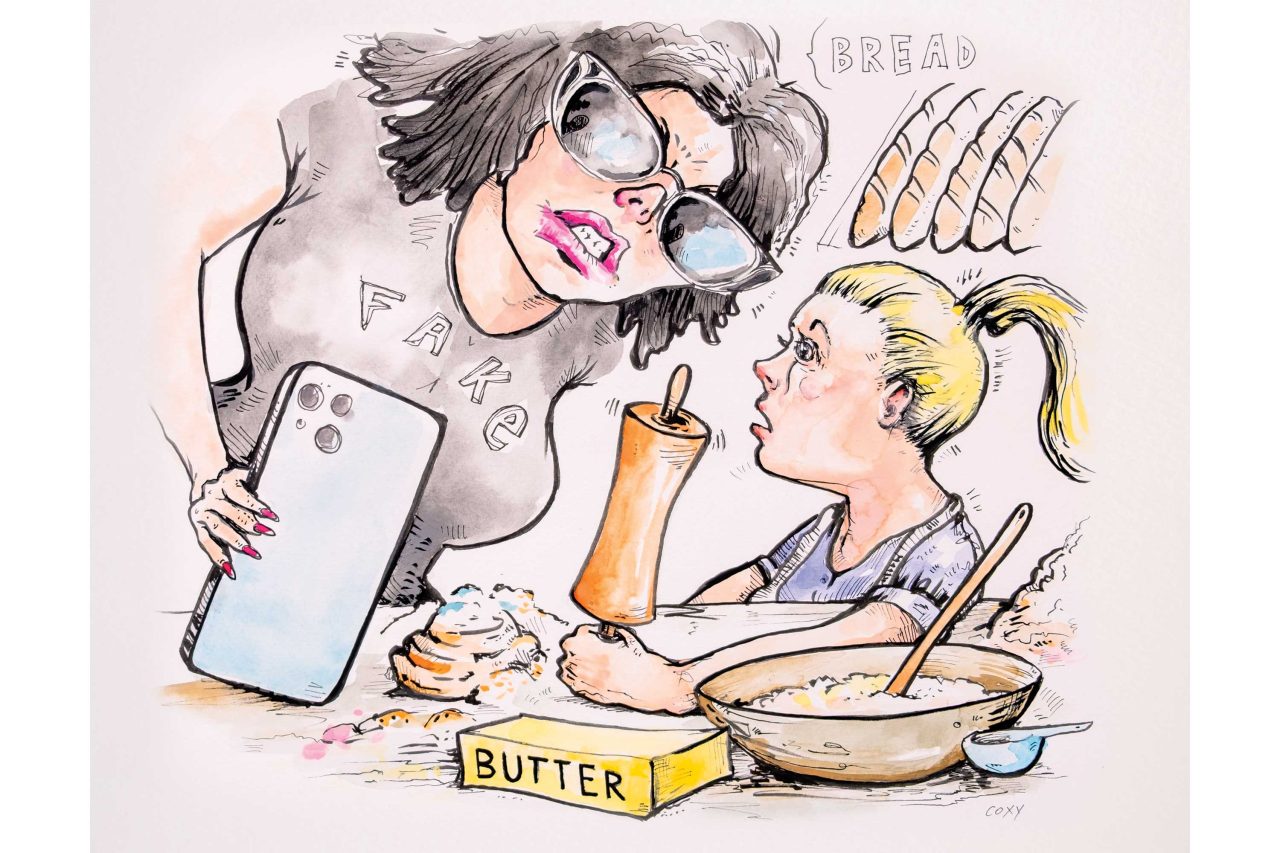
By Eric Vanderwall | Illustrations by Eric Cox
Amy’s Baking Company vs. Gordon Ramsey
A 2013 episode of celebrity chef Gordon Ramsay’s reality show Kitchen Nightmares featured Scottsdale restaurant Amy’s Baking Company and its irascible owners Salomon “Samy” and Amy Bouzaglo. The restaurant had then been open for several years and had earned a minor amount of mixed local attention. But it – and its owners – were about to become world famous.
From the outset, Amy’s Baking Company comes off badly in show. Amy tells an interviewer that she and Samy “have three little boys, but they’re trapped inside kitty-cats’ bodies.”
“I speak feline,” she adds while meowing repeatedly, the shots edited and underscored to make the silly joke appear unhinged. Her other comments suggest a grandiose sense of divine involvement in her marriage (“I prayed for [Samy], and God sent him to me”) and her restaurant career, which is “what God wants me to do.”
Samy, in his first scenes, tells an irritated customer that “your pizza is coming, and you want it, you wait. You don’t want it, you pay what you owe, and you fuck off from here.” He then ejects the man and his friend from the restaurant while delivering a barely decipherable tirade consisting largely of variations on fuck and motherfucker.
When Ramsay arrives, he characterizes the dishes as “confused” and resembling “dry cat food” and argues with the proprietors about, among many other problems, their practice of seizing servers’ tips and their reliance on cheap frozen foods. It becomes “one long nightmare,” as Amy phrases it. Ramsay ultimately abandons the project, telling the Bouzaglos they are “fucking nuts,” to which Samy answers, calmly for once, “I know.”
After the episode, the Bouzaglos capitalized on the notoriety with merchandise featuring Samy’s more quotable lines: “Here’s your pizza, go F**K yourself” and “I’m the gangster!” Meanwhile, negative comments saturated the restaurant’s online profiles, most of which received profane rebuttals sounding very much like Samy. (The Bouzaglos later claimed to have been hacked.)
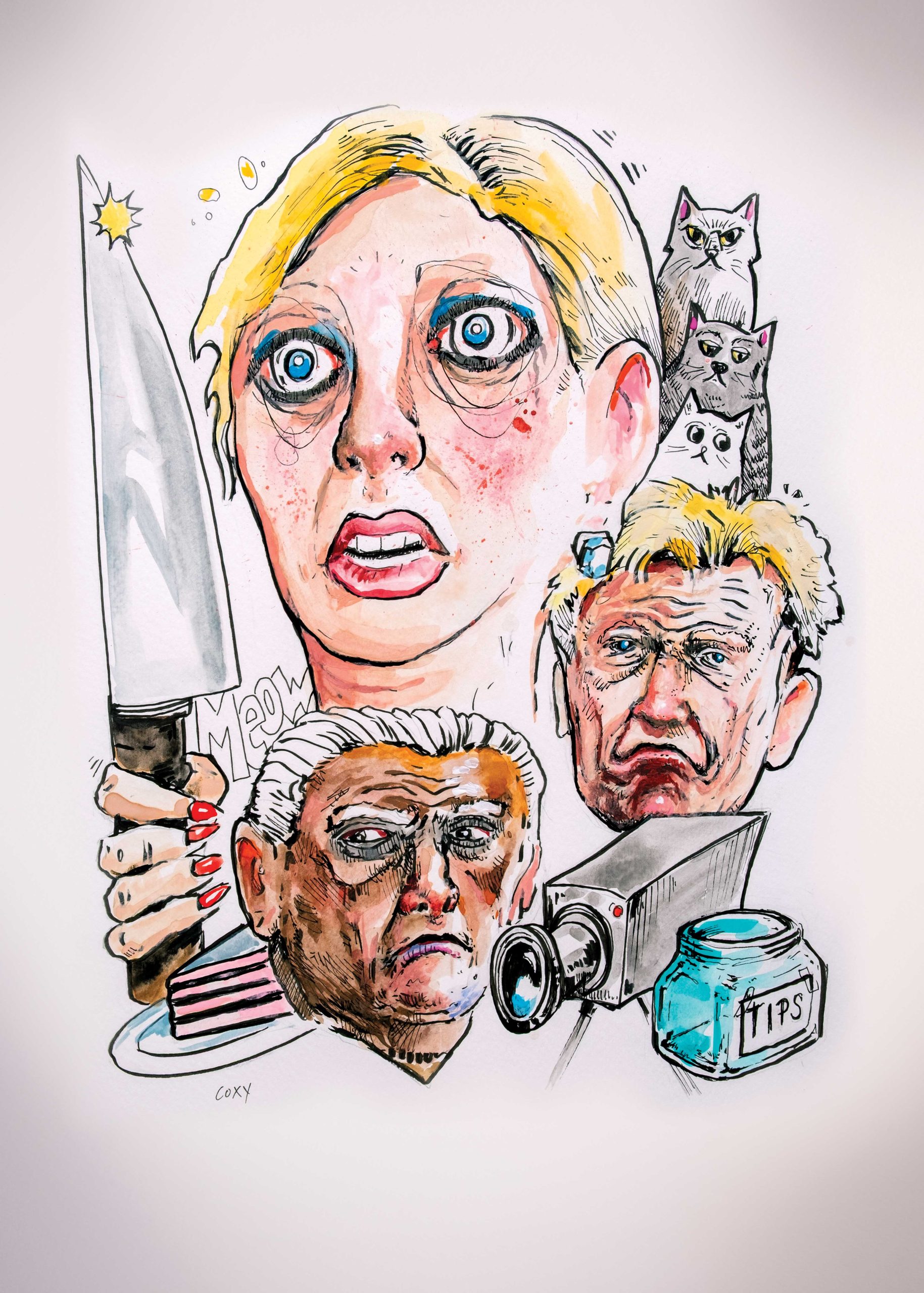
In a follow-up episode that aired in April the following year, Samy makes an implied threat (“You guys made so much money from us, and Gordon Ramsay, he tried to bury us alive, but he won’t. I will bury him first”) and insults Ramsay’s manhood (“He has no balls. He’s jealous of my balls”) while Amy rails against “these Yelpers and these people who hide behind the computer screen,” describing them as “little trolls,” “the camel-toe mafia” and “pussies.”
In September 2015, just over two years after the first episode aired, Amy’s Baking Company closed. The Bouzaglos claimed that the show and its aftermath were unrelated, citing issues with the landlord and interest in starting an online business. Although it’s not clear where Amy and Samy Bouzaglo are now, comment sections scattered across the internet suggest a still-energized personality cult fascinated by their 15 minutes of culinary infamy.
JL Patisserie vs. Glamorama
“It was a pretty rough summer,” Jenna Leurquin, owner of JL Patisserie in Phoenix, says of 2025. “Slow, hot, expensive.” In addition to anemic sales, Leurquin’s James Beard Award-nominated bakery was beset by high electricity bills (considerable for anyone who uses air conditioning in Phoenix, but more so for bakeries with the heat generated by the ovens). Moreover, the Trump trade tariffs raised the cost of JL Patisserie’s ingredients, most of which come from Europe.
It was near the end of summer that TikTok influencer Glamorama (actual name Aurora Griffo) contacted Leurquin about a collaboration.
By most definitions, “collaboration” means working together toward a common goal. Such is not always the case in the world of food influencers. “Everyone has a personal meaning behind it,” Leurquin says. “It’s difficult to get a sense of the true intention of the person before you start investing [time].”
In an email to Leurquin, Griffo sketched out her vision of a “collab.” She would do an “honest review and highlight/focus on what I enjoyed” while being “softer/quicker on [criticisms] with what I may not like as much.” In other words, it would be a friendly review – which she would be willing to do in exchange for a comped meal.
Leurquin wasn’t sold. Watching Griffo’s previous TikTok reviews, the restaurateur thought she had “a persona of being harsh.” She also interpreted Griffo’s offer as manipulative, with coded implications that the influencer would give JL Patisserie a negative review if Leurquin didn’t play ball.
Leurquin declined the “collab,” but Griffo visited the patisserie anyway and sure enough posted a scathing review. In her trademark self-deprecating style, the influencer – who openly spoke about her plastic surgery procedures – claimed that the award-winning pastries were full of “fake-ass ingredients,” that were “about as natural as [my] boobs, ass and waistline.”
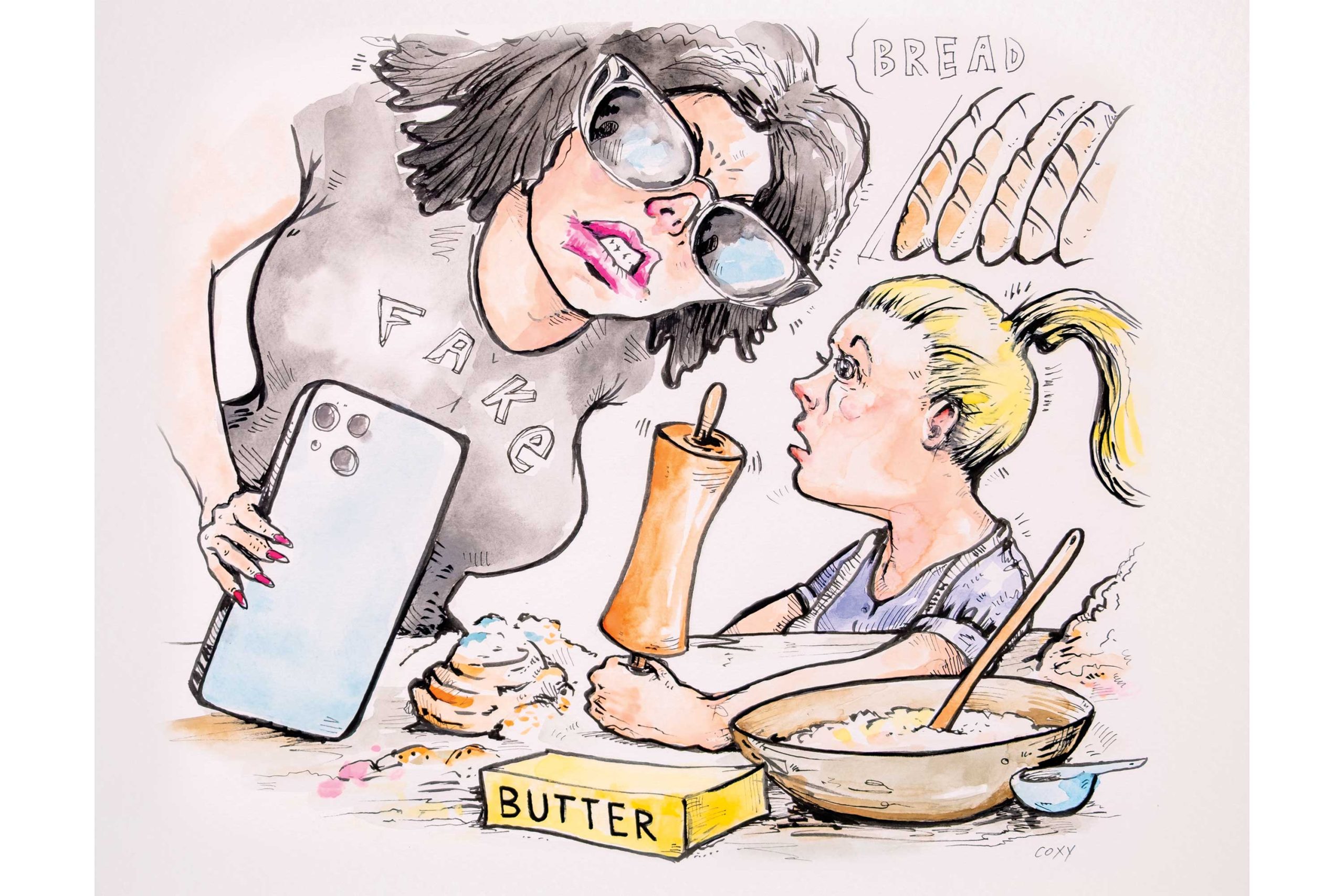
Leurquin didn’t take it sitting down. She posted a response video refuting the charges of fake ingredients in a short tour of the bakery’s supply area. Although Griffo was not named in the video, she responded to online comments with grandiose claims about her earnings (describing herself as “someone who makes more money sleeping than you ever will”) and insults (“you look like your parents didn’t like you”).
Popular opinion ultimately swung in Leurquin’s favor. “The amount of support was mindblowing,” she says. There were more orders than staff were prepared for; lines went out the door; news organizations, from Phoenix New Times to People, Today, and outlets in Sweden and France, contacted Leurquin for interviews. Leurquin is philosophical about the experience, hoping that it will “kind of burst that [influencer] bubble a bit.” She remains proud of her staff for being “the best people in the world” and says she strived to be “a good person, a good boss and an honest baker” through it all.
Griffo, who could not be reached for comment for this story, deactivated her social media accounts after the firestorm and said she was “done creating videos for good” in a farewell message. She no longer lives in Arizona, according to multiple sources.
TexAZ Grill vs. Lone Star Saloon
In 1985, 30-something restaurateurs Steve Friedkin and Jim Mitchell opened Lone Star Steaks, the first Texas-style roadhouse restaurant in Greater Phoenix, on the corner of Bethany Home Road and 16th Street. Having no intention of expanding beyond Arizona, they applied for a trademark on the business name at the state level only.
The restaurant was a smash hit and cruised into the 1990s like a greased log, pard’ner. However, unbeknownst to Friedkin and Mitchell, a Texas investment group had just snapped up the federal trademark on the “Lone Star” name from a New York City music venue that folded in 1989. And those boys were in the expansion mindset.
Hoping to open a barbecue chain in the Southwest and Southeast, the new owners of the trademark sent cease and desist letters to restaurants in their target territories with some variation of “Lone Star” in their names.
“I learned a lot more about trademark law than I ever wanted to know,” Friedkin, now retired and living in Phoenix, recalls.
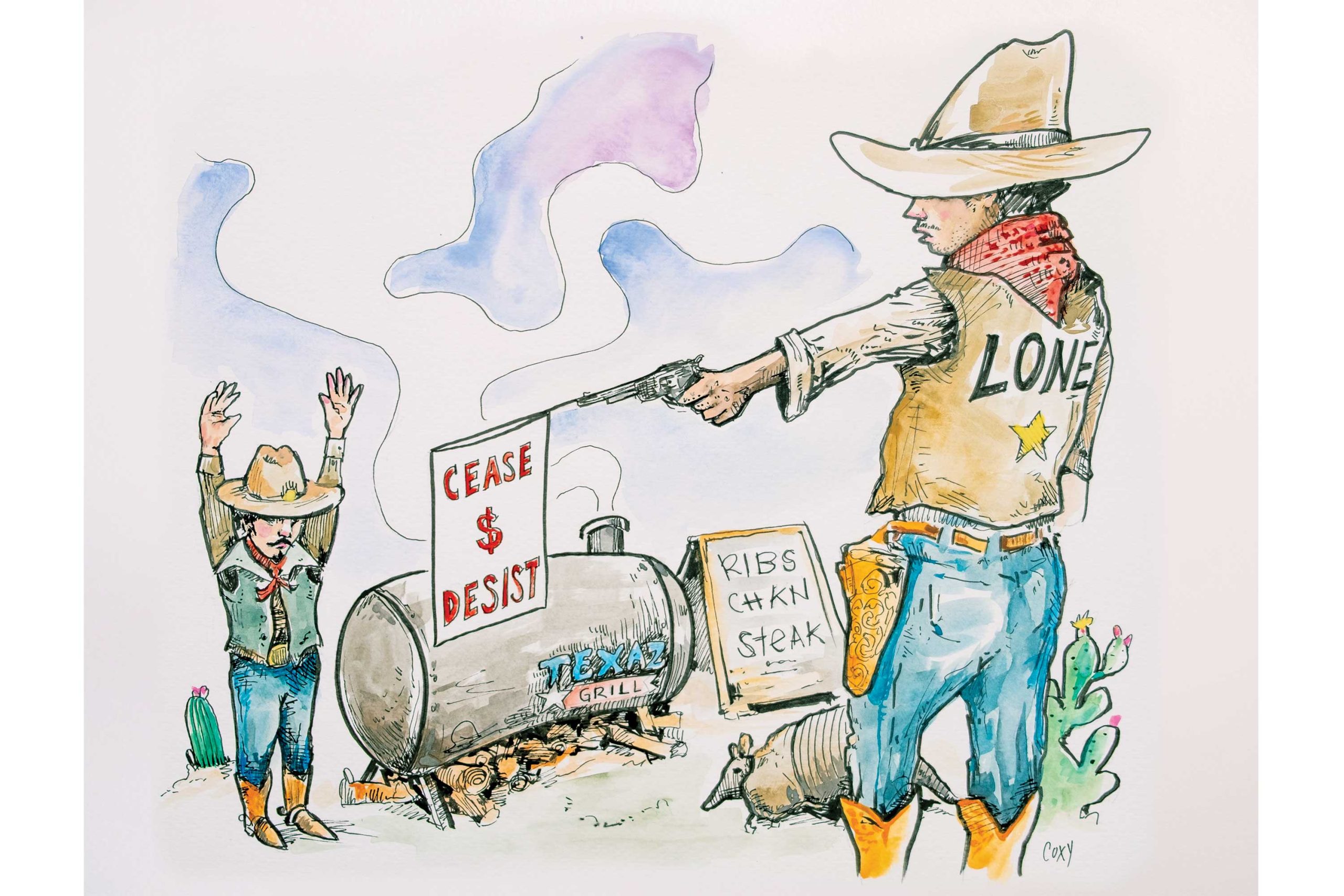
The upstart Lone Star filed suit against a Lone Star Steaks in Georgia, and the Georgia restaurateur won, Friedkin recalls, though it “cost [the Georgia owner] a couple hundred thousand dollars in legal fees” and “was more of a moral victory than a business victory.” Further, because the Georgia case did not set a federal precedent, it didn’t necessarily reflect positively on Friedkin’s legal prospects. A federal judge could very well rule against him in a similar lawsuit.
Two rival Lone Star Cafés soon opened in Phoenix, so Friedkin put it to his customers: “We don’t need no stinkin’ lawyers,” he wrote in a newspaper ad. “Help us rename the restaurant.” More than 1,200 people wrote to the restaurant with suggested names. From those letters, Friedkin and Mitchell extracted about 200 original names – including “TexAZ,” which 27 people independently suggested, Friedkin says.
He and Mitchell loved it. There was a big party to announce the new name, with raffle prizes and a performance from musician Gary P. Nunn. “He [had] played at my wedding a few years earlier,” Friedkin says of Nunn. “I met him at the chili cookoff in Terlingua, Texas.”
After about two decades, the rival Lone Star went out of business, and in a bit of poetic barbecue justice, Friedkin bought up “four or five of their barstools” at auction and took them back to TexAZ, which remains a fixture in the neighborhood where it began.
Carlsbad Tavern vs. Richardson’s
“It’s been a while since I’ve spoken about this,” Carlsbad Tavern co-owner Andrew Capriola says, as if recalling a bayonet charge at Guadalcanal. “It used to be bad back in the day.”
In November 1995, Andrew’s father, Michael Capriola, who had previously owned and managed Scottsdale restaurants The Salt Cellar and The Bombay Bicycle Club, opened Carlsbad Tavern, a restaurant-bar serving New Mexican cuisine. Andrew says his dad was inspired by Richardson’s, the North-Central Phoenix hotspot run by visionary restaurateur Richardson Browne, who introduced the Valley to such New Mexican classics as Chimayo chicken and green chile stew at his bustling, late-night tavern. Michael wanted “to create something similar,” his son says. He brought on Andrew, recently freed from a four-year stint in the U.S. Navy, to help manage accounting. He even hired two former Richardson’s employees – Judith Merritt and Jim Smith, as server and chef, respectively – to complete the cosplay.
What happened next is best prefaced with some backstory on Browne. Tall, lean and bald, with a deep speaking voice that seems to thunder down from on-high, Browne is known as one of the true iconoclasts in Valley dining – a “hothead” in the words of Merritt, and not without his eccentricities. She recalls the “strange setup” at Richardson’s that required her, after closing the restaurant at 4 a.m., to “drive to [Browne’s] house and drop the money through his cat door or whatever,” and says that he would sometimes “walk around the streets [in] his robe and slippers.” Profiled in a 2010 issue of PHOENIX, Browne by his own admission has fired, re-hired and fired again more employees than he cares to count. In a September 2000 article in the Phoenix New Times, his then-wife Barbara described him as a quirky artist and “like most artists, on the verge of insanity.”
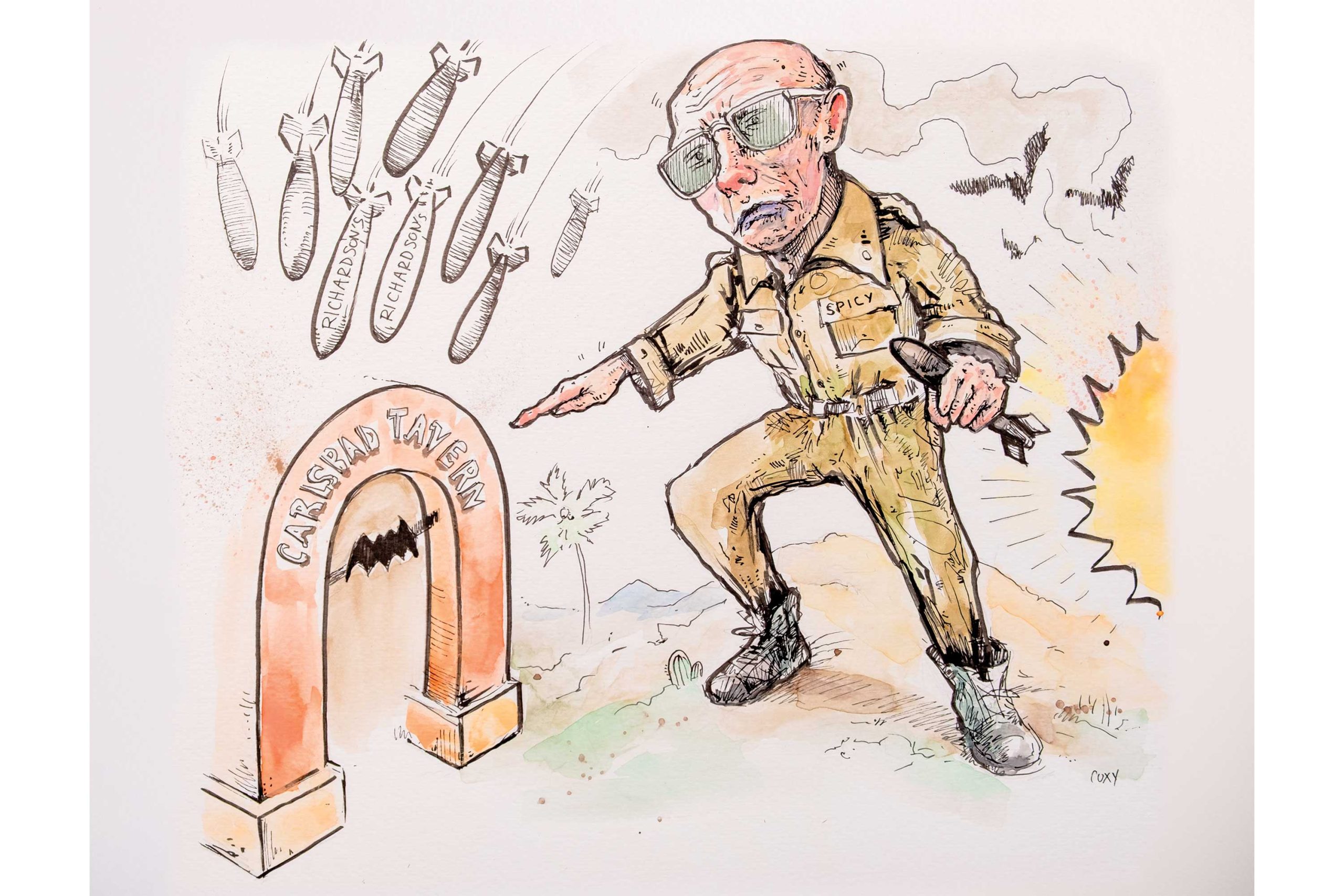
Knowing all this, you might be able to predict Browne’s reaction when he found out about Carlsbad Tavern.
Hardly flattered by the imitation, Browne drove through the Carlsbad Tavern parking lot “flipping people off,” Andrew later told the New Times.
He was particularly offended by the food menu, which featured “a lot of the recipes [that] were the same,” Merritt concedes. The feud raged at least until 2000, when Andrew described Browne as “a bitter old man with overpriced food and a staff that hates him” in the
New Times.
Perhaps covering his flank, Andrew today dismisses the imbroglio as “lore that was passed down from my father” and says “nothing has happened” since Michael’s passing in 2020. He and Merritt, now co-owner, recently celebrated their 30th year in business.
Browne, who didn’t respond to a request for interview, scored another success with Euro-styled steakhouse Rokerij and now runs four always-busy restaurants in the same North-Central neighborhood. And still can’t stand imitation, insiders say.
Silvana Salcido Esparza vs. Barrio Queen
In 2002, when Silvana Salcido Esparza and Wendy Gruber, her partner in business and life, opened Barrio Café, their goal was to “help change those erroneous perceptions North Americans have about Mexican food,” Esparza told KJZZ in 2024.
Barrio was an enormous success, and within a few years of its opening, a regular customer and successful franchisee of McDonald’s, Carl’s Jr. and Hardee’s broached the possibility of a business partnership. That man was Steve Rosenfield.
When Esparza separated from Gruber, she decided to take Rosenfield up on his offer. “After Wendy [Gruber] left me, by Saturday morning, I texted [Rosenfield], ‘Are you serious?’” Esparza says. “And that was how it started. He did seem to love Barrio.”
Esparza and Rosenfield agreed to split ownership, with Esparza bringing the name, the recipes and reputation, and Rosenfield providing most of the funding.
In December 2011, the first Barrio Queen location opened in Scottsdale to a lukewarm reception. (A Phoenix New Times review called Barrio Queen a “sometimes good, but not-always-great restaurant,” and a review in PHOENIX characterized the service as “hit or miss” and “virtually always leisurely.”) Esparza had also begun dealing with sarcoidosis, a chronic autoimmune disorder that made it difficult for her to keep up with all the work the two restaurants required.
Esparza says that Rosenfield was unsympathetic. “He didn’t invest the money. He leant the money,” she says, followed by one of the florid epithets for which she’s become famous: “Colonizer asshole extractionist.” (Rosenfield did not respond to a message on social media requesting his comments.)
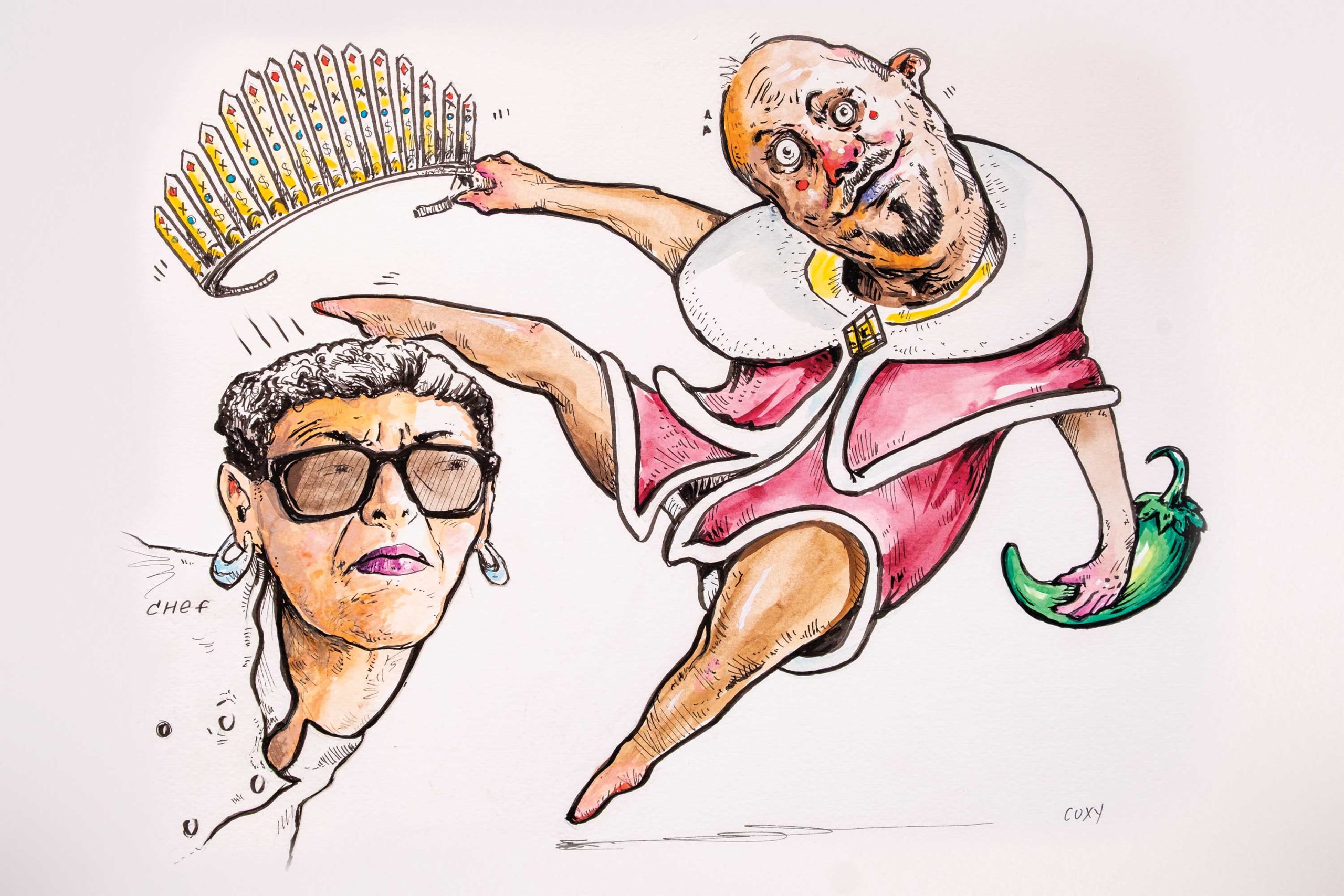
The situation became untenable for Esparza, and in 2014 she accepted a buyout offer she considered unfavorable. (A nondisclosure agreement prohibits her from revealing the terms of the deal.)
“It would have eaten me out of house and home [to cover the losses],” she says. “As it was, I had to pay taxes on the money I left on the table.”
Meanwhile, Barrio Queen continued after Esparza’s departure and added new locations, capitalizing on her brand and reputation by osmosis. In Old Town Scottsdale, city tour guides would still drop her name while touting the restaurant; uninformed bloggers continued to name her as the owner.
“I’d see the restaurants, and it would be, ‘That’s my fucking tattoo [in the brand imagery], my cooks. And even against the [separation] contract, [Rosenfield] poached my manager,” Esparza says. “They were appropriating my food and my culture.”
Rosenfield ultimately sold the franchise to the Famous Dave’s BBQ parent company in 2022 for $28 million – but Esparza is philosophical about the ordeal. After weathering the pandemic and years of illness, she picked up her eighth James Beard Award nomination before she closed Barrio Café in 2024, concluding one of the great culinary success stories in Arizona history.
She has since retired to Rosarito, on the coast in Baja California, while publishing her autobiography, La Hija de la Chingada: Chronicles of a Mexican Chef. She also has a commercial wellness retreat in the works and several more literary projects, including children’s books, histories of certain foods and a novel based on her grandmother’s life.
“I’m going to tell you about the history. I’m going to tell you about the pathways,” she said in a 2024 interview with ABC 15. “I’m ready.”