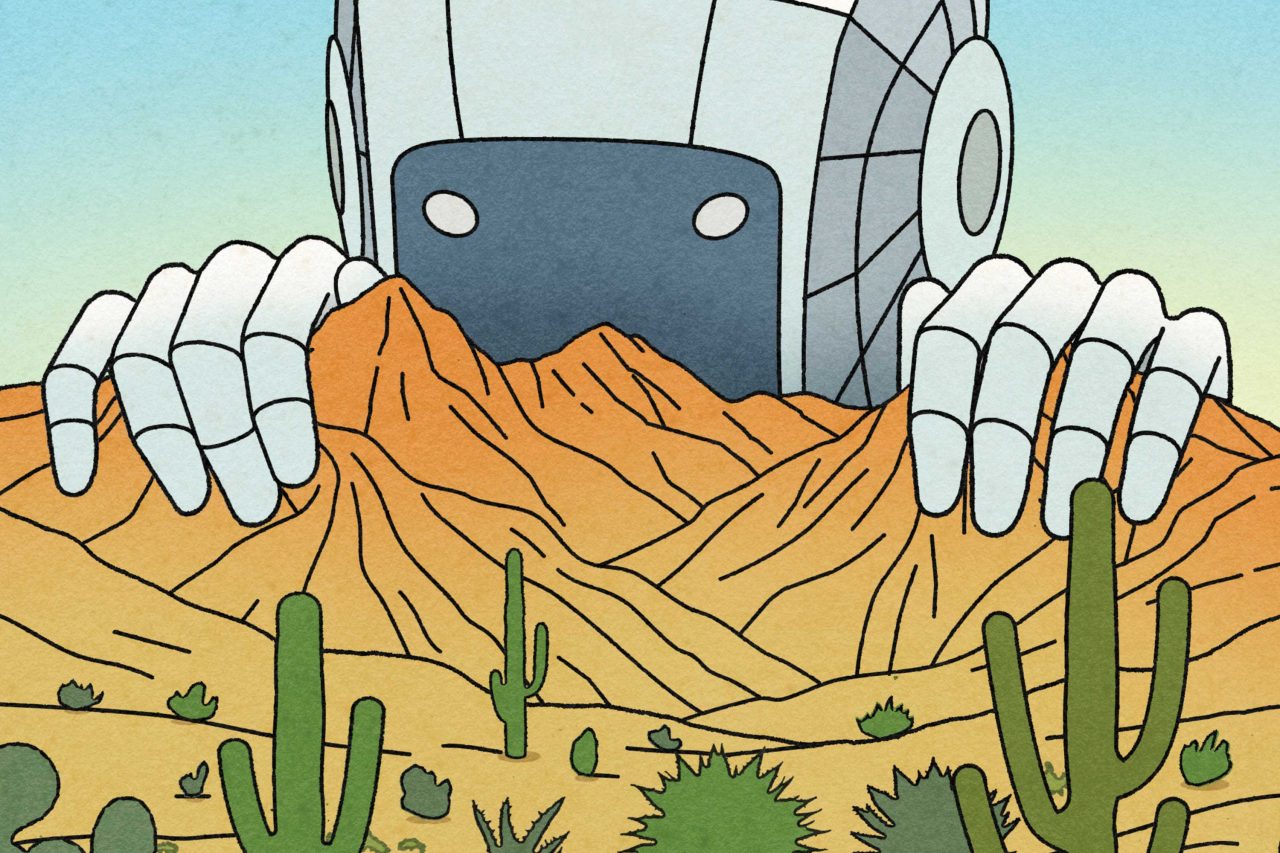
It’s not just about prisons and payday loan centers anymore.
Data centers are now the primary provider of Valley homeowner angst.
by Jimmy Magahern | illustration by Dan Page
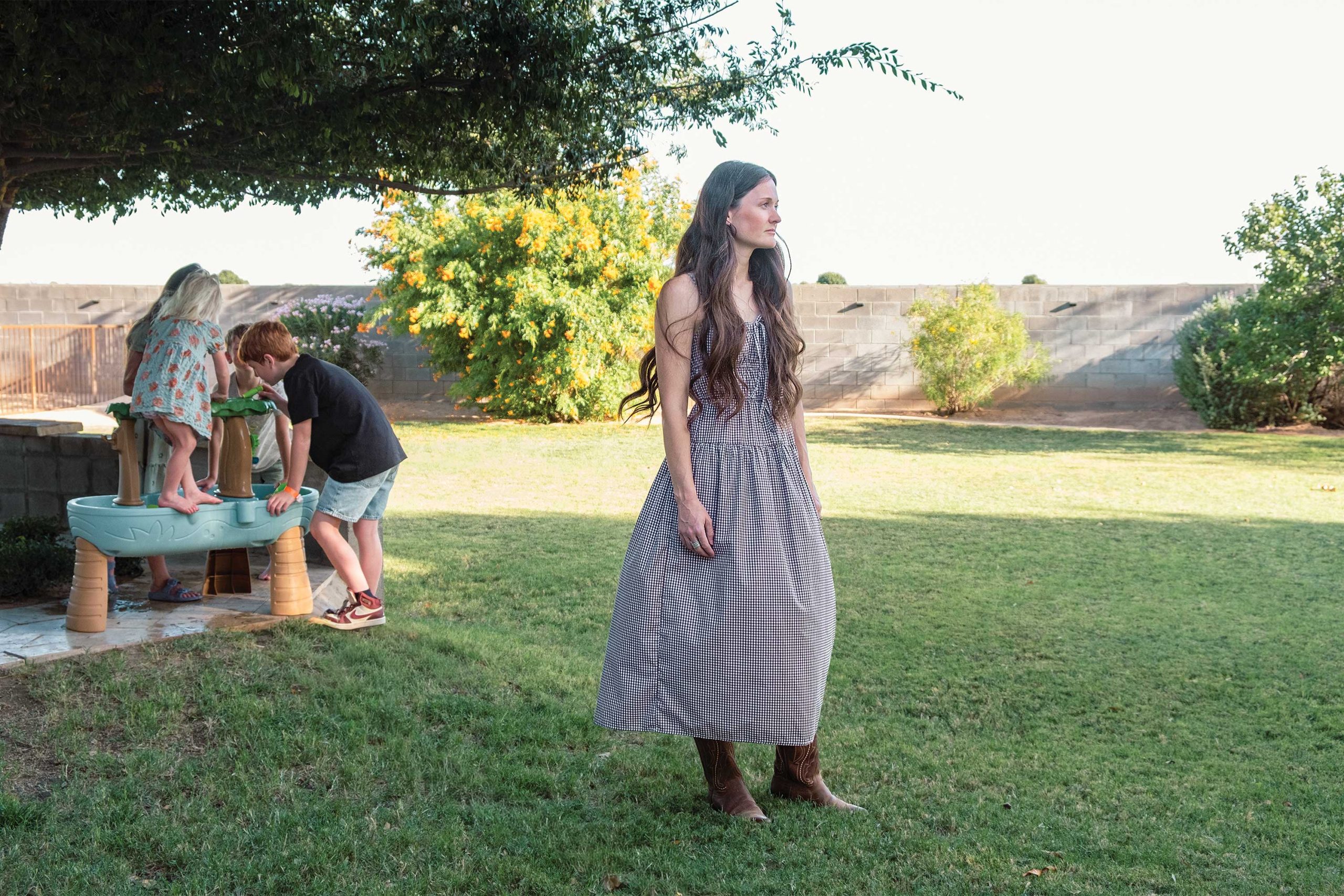
In early May, two calves were born in the pasture behind Hollie Tolmachoff’s house. From her backyard in Surprise, she can still hear cattle lowing at night. “The kids love it.”
Beyond the pasture sit rows of citrus trees stretching across an 80-acre orchard. On clear nights, the stars are still visible here. “From our backyard, we still have all the sights and sounds of a rural neighborhood,” she says. “It’s stunning. I love it.”
Hollie and her husband Jack spent more than a decade searching for what felt like their forever home. When they finally found it a few years ago, they poured six figures into renovations, building what Tolmachoff describes as their “little oasis” – a place where their four children could grow up around gardens, chickens and open desert skies.
Then a postcard arrived in the mail.
At first, the notice barely registered. Tolmachoff says it sat unread on her desk for days. When she finally studied the small project map printed on the card, she felt what she describes as a “heart plummeting into your stomach moment.”
The empty land beyond the orchard, less than a half-acre from her home, had been identified as the future site of Project Baccara – a proposed multibillion-dollar data-center campus and natural-gas-powered energy facility that has become one of the West Valley’s most contentious development battles.
“Our little oasis, our piece of heaven, feels like it’s being stolen away from us,” Tolmachoff says.
Hers is a homeowner drama being played out all across metro Phoenix, as lifestyle- and property-value-minded residents gird themselves against an invasion of data centers – those lucrative but sometimes unsightly pillars of the AI economy. Arizona has positioned itself as one of the country’s fastest-growing hubs for data centers. But neighborhoods are not always on board.
In previous decades, suburban opposition movements often formed around prisons, landfills or airports. In metro Phoenix’s emerging AI era, hyperscale data centers are increasingly becoming the new not-in-my-backyard flashpoint.
“Most of those opposed are not opposed to the data centers themselves,” says David Kraus, organizer of a petition opposing Project Baccara that has gathered thousands of signatures. “Just the locations.”
Even if some homeowners resent having data centers next door, few dispute that the facilities have become an essential part of the modern information economy. Arizona has quietly become one of America’s most important data-center markets, attracting billions of dollars in investment and generating an estimated $14.1 billion in annual economic activity statewide (see below).
That growth has made the industry a darling of economic-development officials. But it has also left utilities scrambling to answer a basic question: How do you power an AI economy whose demand for electricity keeps accelerating?
Patrick Bogle, director of data center strategy for Arizona Public Service, spends his days trying to solve exactly that problem. Part of the challenge, Bogle says, is that many people still associate the data-center boom primarily with AI chatbots, viral image generators and the seemingly endless churn of internet content – the kind of online culture that inspires jokes about “burning enough electricity to power a small city just to make a cat meme.”
But the infrastructure now spreading across Arizona underpins far more than novelty technology or social-media distraction. “A single hospital will create 143 terabytes of data on a daily basis,” Bogle says. That’s about the total cumulative memory capacity of 286 iPhone 14s.
The average home, by comparison, generates about three terabytes, between streaming services, emails, Snapchat photos and all the other cargo of day-to-day digitizing.
What’s more, a hospital’s imaging scans, medical records and other critical data must be stored securely and retrieved almost instantaneously. “If you’re taken into the emergency room and they need your medical history,” Bogle says, “you want it to be available as fast as possible so that they can give you the best level of service that you can.”
And health care is only one piece of a much larger digital ecosystem now expanding at extraordinary speed – with artificial intelligence acting as a multiplier. AI queries require significantly more computing power than traditional internet searches, forcing utilities and developers alike to rethink assumptions about how quickly digital infrastructure needs to grow.
When Bogle took his current role about a year ago, the average large-scale data-center proposal seeking service from APS required roughly 200 to 250 megawatts of electricity – enough to power about 40,000 homes. Today, he says, many requests arriving in the utility’s queue are approaching 400 to 500 megawatts, roughly the equivalent of 80,000 homes.
“The scale is increasing,” he says.
Unlike residential neighborhoods, data centers also draw power steadily around the clock, forcing utilities to rethink how they balance solar generation, battery storage and overnight demand. The challenge has forced utilities into an uncomfortable balancing act – expanding aggressively enough to support Arizona’s surging AI economy while assuring existing customers that reliability will not suffer.
“We’re not going to put residential customers – where air conditioning in the middle of summer is your lifeline – at risk just to serve an additional data center building or site,” Bogle promises.
But he also acknowledges that traditional grid expansion timelines are struggling to keep pace with AI-era demand. “We’re building the plane as we fly it,” Bogle says, with a weary laugh.
That widening gap between technological demand and electrical infrastructure is helping drive a new phase in Arizona’s data-center boom – one in which some developers are no longer waiting for utilities to expand the grid traditionally, but instead developing power generation alongside the data centers themselves.
And that is where initiatives like Project Baccara begin to alarm nearby residents.
The proposed $10 billion West Valley development, led by Michigan-based developer Takanock, has become one of Arizona’s most closely watched data-center battles precisely because it represents what many observers see as the industry’s next evolutionary step – not simply a massive AI-era server campus, but one paired directly with a large natural-gas-powered energy facility designed to help run it onsite.
“There’s really not an effective way to meet all of this demand without looking to the private markets to effectively bring their own generation,” says Craig McKesson, Takanock’s chief commercial officer.
McKesson describes the company’s approach as “energy first” – effectively building the power infrastructure alongside the data center rather than waiting years for traditional grid upgrades to catch up. “There’s a gap there where this demand would not be able to be supported in a conventional manner by the utilities,” he says.
Project Baccara’s proposed onsite generation facility is intended to close that gap – allowing the campus to begin operating sooner while potentially supplying excess energy capacity back to the broader grid during periods of need.
But for nearby residents, the idea of pairing hyperscale data centers with a power plant is kind of a double NIMBY. In a sign of just how unpopular data centers have become, a March Gallup poll found more Americans are opposed to living next to a data center (71 percent) than a nuclear power plant (53 percent). For opponents of Baccara, the project amounts to a two-for-one industrial neighbor.
Tolmachoff imagines industrial lighting replacing the darkness around her home, hotter nighttime temperatures radiating from the site and the steady mechanical hum of turbines and cooling systems overtaking the rural quiet her family moved there to find.
“We have a ton of great horned owls, barn owls, red-tailed hawks,” she says. “I don’t think they’re going to want to stay where they are with the light pollution.”
Tolmachoff says she is equally concerned about heat and noise. “They’re claiming that the sound by the time it reaches our homes is going to be no louder than a quiet refrigerator. I’ve driven by data centers, and they are loud.”
More troubling to her is the possibility of low-frequency “infrasound” generated by large industrial equipment – vibrations residents may physically feel even when they cannot consciously hear them.
“It’s the sound you can’t hear, but that your body can feel,” she says, adding that her group has been “really adamant on finding actual government resources or published articles with scientific backgrounds and studies to support all the points that we’re making.”
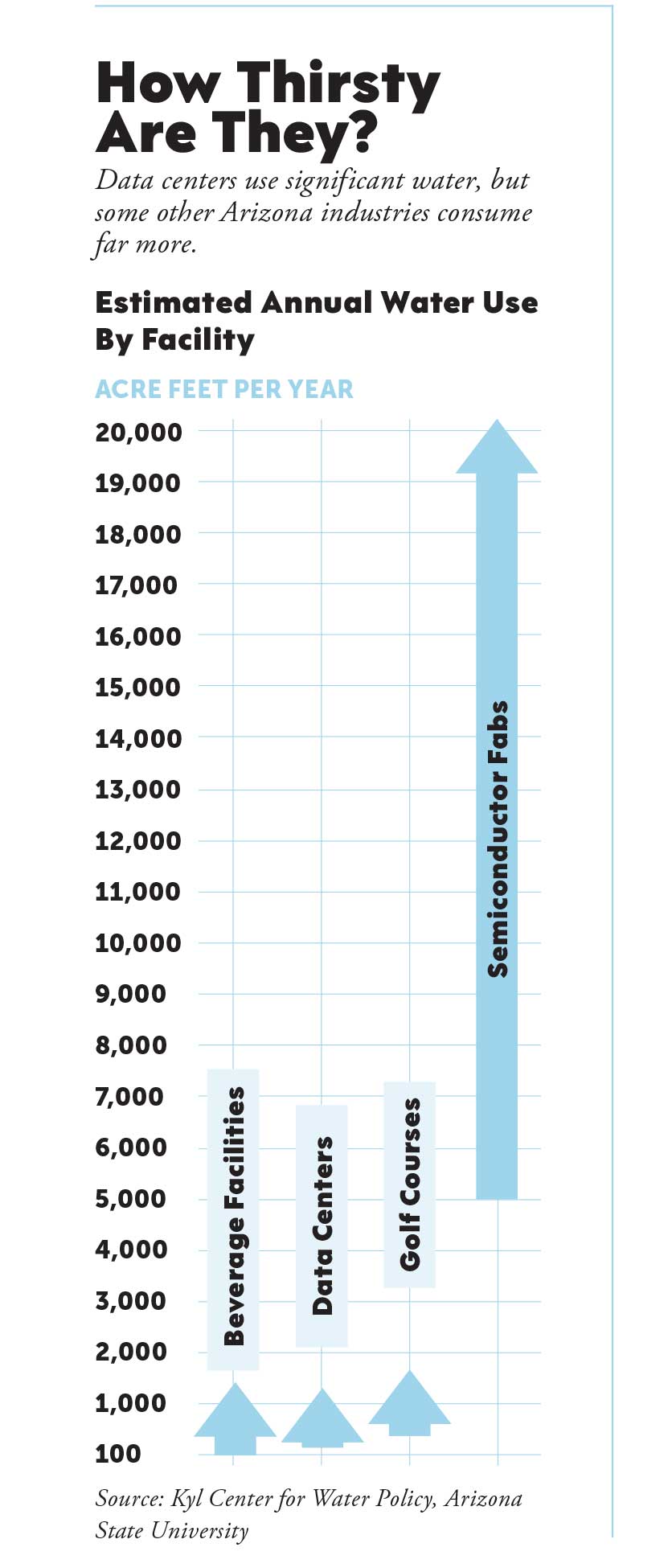
Some concerns have stronger empirical support than others. A recent Arizona State University study found measurable heat-island effects near several Valley data centers, with temperatures elevated in surrounding neighborhoods. Water use, meanwhile, varies widely depending on cooling technology and water source. Data centers can consume substantial amounts of water, though researchers note that some industrial users and golf courses consume comparable or greater volumes.
Water concerns have become particularly prominent in communities such as Ahwatukee, where residents question whether large industrial users should be added as Arizona confronts long-term groundwater and drought challenges. There, members of a newly formed opposition group called Ahwatukee Community Alliance say many residents did not even realize a hyperscale data center was being developed nearby until demolition crews arrived and “Menlo Digital” signs suddenly appeared at the site of the future East Thistle project.
“We don’t see the ‘cloud’ when it’s at work,” the group wrote in responses provided to PHOENIX magazine. “We just see the results on our phones and computers. But it really makes a difference when we can see that the cloud’s ‘brain’ is heating up our neighborhoods, using up groundwater and driving up the cost of electricity.”
Even residents who support technological growth and the regional economic benefits of data centers say they are struggling with the physical footprint accompanying Arizona’s AI economy.
“I don’t disagree that AI is a very useful tool. A lot of people are using it,” says Tolmachoff, who admits that even her family depends on a little AI to run their mobile heavy machinery repair business from home. “I just don’t understand why they’re not building them out in places where there are almost no homes versus somewhere like this, where there’s a thousand homes.”
It all circles back to a NIMBY truism: Almost everywhere in Greater Phoenix is somebody’s backyard. Developers argue that modern hyperscale data centers cannot simply be dropped arbitrarily into remote desert locations. The facilities depend on existing power infrastructure, fiber-optic connectivity and proximity to major population centers where enormous amounts of digital traffic are generated and consumed.
McKesson notes that many of the nation’s largest data-center markets emerged during the early dot-com era, when fiber-optic lines were frequently laid along railroad rights-of-way through cities like Phoenix, Dallas, Atlanta and Chicago.
A lot of facilities are even hidden throughout Greater Phoenix, says Bogle: “I’m not gonna disclose the addresses, but there are some data centers you can walk past Downtown and you just don’t know they’re there.”
Utilities, also, generally do not decide where those facilities ultimately get built. Jennifer Schuricht, Salt River Project’s public and media relations manager, says local governments determine whether data centers are appropriate for their communities. “Like any other customer in our service territory, once a data center secures proper zoning and local city or county approval, SRP will plan and work to serve their electrical needs,” she says.
For opponents of Project Baccara, that distinction has become a source of frustration. Although many nearby residents consider themselves part of the Surprise community, the proposed site lies outside city limits, leaving key land-use decisions largely in the hands of county and state authorities.
For developers and utilities alike, proximity to existing infrastructure remains a major advantage.
“Fundamental site selection for data centers really happens at the intersection of fiber optics and power infrastructure,” APS’s Bogle explains. “It doesn’t necessarily make sense to have these facilities out in a super remote area because they don’t have their supporting infrastructure in place.”
Residents have few tools available once a project reaches advanced planning stages. Most opposition campaigns focus on zoning hearings, county planning commissions, city councils and state siting boards, where residents can challenge permits, environmental assumptions and land-use compatibility.
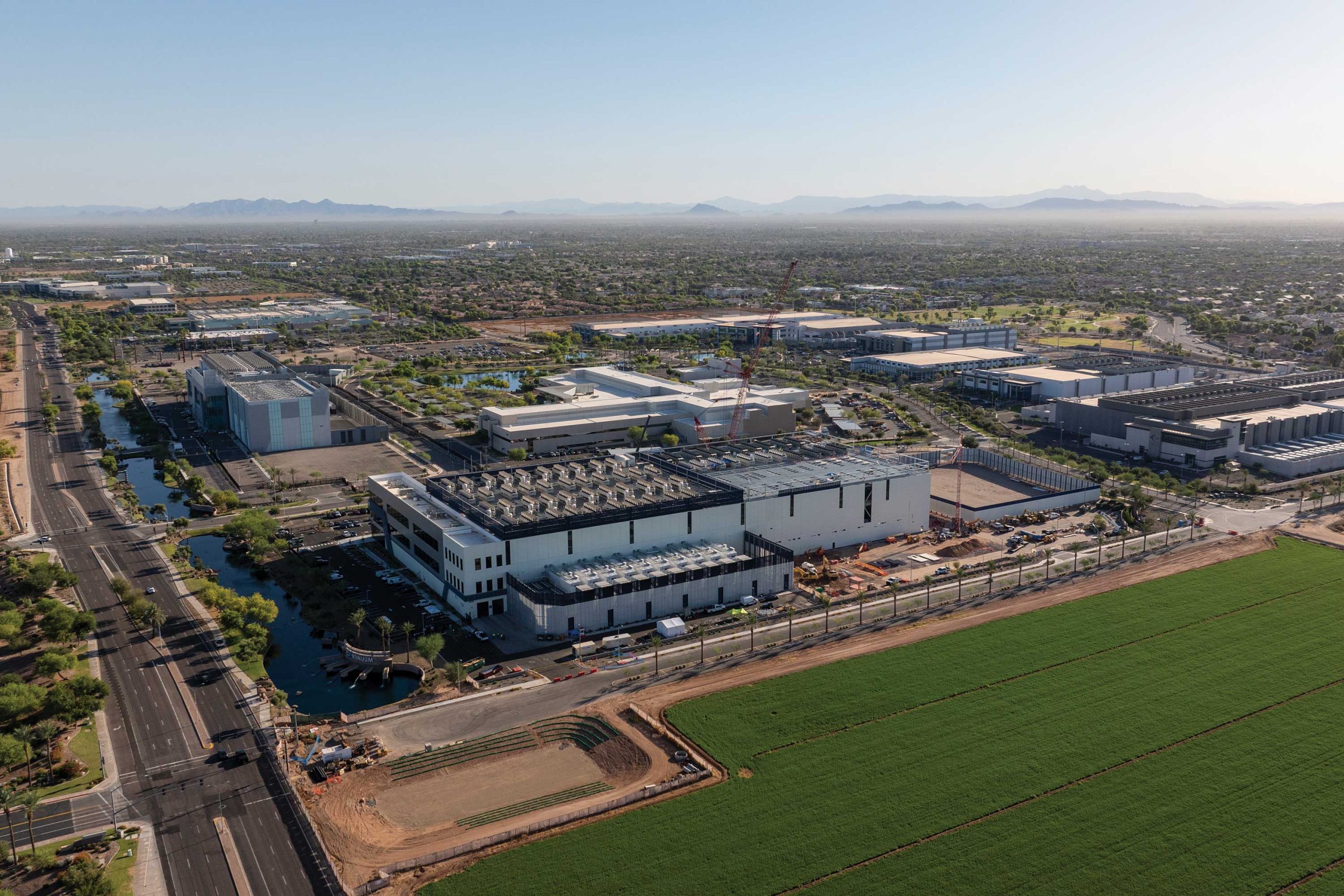
So far, success has been mixed. Several proposed data-center projects around the Valley – including projects that have drawn organized opposition in Chandler, Ahwatukee and the West Valley – have faced delays, redesigns or heightened scrutiny after organized neighborhood opposition. But Arizona’s broader push to attract technology investment has generally kept the industry’s growth trajectory intact, leaving many residents focused less on stopping data centers altogether than influencing where and how they are built.
For now, the pasture behind Hollie and Jack Tolmachoff’s house is still there. But Hollie says the uncertainty has changed the way her family experiences the home they spent years searching for.
“I have four young kids,” she says. “It’s one thing if it was just me, but they have their entire lifetimes to deal with those consequences.”
Across metro Phoenix, that same uncertainty is beginning to spread alongside the Valley’s rapidly expanding AI infrastructure – a growing realization that the cloud is not floating somewhere far overhead, but increasingly rooted in substations, cooling systems, transmission corridors and industrial campuses rising directly beside neighborhoods.
Tolmachoff says she understands that Arizona’s technological future is probably coming whether communities are ready or not. What she still questions is how much of the burden residents should be expected to absorb.
“I don’t plan on being a guinea pig,” she says.
Boom Town
Even as homeowners rend their frost cloths over data centers, the Valley reaps the rewards.
108,700
Arizona jobs supported by the data-center industry in 2023 (including indirect jobs)
$14.1 BILLION
Estimated contribution to Arizona GDP in 2023
$1.1 BILLION
Estimated Arizona state/local tax contribution in 2023
Source: PwC/Data Center Coalition, 2025
More NIMBY
Data centers are snapping up most of the press, but these new-jack homeowner peeves also generate opposition in Valley neighborhoods.
Retirement Homes
Group homes in general stick in the craw of neighborhood groups – and the expanding memory care and assisted-living industry are no exception. In February, the Paradise Valley Town Council unanimously approved a proposal to reduce occupancy in assisted living facilities from 10 to six residentsmaximum within township borders.
Battery Storage Facilities
Severe fire risk and toxic gas release are two unfortunate byproducts of the lithium-ion boom. Residents remember a 2019 explosion in Surprise and a 2025 blaze at a SRP substation in Glendale.
Build-to-Rent Developments
Increased traffic, higher density and a lack of on-street parking are some of the controversies that attend these “horizontal apartment” units, which now number 30,000 citywide.
Homeless Shelters/Navigation Centers
Think of this one as “legacy NIMBY.” In 2025, West Phoenix residents came out in force to oppose a 280-bed shelter planned near 71st Avenue and Van Buren Street, citing its proximity to an elementary school.
Semiconductor Plants
Not everyone is celebrating the Valley’s influx of Taiwanese tech. Last November, city officials received 243 letters opposing zoning changes that would clear the way for a mixed-use devlopement near the new Taiwanese Semiconductor Manufacturing Co. in North Phoenix.