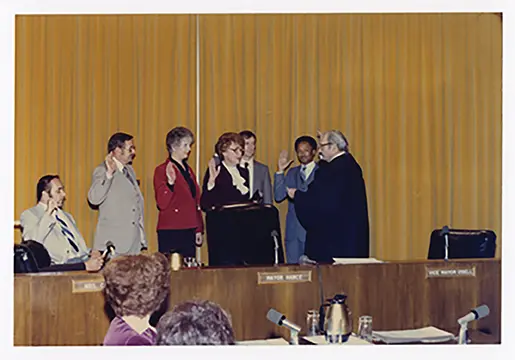
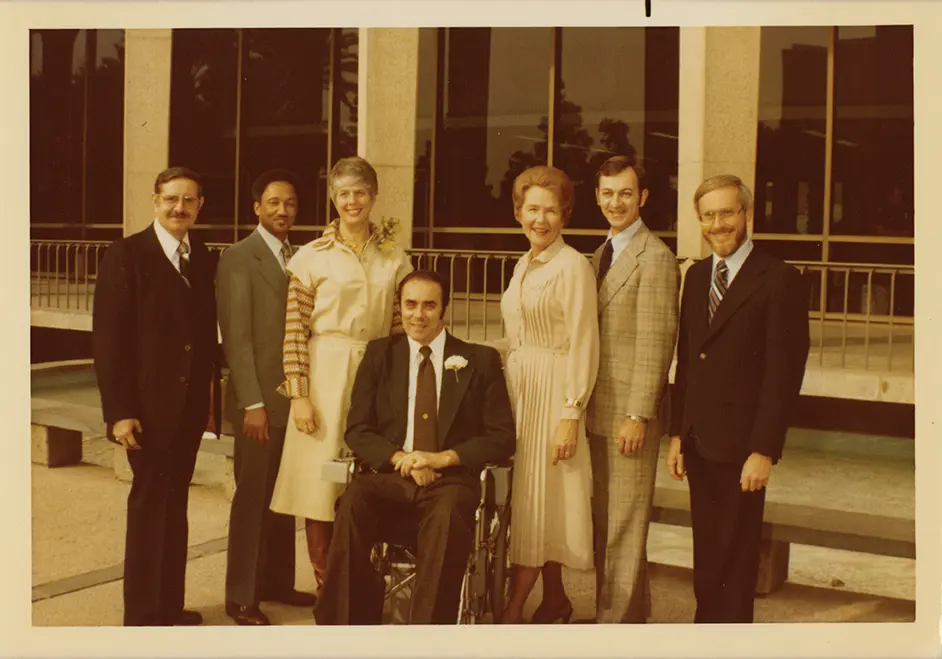
As the first female mayor of Phoenix, Margaret T. Hance reshaped the Valley’s transportation landscape and forged the municipal park system, including the park that bears her name today.
by Clayton Trutor
In November 1975, Phoenix elected Margaret T. Hance as its first female mayor. Never had such a large American city – population at the time: 664,721 – elected a female mayor. Back in 1926, Seattle (population 315,000) elected Bertha Knight Landes as its chief executive, making her the first female mayor of a major American city. But victories for female mayoral candidates were few and far between until Hance, who initiated a new wave of female mayors that included Chicago’s Jane Byrne and San Francisco’s Diane Feinstein.
Despite her breaking the proverbial glass ceiling, Hance is most known to modern Phoenicians as the namesake of Margaret T. Hance Park, an iconic community gathering space that has played host to food festivals, fundraisers and Super Bowl extravaganzas on its 32 acres in Downtown Phoenix. It’s a fitting legacy for a champion of the municipal park system.
Four years before her mayoral election, Hance ran for public office for the first time. She was the furthest thing from a career politico, making her rapid ascent and pioneering role in city politics even more remarkable. In 1971, following the death of her insurance executive husband, Richard, she was a single homemaker who served on the city parks board and worked for KAET public television. Hance, then 48, had been involved in community service for years and decided to cast her net more widely. Her three children were all out of the home.
She won a seat on Phoenix’s then at-large city council in 1971, earning the backing of the Charter Government Committee.
Referred to as “The Charter,” this lobbying group consisted of business elites that regrouped every municipal election to support “business-friendly” candidates. The Charter were politicial kingmakers, backing virtually every successful candidate for mayor or Phoenix’s six-member city council since the 1940s. The likes of Valley National Bank’s Walter Bimson, corporate attorney Frank Snell and newspaper publisher Eugene Pulliam were stalwarts in the Charter clique.
“The city’s charter government, inspired by calls for reform and efficiency, played a significant role in shaping modern Phoenix,” says Marshall Trimble, Arizona’s official state historian. “This movement aimed to establish a nonpartisan structure that prioritized professionalism over political favoritism.”
Hance was very much like the Phoenix bluebloods who formed The Charter. Her father, Glen Taylor, was one of the founders of Blue Cross Blue Shield Arizona. Her husband had served as an executive for Valley National Insurance and Valley National Bank. She resided in an affluent neighborhood just off North Central Avenue and served as president of Phoenix’s Junior League.
In 1975, incumbent mayor Timothy Barrow decided not to run for reelection. Hance, by then a two-term veteran of the council and vice mayor, decided to enter the race. The Charter refused to endorse her, despite her agreement with its leadership on most issues. Hance was an ardent Republican (though city elections were non-partisan) who was as pro-business and pro-development as any candidate imaginable. Yet Charter members thought a woman would be unelectable, and chose instead to endorse accountant Lyman Davidson.
Hance and her campaign responded creatively to the snub. She positioned herself simultaneously as an insider who shared the civic boosting sensibilities of the city’s business class and an outsider who challenged the iron grip of the old boys’ network. Hance combated the Charter’s opposition by making decidedly modern and targeted use of campaign mailings. The Hance campaign sent mailers aimed specifically at women. They used other mailings to focus on such subjects as freeway expansion, crime, parks preservation and her opposition to proposals for a ward-based political system. She also favored the repeal of a sales tax on food, a policy favored by many in the business community, but which was unpopular among consumers.
The prim, understated Hance went on to trounce Davidson, winning 55 percent of the vote to Davidson’s 18 percent in the first round of voting, precluding a runoff election.
As mayor, Hance’s efforts reshaped the landscape of Maricopa County by valuing freeway expansion over all other transportation priorities. She shepherded the Papago Freeway Project into existence as well as the Squaw Peak Parkway project, now known as the Piestewa Freeway (SR-51). The borders of Phoenix expanded greatly during her tenure as the city annexed land to the north, west and south.
“Her rise in politics was grounded in a commitment to voluntarism at the local level,” Trimble says. “I worked for the Phoenix Parks Department while attending ASU. I can personally attest that she brought new energy to the department.”
Hance also focused on large-scale, center-city development, favoring prestige projects such as high-rise buildings Downtown and the establishment of signature public spaces. Highlights of her administration included the expansion of Civic Plaza and the development of the Herberger Theater, Patriots Square and Symphony Hall. Ceremonial shovels lined the walls of her office.
“One of her great legacies as mayor was attracting businesses to liven up the Downtown. The city practically went dark as city workers headed for the suburbs,” Trimble says.
Hance displayed a distinctly Phoenician juxtaposition in her policy views. She was an unabashed advocate of sprawl and highway expansion while simultaneously favoring a program of conservation, working to preserve the very natural spaces that her other policies endangered. Building on her work on the city parks board, Hance helped forge the city’s extensive municipal parks system. Known as the “Mother of the Phoenix Mountains Preserve,” which she guided into existence, she ensured future generations could enjoy extensive outdoor recreations within the city limits. Much of the land in the preserve was acquired during her tenure, and the infrastructure to support the parks was also established during her time in City Hall.
Through her dual promotion of development and conservation, Hance shaped the lifestyle of Valley residents as much as any mayor in the city’s history.
“Phoenix is the quintessential Sun Belt boomtown. A real estate speculator’s paradise and a planner’s nightmare,” Robert Gottlieb and Peter Wiley wrote in Empires in the Sun: The Rise of the New American West, a 1982 study of the development of major western American cities. “[Phoenix’s] lifestyle had become largely responsible for redefining the very term ‘desert’ – the term signifying an appealing landscape and attractive place to live in, a kind of adult playground.”
Some of her opponents described the reserved Hance as alternately unapproachable and inaccessible. She displayed striking hostility toward firefighters and police unions and was a virtual rubber stamp for the policies favored by the city’s corporate establishment. Such criticisms did not curb her popularity. Hance won reelection by wide margins on all three occasions. In all, she served four two-year terms as mayor (1976-1984). The Charter endorsed her subsequent runs, but she refused to stump for their slate of candidates.
In 1982, Phoenix voters approved Prop. 200, which established a new, district-based city council. Unhappy with the new direction, Hance announced she would not seek a fifth term as mayor. She favored a lean, non-partisan council-management system. She revered the city’s at-large elections for city councilors, regarding ward-based politics as an invitation to conflict, corruption and inefficiency. Jon Talton, longtime columnist for The Arizona Republic and author of A Brief History of Phoenix, notes the trade-offs that have come with the current system.
“The upside is better representation of parts of the city,” Talton says. “The downside is that the council districts are so large, the council members are like mayors of substantial cities, each with often competing interests. It’s difficult to cobble together a constructive majority.”
Weeks after leaving office, Hance accepted the position of co-chair of the Reagan-Bush ’84 reelection campaign. She traveled the country, speaking to women’s groups on behalf of the president’s reelection campaign. Reagan would win in the biggest landslide in presidential history. In 1988, she chaired soon-to-be chief executive George Bush’s presidential campaign in Arizona.
Hance died of cancer at age 66 in April 1990. Just 15 years after her election as mayor, she had established a legacy not only as a political pioneer, but as a policymaker that shaped the direction of Phoenix.