PHOENIX magazine debuted 60 years ago, capturing the zeitgeist of a dynamic city on the move.
Selling advertising and meeting deadlines are standard challenges of producing a city magazine. But back in the day, PHOENIX even had to worry about the weather. “When I came on board in 1992, the magazine’s staff [was] located at 12th Street and Highland Avenue, in an older, garden-style, one-story office building,” says Win Holden, the magazine’s former publisher and editor-in-chief. “Any time it rained, the parking lot flooded, the power would go out and we were basically out of business until APS restored the electricity, which sometimes didn’t happen until the next day.”
Media trailblazer Kenneth Welch presumably had less weather-dependent publishing conditions in mind when he founded the magazine 26 years earlier. Celebrating its 60th anniversary this November, PHOENIX has gutted out an unusually long lifespan by magazine standards, sustained by a dynamic desert metro that’s grown at a pace unrivaled among modern American cities – and a readership with an always-burning thirst to understand itself.
A Michigan native and public affairs executive, Welch moved to Phoenix in 1960 at age 39 for a classically Phoenix reason – to ease his arthritis. After working for the Kenneth G. Patton and Associates advertising agency, he set his sights on publishing, and an emerging niche in particular – the “city magazine.” At the time, there were little more than a dozen general-interest, city-branded monthly publications in the U.S., including Los Angeles, Boston and Atlanta, which all opened between 1961 and 1965. In November 1966, Welch joined this group of first-wave city magazines by launching PHOENIX with his wife, Anita Welch, who became editor. Valley billboard magnate Karl Eller served as his silent partner.

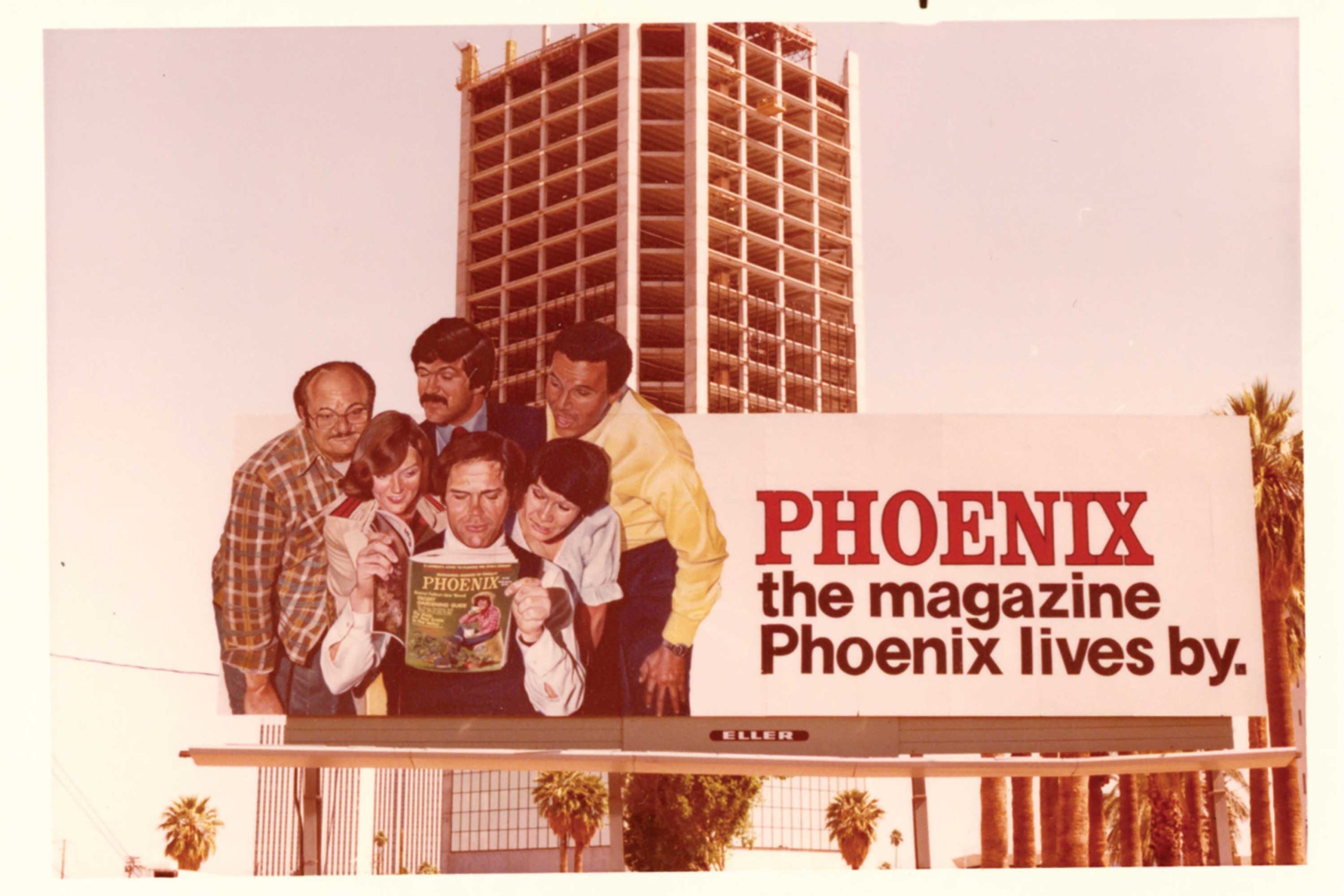
In its infancy, the magazine had many supporters, including the Phoenix Chamber of Commerce, which retired its 12-page publication, Phoenix, in solidarity and announced it would purchase 4,000 copies of future issues. “[PHOENIX] will convey nationally as well as locally the excitement and promise of Phoenix as one of the country’s fastest-growing and most progressive communities,” Ozell Trask, the chamber’s president, told The Arizona Republic in 1966.
At the time, Phoenix was a city of about 500,000, though it was growing rapidly. “Ken believed PHOENIX had an obligation to not only be a valuable user’s guide for the Valley, but also a forum for important topics related to managing growth,” Holden says.
Longtime Valley journalist Nora Burba Trulsson, who worked at the magazine from 1978-1980 recalls a tight-knit staff working late nights and letting loose during happy hour on Fridays. “PHOENIX didn’t shy away from controversial topics such as abortion, child abuse and pollution; it wasn’t all pretty pictures,” she says. “I never felt I was forced to write something with a positive spin.”

During these peak pre-digital years, Trulsson, who now contributes to the magazine in a freelance capacity, recalls unique situations that tested her editorial mettle. One such was an interview with actor Tim Curry – aka Dr. Frank-N-Furter in The Rocky Horror Picture Show – at The Clarendon Hotel, which included a request to chat in the hot tub. “I was in my regular clothes, so I took off my shoes, rolled up my trousers, stuck my feet in the water and we talked,” Trulsson says.
By the late 1980s, local development slowed and the magazine’s revenues declined along with Welch’s health. “MAC America bought the magazine in 1989 to try and salvage a community asset and, not incidentally, give Ken and Fern (his second wife, after Anita died in 1978) a way to exit the business with their heads held high,” Holden says.
The Lewis family, which owned MAC, was building a media enterprise of television and radio stations but no other magazine – thus, PHOENIX was the proverbial stepchild. Holden was hired as general manager of MAC’s one-publication “Publishing Division.”
To get up to speed, Holden attended the annual City and Regional Magazine Association (CRMA) meeting, a group that Welch had helped found in 1978. “I literally went to school learning the business and what was working in other markets,” he says. “PHOENIX had a successful monthly dining guide feature, but we lacked more ‘franchise’ features, including ‘Top Doctors’ and ‘Top Lawyers.’”
Holden also hired lightning-rod pundit Jana Bommersbach, formerly of the Phoenix New Times, as lead columnist to make the content edgier. “That worked… we received more mail and phone calls about her columns than any other part of the magazine.”
In 1999, MAC America sold PHOENIX to Cities West Publishing, owned by Bill Phalen. The longtime Tucson radio magnate merged it with his other publication, Phoenix Home & Garden, to create a prosperous, print-based publishing company in the last fleeting days before media’s digital diaspora.
Though print revenue has shrunk considerably over the interim, swallowing once-invincible magazine titles like Sports Illustrated and Newsweek, PHOENIX remains solvent and robust, out-selling titles such as Vogue by several orders of magnitude in Greater Phoenix. President and publisher Brett Wilson – who oversaw the company’s ownership shift after Phalen passed away in 2016 and its rebranding as Cities West Media – attributes PHOENIX’S durability to its relentless focus on local people, business and culture. “It’s what the city magazine model is all about,” says Wilson, beginning his 10th year helming the company. “We keep our coverage very narrowly focused on Greater Phoenix, and on Arizona. Readers can’t turn to national titles for, say, reviews of the new Chris Bianco restaurant, or the ins and outs of a development in Scottsdale. That’s kept PHOENIX insulated from the contraction that national magazine titles have experienced.”
Athia Hardt, who served as press secretary for Governors Bruce Babbitt and Rose Mofford, says that despite 60 years of evolution to stay relevant, one element of the magazine hasn’t changed. “It has looked for interesting stories about people and events, has been well edited and always attracted a lot of readers from a wide range of audiences.”
Urban Beats
The origin stories of three other “first-wave” city magazines.


Baltimore Magazine
Baltimore’s Chamber of Commerce released what is now the oldest continuously published city magazine in 1907. A private entity acquired it in 1977. The pub focuses on celebrating Charm City offerings, featuring the tagline, “Inspiring Baltimore to discover more, do more and be more.” After initial success hosting the Best of Baltimore party, it now features other events, including Crab Fest.
CHICAGO Magazine
This debuted in 1952 as WFMT Guide and featured classical music radio programming. It changed its name to Chicago Guide in 1970 after evolving into a lifestyle magazine, and shortened its name in 1975. In 1981, CHICAGO introduced the Nelson Algren Award, a short-story contest honoring the longtime Windy City writer.
Los Angeles Magazine
Founded in 1960 as the Southern California Prompter by a graduate student and advertising executive, the publication changed its name the following year. “Los Angeles is vast and complicated,” says senior editor Chris Nichols, a lifelong Angeleno. “Our goal is to uncover the best parts of the city… and share them with readers. We try to explain the city to itself.”