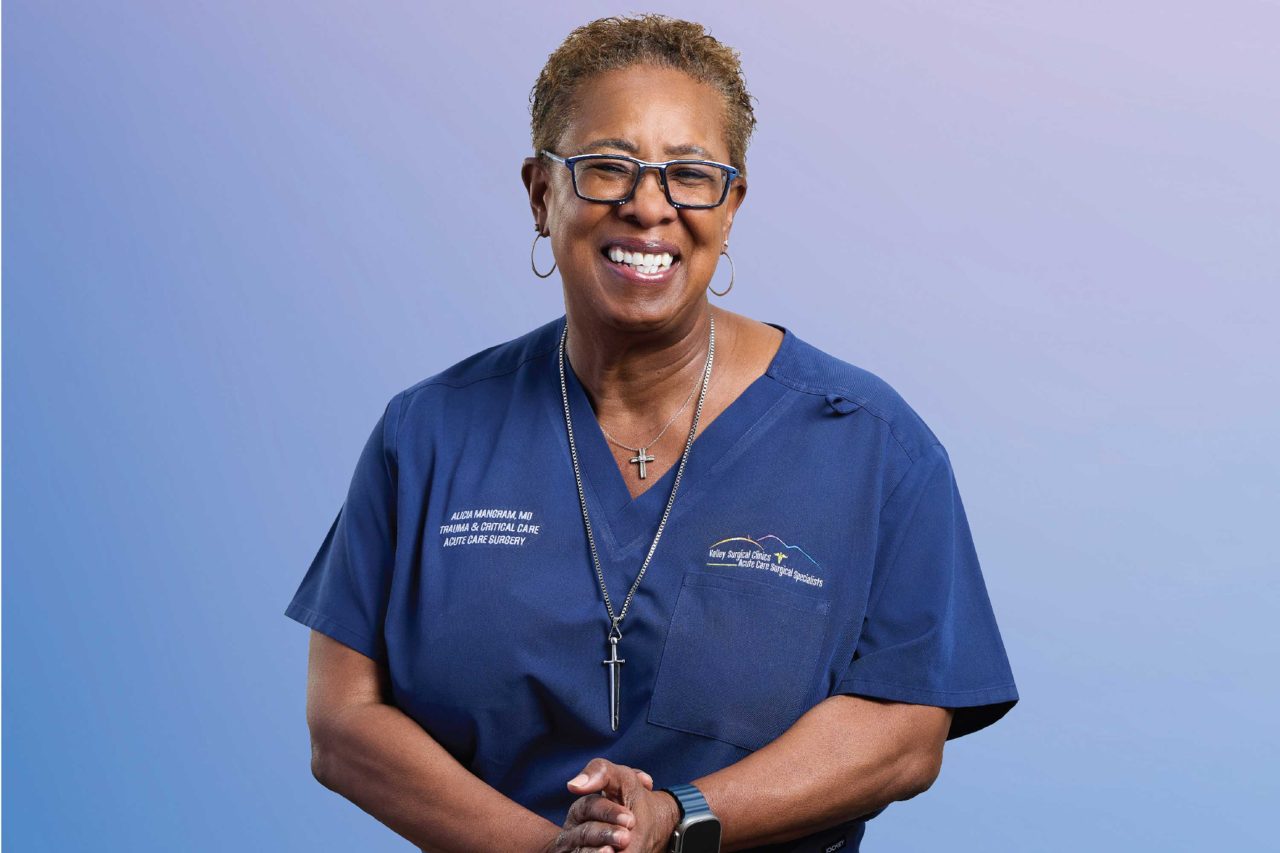
Med School/Year Graduated: Meharry Medical College, Nashville, 1994
Years in Practice: 32
You’re part of our inaugural class of Top Doctors in surgical critical care. Please give us the elevator pitch. How is it distinct from traditional critical care?
[It’s] the bridge between the precision of the operating room and the complexity of the ICU. While traditional critical care focuses on managing organ failure and medical illness, we specialize in patients recovering from major surgery or life-altering trauma. As surgeons, our perspective is distinct – we understand the surgical insult to the body from the inside out.
Our editors have noticed more doctors joining your field. Is that true, from your experience? If so, what’s driving the growth?
I think there’s a growing desire among surgeons to be “complete clinicians.” By being double-boarded in general surgery and surgical critical care, we don’t have to hand our patients off when they leave the OR. We have the expertise to manage their physiology in the ICU, which leads to better outcomes and deeper professional fulfillment. The other driver is technology. We’ve integrated robotic surgery into the emergency setting. This has made the field incredibly attractive to a new generation of surgeons who want to combine the intensity of trauma and emergency work with the precision of minimally invasive, robotic platforms.
People hear “trauma” and think “horrific accident.” But it can have a broader definition in your field, right?
In my world, trauma is defined by the impact on the human body, not just the drama of the event. While it certainly includes high-velocity car collisions or gunshot wounds, it also includes the silent traumas like a ground-level fall in an elderly patient, a sports injury on a Friday night or a household accident with a chainsaw. Essentially, trauma is any external force that disrupts the body’s integrity.
You were born in Kansas City, but did your residency and fellowship in Texas. Which barbecue style do you prefer?
That’s a dangerous question to ask a surgeon! To be honest, we left Kansas City when I was only 5 years old, so my early palate wasn’t quite developed enough to appreciate the nuances of KC burnt ends. And as for Texas? During my residency and fellowship, I spent so much time in the OR and the ICU that most of my “barbecue” was whatever was available in the hospital cafeteria at 3 a.m.!
What shows are you streaming these days?
Lately, I’ve been completely held captive by 61st Street. It’s an incredibly powerful, raw look at the complexities of the justice system and the fight for integrity in Chicago. As a trauma surgeon, I’m used to navigating high-stakes environments where every decision matters, and that show perfectly captures the intensity of fighting for what’s right in a broken system.
“If I wasn’t a doctor, I’d be…”
A schoolteacher. If I weren’t in the operating room, I’d be in a classroom… helping the next generation find their own “special gift” and teaching them how to use it to change the world.