How Cheba Hut founder Scott Jennings grew his stoner sub shop into a mainstream sandwich empire.
by Niki D’Andrea | photos by Brandon Sullivan
In 1992, Scott Jennings was a communications major at Arizona State University, working as a busser at Rosarita’s Fine Mexican Food in Tempe about a mile west of campus. He says Rosarita’s was “the shit” back then.
After saving $20,000 and maxing out his credit cards, Jennings eventually opened his own restaurant next door, a stoner-themed sandwich shop he archly christened Cheba Hut. More than 25 years later, the place is still going strong, with a line of people snaking out the door on a Friday night in November. Meanwhile, the 54-year-old restaurateur sits at a booth drinking soda, talking animatedly.
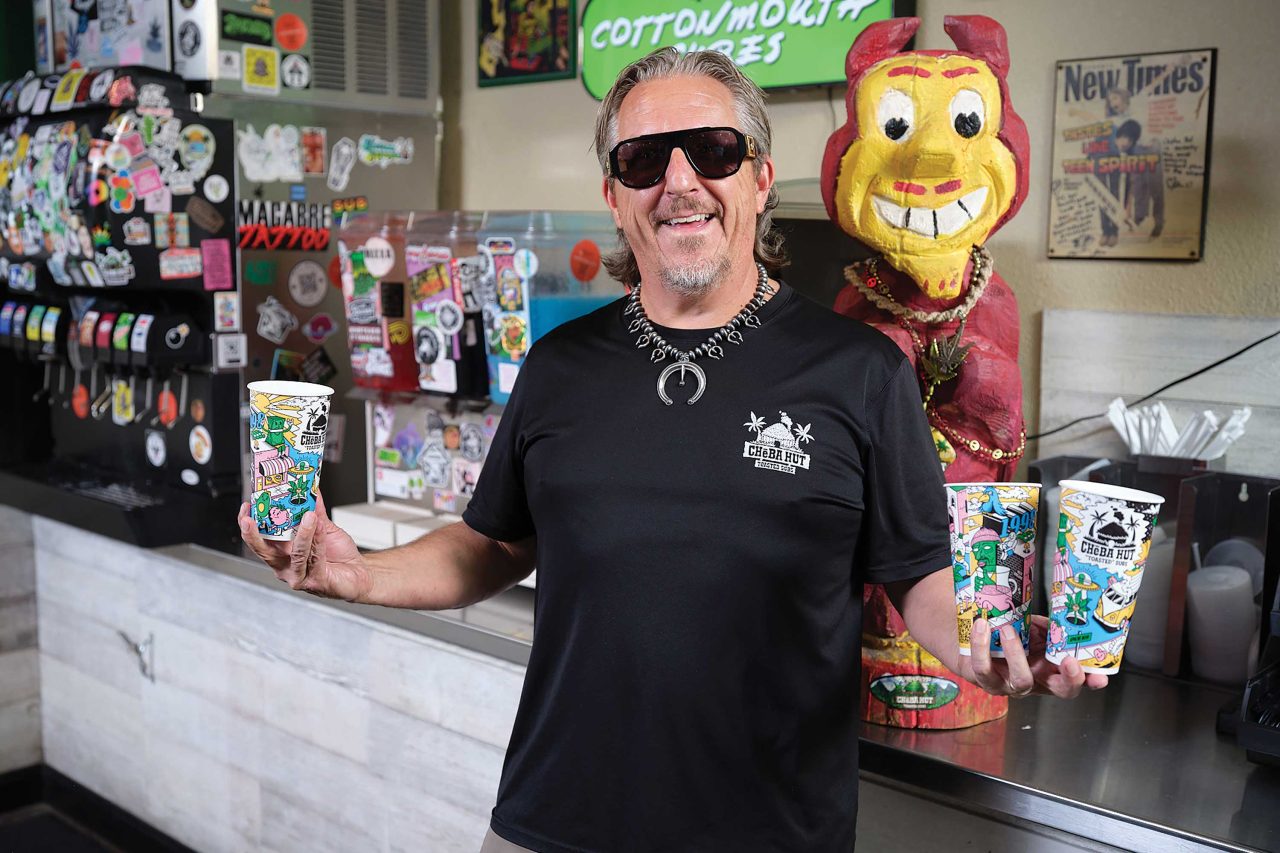
With his shoulder-length hair, goatee and surfer-stoner panache, Jennings exudes a bit of The Dude character from The Big Lebowski, albeit with a lot more business acumen. Factoring in the recent opening of a location in Gilbert, Jennings now rules a sandwich empire of 75 shops across 16 states.
You might say Cheba Hut has become “the shit.”
Jennings cultivated his culinary passion in his native Nebraska, where he returned after graduating to work at a pizzeria – an experience that left a lasting influence. “That’s what inspired me to do toasted subs,” he says. “You see the nod to Italian here, where there’s oil and vinegar on top of the Parmesan-oregano pickles. We use real prosciutto on that Italian sub instead of capicola.”
He also drew inspiration from stoner comedian duo Cheech & Chong’s 1981 movie Nice Dreams, in which the pair sells weed treats out of an ice cream truck. “I didn’t know shit about ice cream,” Jennings says. “But I could make a good sandwich.”
With a menu of toasted subs named after marijuana strains, and décor reminiscent of a head shop (including a 6-foot-long papier-mâché joint over the cash register), Cheba Hut drew tons of publicity when it opened. “I was smoking weed and, back then, it was a felony [in Arizona],” Jennings says. “I never got popped, but a lot of my friends did. It was no joke back in ’98 when I opened.”
Things have changed since then. Marijuana was decriminalized in Arizona and many of the states into which Cheba Hut expanded, facilitating its evolution into a family-friendly brand. Jennings grew the chain through loans and seller financing (signing over his first shops to employees, carrying the note and keeping a percentage of sales).
The new Gilbert location (Cheba Hut’s eighth in the Valley) drew a lot of old fans, says Jennings, who divides his time between his homes in Arizona and Colorado. “It was great because people are like, ‘I remember the Apache [Boulevard] store 22 years ago,’” he says. “It was goosebumps for me because it was just like, they’re so happy to be there.”
He moved Cheba Hut headquarters to Fort Collins, Colorado, in 2003 after selling his first franchise in Boulder. It was the first of many franchises for a sub shop with an attention-getting aesthetic and affordable price points of $6-$12 per sub (not as cheap as Subway, less expensive than Jersey Mike’s).
But overseeing an expanding empire comes with challenges. “It’s hard to stay up with cost,” Jennings says. “We’ve always been a value, and a value is more than just price.” He eschews wrapping to-go sandwiches in paper because the paper saps moisture from the sandwiches. Cheba Hut’s leftover subs are wrapped in aluminum foil. “And foil costs a ton,” Jennings says, “But man, there are some things that are non-negotiable for us.”

Another non-negotiable is the idea of adding marijuana-infused items to any of Cheba Hut’s food. “When you add pot to food, it does change the flavor,” he says. “It doesn’t taste right.”
Some might call it a ganja gimmick, but at the end of the day, Cheba Hut is a food joint first. “We’re really foodies at heart,” Jennings says. “That’s a big reason for our success.”