Alloy Midtown leads a new spate of Valley office-to-apartment conversions.
Gary Blakeslee regrets not saving a remnant of the old Drug Enforcement Agency headquarters in Phoenix that his company gutted to create Alloy Midtown, a 57-unit office-to-apartment conversion coupled with a newly constructed 114-unit apartment building on what used to be the DEA’s parking lot.
“I wish we could have saved something as a cornerstone,” says Blakeslee, managing director of Soltrust, the Seattle-based firm that’s also in the process of converting a former assisted living center in Mesa into apartments tailored to a younger demographic.
“I actually looked for an old DEA sign or something that would have been fun to salvage. But there wasn’t much worth preserving. [The building] had been heavily used for 40 years and only minimally maintained.
“But,” he adds, slyly, “I can tell you exactly which unit El Chapo stayed in when he was captured.”
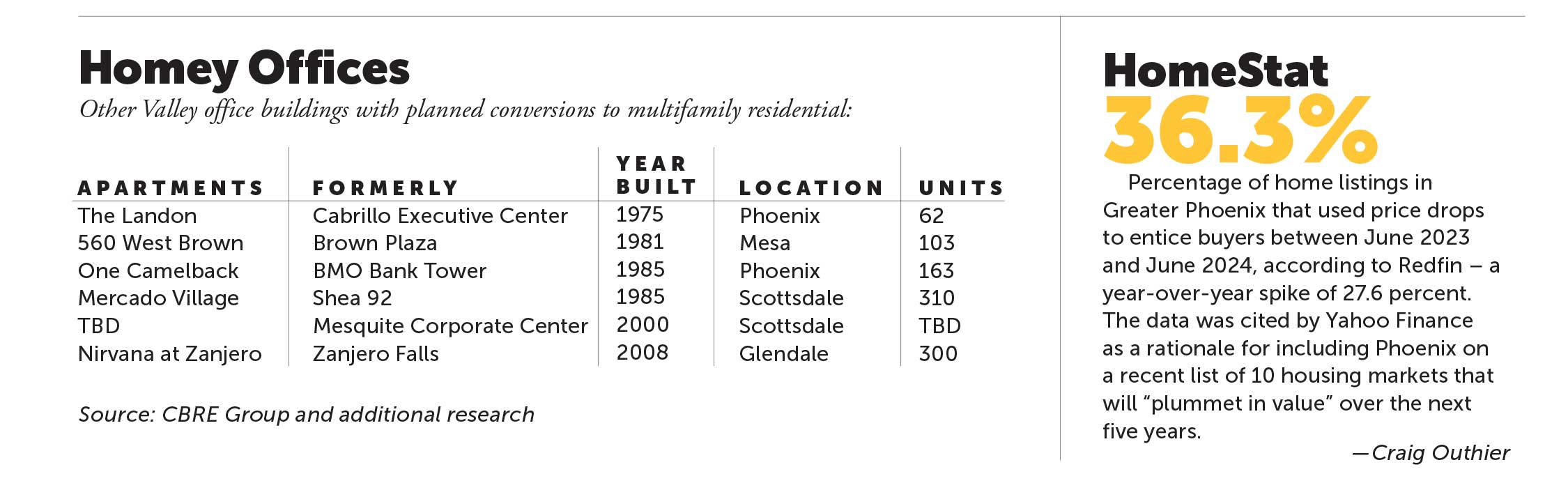
Alloy Midtown is one of seven new urban office-to-apartment conversions various developers have planned for the city (see sidebar). And like it, each one has its history.
One Camelback, the long-delayed conversion of what was once the Dial Tower, later the BMO Tower, is finally accepting tenants (monthly rents top out at $8,200). The 49-year-old Cabrillo Executive Center in North Phoenix used to serve as the local office of the American Diabetes Association. It’s now The Landon, a boutique luxury apartment complex.
After years of developers pushing the “live-work-play” concept of one-stop mixed-use properties, we’re now entering the live-where-you-worked phase, as office buildings struggling to fill vacancies in the work-from-home era convert to full residential.
“Post-COVID, the office market is just materially different than it used to be,” Blakeslee says. As of June, nearly a third of Valley office building spaces were vacant. “So, it was kind of natural to say, ‘OK, what would it take to convert this to apartments?’”
They ran into unique challenges, like how to convert what Blakeslee jokingly calls the “El Chapo Suite” into a living space. “A lot of the former holding cells were fortified with steel, but that room was super-fortified, with heavy bomb-resistant doors and padded walls.”
The company nixed marketing the units with DEA themes, but Blakeslee says if a prospective tenant asks for a unit’s history, he’s happy to share. “Each part of the building has its stories to tell.”