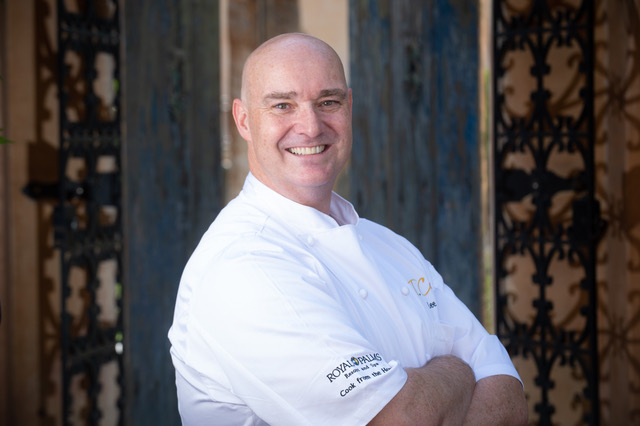
We recently caught up with Lee Hillson, executive chef at T. Cook’s at the Royal Palms Resort, to chat about fine dining, menu development and how he kept his staff happy during the pandemic. The veteran chef spent 12 years at T. Cook’s in the early 2000s, and then left for another opportunity. He’s been back since 2019 overseeing the iconic resort’s food and beverage operations. Here’s what he had to say.
How has fine dining changed because of the pandemic?
Menus became a lot more limited when we reopened. We had three appetizers, four entrees and three desserts, but people were just happy to get out and eat. It was really, really cool that they came and supported us. We’ve been very fortunate because our human resources team has managed to keep us staffed pretty well. We’re not back to where we were, but we’ve been able to expand the menu and we’re fully open now, which is fantastic. The pandemic has affected all of the pricing so it’s much more expensive to eat in restaurants, whether it’s fine dining or not fine dining. We’re much more flexible changing the menu now, whereas before, we used to change every quarter.
What’s your process for developing menus ?
We’ve opened up designing the menus to everybody [in the kitchen]. Before, I would design the menus or my sous chef would design them. Now I say to my guys, “Hey if you’ve got an idea, let’s do it. We’ll run it as a special. Let’s try it out.” It gives everyone much more ownership and excitement. They can say, “My dish is on the menu at T. Cook’s at the Royal Palms.” Many years ago, that was not the philosophy. Now it’s a great way for me to keep learning and a great way for my guys to keep learning. It keeps everybody fresh and engaged and want to stay. It’s a really cool way of keeping people.
What are some of the other ways that you keep your employees happy?
I think nowadays, we as chefs, have to really appreciate our teams and I think it’s even more important to thank them every day. We’ve always walked out and said, “Great job, thanks,” but I think it’s more important to look them in the eye and say, “Hey you’re great at this, thank you so much.” Or, “You’re crushing it. I know it’s hard right now, but you guys are doing it.” I think it’s very important that we tell them this.
What advice would you give an upcoming chef?
I would tell them not to give up and not to be greedy. It’s an industry where [cooks] can hop from place to place and as an [executive] chef, you see that and start to question their work ethic. They have to get that work ethic and realize this is their job. This is their industry. They’re going to be working holidays. It sounds kind of harsh, but sometimes you just have to suck it up. On the flip side, as the [executive] chef, I always try to give the staff off whenever I can in the hopes that they’ll reciprocate when I need them. It’s not an easy industry and I think it’s gotten harder with the pandemic because there is more expected out of everybody. They have to be resilient and more understanding.
What trends are you seeing in the industry, for better or for worse?
For worse, staff poaching. It’s ripe right now. The chefs aren’t doing the poaching themselves, it’s other [cooks] saying, “I work at this restaurant and I can get you this amount of money.” Also, it’s very hard to get products consistently. We have monkfish on the menu and then all of a sudden you can’t get monkfish for a few days, so we have to switch it out. The prices are rising on everything. On the good side, creativity. Because we don’t have everything at our beck and call, people are getting more creative. Now it’s like – OK what can we do now to fix this? We fix it as a team, which I really like. When I was coming up through the ranks, it wasn’t a team, it was chef says, chef does, that’s it. And now it’s what can we do to figure this out together?
If money were no object, what dish would you put on the menu?
No object? Probably, I’d like a really great A-5 Wagyu with a nice big slab of foie gras and wild mushrooms. I’d be all over that.