Six years ago this month, I lost a friend but learned a lesson in agency.
by Amy Silverman | illustration by Koren Shadmi
By September 2020, I was numb. I’m pretty sure we all were.
By then, I’d attended so many Zoom meetings, I memorized every detail of my backdrop. Replacing my kitchen wall with the image of a pretty beach or even a blur was never something I learned to do. Somehow, that felt like defeat. Too fake, as we pretended to continue to live our lives.
There had been so much death that even that started to feel fake. Rather, unbelievable, because as humans we are not hard-wired to endure and acknowledge so much loss in so many horrible ways.
Nothing was in our control, which is probably why I sprayed bottles of Clorox on my delivered groceries, even though I knew on some level it didn’t matter.
And then, on September 5, I received an email from someone who – when faced with the worst – had decided to take control of his own life. And death.
You may not have ever heard the name Stephane Janssen, but it’s likely you’ve seen artwork from his personal collection on display at museums here in the Valley.
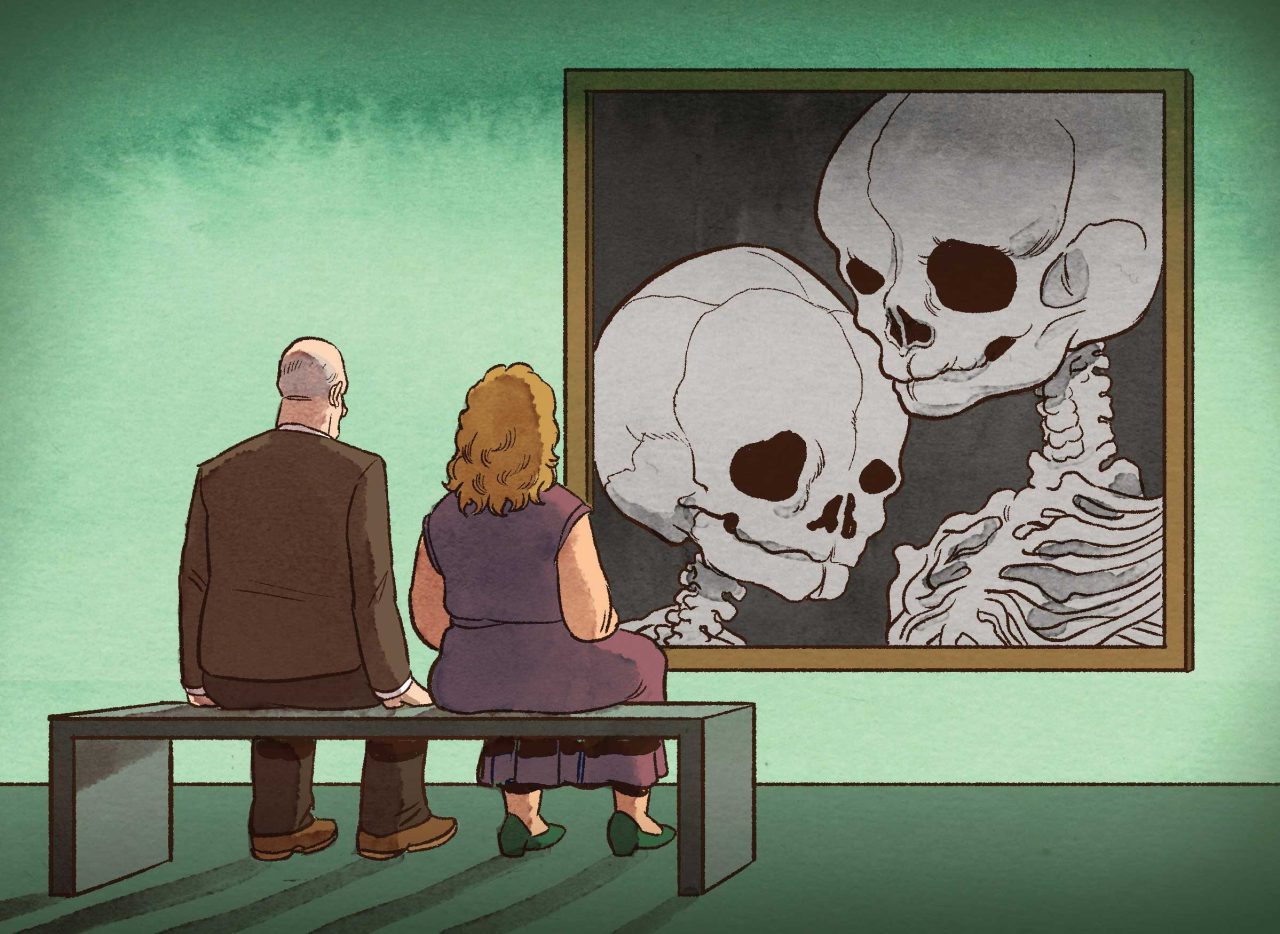
He didn’t love pretty pictures. Janssen was into art that tells hard stories, that makes people think. He collected famous artists like Joel-Peter Witkin, but also work by unknowns. On occasion, he became part of the art. He joined thousands of people willing to be photographed – naked – for installations created by the photographer Spencer Tunick. In 2014, Phoenix Art Museum presented a comprehensive exhibit of Janssen’s collected works, featuring themes of death and desire.
Janssen was born in Paris to a wealthy family, raised there and in Brussels, and lived in all kinds of places before ending up in Carefree after he and his lover, a ceramicist named R. Michael Johns, left Los Angeles in 1988, spooked by the Northridge earthquake. They were worried about Johns’ ceramics breaking.
Janssen still spent time in Europe, Santa Fe and other places, but a big chunk of his heart was always in Arizona because that’s where he and Johns lived – and it’s where Johns died.
I met Janssen at the beginning of my journalism career, when I profiled Johns, who had AIDS. In 1992, people in places like Carefree, Arizona, didn’t share that kind of thing publicly. It was a brave act for both men.
When Johns passed away in 1994, Janssen gave me one of his sweaters, which I still have. Janssen and I had lunch occasionally, when he was in town. So I wasn’t entirely surprised to hear from him, that September day in 2020.
Dear Amy,
I am following you on FB and I am glad to see that you are all well despite those terrible COVID times… and the horrible orange in the WH.
Although we see each other rarely your friendship for over 30 years is very precious to me.
Yes, I know. I had broken the rules of journalism by becoming friends with a source. It happens.
That past February, Janssen explained, he had suddenly stopped peeing. He was diagnosed with prostate cancer, outfitted with a catheter and a bag. He made it to Brussels the day before the world shut down.
By summer, he was miserable.
My health situation has degraded seriously, I walk with a cane and my quality of life has become unacceptable… so I tried to commit suicide with pills… I slept 14 hours and the friend and doctor who were supposed to find me and declare I had a heart attack found me alive having puked the enormous amount of pills I had taken.
After that, doctors allowed him to make the decision to end his own life. That was to take place September 17 at 4 p.m., in his bed in his Brussels apartment. He would have turned 85 the following January.
The silver lining of my botched suicide was the support of my children, grandchildren and friends. I have received so many beautiful messages. So soon I will be one of your guardian angels.
Thank you for your friendship.
Love,
Stephane
I responded that I was honored to be included among those he chose to tell.
And I had a question. No pressure at all, I promised. But if Janssen had any interest in sharing this part of his story with the world, I was here.
The answer was almost immediate. When could I talk? We arranged a Skype conversation September 9.
STEPHANE: I still have no pain at all, but my life is ridiculous. I mean, I have a catheter. I have a pee bag. I walk with a cane.
AMY: Yeah. That’s not your style.
STEPHANE: No, I mean, my life would never be what I like. So on the 17th of September, they are going to put me down.
AMY: Now, is this something that you’d thought that you wanted to do for a long time?
It was. I wasn’t surprised by the answer. I knew Janssen had met the late Elisabeth Kubler Ross, the author of the 1969 book On Death and Dying, when both were living in the Scottsdale area. He had a strong belief in life after death. He’d mentioned over the years how eager he was to be reunited with loved ones, particularly Johns.
AMY: I mean, it sounds corny, but what do you want people to know about you? What do you want to be remembered for?
STEPHANE: I want to be remembered for loving art collecting since I was 16 years old and sharing my art with people, especially when I came to Scottsdale… It was very, very, very, very important for me. And that I supported artists and discovered artists and helped them… I love life. I love art. I love Michael.
AMY: You didn’t just love art. You loved artists. You loved to get to know them and what inspired them, right?
STEPHANE: Some of them, I followed them for 40 years… I only bought work that I loved.
Soon, we returned to the topic of death.
AMY: You’ve definitely fought for your life in the past, right?
STEPHANE: I escaped death miraculously when I was 14, I fell a hundred feet from a mountain, in the snow, and broke my leg. I rolled my father’s car over, I was not injured at all. In ’97 I had an operation on my back and I heard the nurse say “He’s going to die.” And I said, “No, no, no, no, no, no, no, no.” I love life, but I want life to be alive, not to be attached to a catheter, a bag and a cane and go from my bed to the, to my kitchen, to the bathroom.
AMY: You saw the entire situation with AIDS. You certainly saw it up close with Michael, but you saw it with the whole community.
STEPHANE: You know, I had sex with Michael without any protection… It’s a miracle.
AMY: You’ve really cheated death several times. It must on some level feel good to be able to make the decision yourself.
It did, he said.
I asked about his plans for the next week. He said he was going to eat oysters with his youngest daughter, and go to lunch with a dear friend.
He didn’t want his grandchildren to see him in his current condition. He planned to watch French TV and Netflix.
STEPHANE: You know, that’s my life.
AMY: That’s not the Stephane I know. So I get it.
STEPHANE: It seems strange to people, but I’m really in a good mood because that’s what I wanted. And I got it.
AMY: What else? What have I forgotten to ask?
STEPHANE: Do you have any more questions?
AMY: No, I feel like, I mean, I probably will on September 18th, but, I don’t know. Is there anything I should have asked?
STEPHANE: No, no, no, no. I’m, I’m glad I met you and you are a fantastic person. And I told you, I admire you so much because you have so much courage. I don’t think I would have the courage you have.
Over the years, Janssen had asked me a lot about my daughter, Sophie, who has Down syndrome. He never met her – I got the sense he didn’t feel comfortable with that – but he always wanted updates and was delighted to hear about her life.
AMY: It’s amazing what you can surprise yourself with. I think you have a tremendous amount of courage.
He said he surprised himself when Johns was diagnosed with AIDS and began failing and he found himself caring for him.
STEPHANE: I’m very bad with people who are sick…[but] it came automatically.
AMY: Yeah, exactly.
After more than an hour, Janssen sounded tired. He said he had to go.
AMY: Thank you. Thank you, Stephane. I love you.
STEPHANE: I love you, too. And if you have any more questions, you can always send me a message and then I would answer.
AMY: Okay. And after that, I don’t know. I’ll come up with something creative. I’ll be thinking about you.
STEPHANE: Thank you.
Amy Silverman
Born and raised in Phoenix,
Amy Silverman is a multiple winner
of the Virg Hill Arizona
Journalist of the Year award.
She also penned the memoir
My Heart Can’t Even Believe It.