Our columnist pays tribute to a health-care whistle blower who isn’t being heard.
We could use more like her.
by Amy Silverman | illustration by Jess Suttner
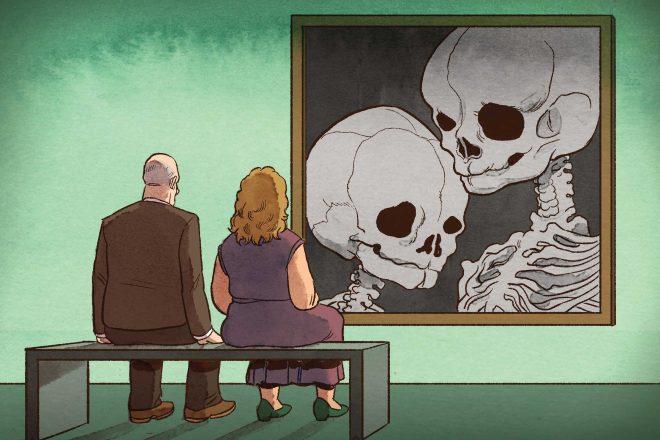
Like so many of us, my faith in our health care system is on life support.
There’s not one particular reason or category, and I can’t blame a single person or even a certain political administration. You can see things falling apart from every angle, and they have been for a very long time.
This was on my mind last November, when I received a text from a woman I’d never met but whose name I recognized immediately. I’ve gotten to know her over the last several months.
Funny, it’s her lack of confidence in the system that makes me feel better.
You might also have heard of Dr. Satya Sarma. She worked for the Arizona Health Care Cost Containment System as a medical director from 2019 to 2021, a blip in a 30-plus year career in medicine.
But those two years will always haunt Sarma because during that time, she says, she learned about what years later ended up being one of the largest Medicaid abuse and fraud schemes in U.S. history.
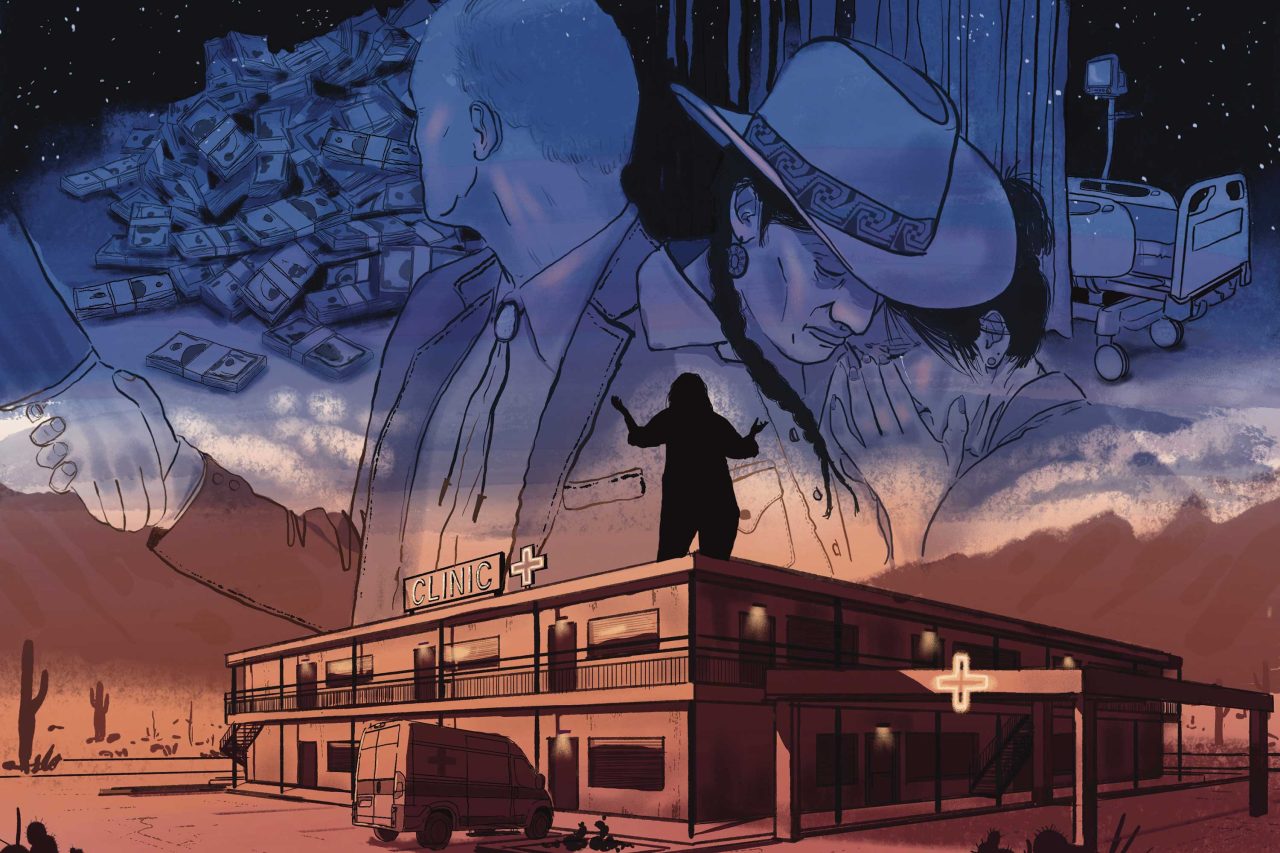
For years, behavioral health providers contracting with the state misled Native Americans who needed treatment for substance abuse – in essence kidnapping them from their communities and confining them, sometimes giving them drugs and alcohol to keep them reliant on the “services” they were being provided. In the last three years, about 140 providers have been indicted; there have been more than 40 convictions. So far.
This story isn’t just about health care. It’s about politics and money and bureaucracy and vulnerable people, particularly those who happen to be Indigenous.
It’s about how we treat one other. And that’s what bothers Sarma, whose entire career has been about providing good care. She remembers exactly when she knew she wanted to be a doctor. “It was the first time my mother took me for vaccinations, just before we were going to travel out of the country,” she says. “And I don’t know why getting a shot in your arm should make you want to be a doctor when you’re 6 years old, but that was kind of it.”
After graduating from college and medical school in Pennsylvania, Sarma moved to Phoenix in 1994 and set up a solo internal medicine practice.
“I started off actually wanting to be a surgeon,” she says, but she’d grown up reading detective stories. “Diagnosis is a little bit like being a detective. You listen to clues and you put together what this patient might have. And I realized surgeons basically face people under anesthesia who can’t talk.”
She really loved practicing medicine.
“I was in practice for 16 years,” she says. “I got to know patients really well. I got to know their families. There’s one family that four generations of them ended up coming to me. I got to see people through their lives. I got invited to Thanksgivings. I got to see them in their homes.”
When she got pregnant, she was touched by their generosity. “That first year that my daughter was an infant, I didn’t have to buy a piece of clothing for her or books or anything,” she recalls.
“I have to tell you, I always ran late because I would end up spending a lot of time. And they were mostly elderly patients. But, I mean, the stories I got to hear, right?”
Parenthood and a solo medical practice didn’t mix well. Sarma craved a 9-to-5 schedule. She found it in managed care.
For years, Sarma held various positions at several managed care organizations, including medical director. She reviewed tough cases and, she says, followed the complicated protocols required by Medicaid.
What she really wanted, she says, was a job at AHCCCS. She had for years.
At first, I think she’s joking. What could be farther afield from a country-doctor-style practice than managed care and Medicaid?
Sarma felt she could help more people this way – by monitoring and fixing systems at the highest levels of care management in the state.
It didn’t work out that way.
As she tells it, Sarma was hired in November 2019 as a medical director in the office of then-AHCCCS director Jami Snyder. Sarma quickly sensed that something wasn’t right, that her questions were not welcome.
In early 2020, just before the world shut down, Sarma attended a meeting with the quality manager from a program she was not familiar with, the American Indian Health Plan. The manager described what would come to be recognized as a common practice. His team of AHCCCS monitors reported being intimidated by employees at these sober living facilities, feeling like patients they spoke with were feeling threatened. They also reported that billing practices appeared fraudulent.
That was not the last time Sarma would hear such reports, or watch co-workers struggle to be heard. In January 2021, Sarma was transferred from the director’s office to – no kidding – the American Indian Health Plan. As the medical director, she was in charge of making sure those served were safe.
Sarma heard increasingly alarming stories and began gathering reports. She says she blew the whistle – repeatedly – and that many of her colleagues did as well. Nothing changed.
In November 2021, Sarma left AHCCCS amid complaints of insubordination. The scandal was not made public until 2023, when Katie Hobbs succeeded Doug Ducey as governor.
“I still lie awake wondering how many people were harmed or died since 2021,” Sarma told a state legislative committee last year. She’s also not sure how far back the scandal goes; she suspects it began before 2020.
She has no regrets about speaking up. “For me, the moral of the story is, I do believe that… what is that phrase, the arc of history bends towards justice, right?”
But that, she adds, requires sacrifice.
I reached out to three former AHCCCS directors. No response from any of them. Governor Katie Hobbs’ office declined comment and AHCCCS sent a boilerplate statement about how the problems have been solved. No comment regarding Sarma or her employment at the agency.
Privately, several local progressives – the kind of people you’d expect to be Sarma’s kindred spirits – have complained to me that she won’t let this go. That the scandal is over and it’s time to move on. But she won’t. She believes that abuse and exploitation could still be happening, and she writes about it on her Substack, Dr. Dark Side.
No one will say so, but I suspect that the Trump Administration’s current zeal for uncovering fraud in public systems including Medicaid as justification for cutting programs has made political leaders even more eager to put this scandal behind them. And as she faces reelection, Hobbs obviously doesn’t want to take the blame for something that happened while Doug Ducey was governor.
It is true that in the last several years, in the sober living industry, lawsuits have been filed, convictions handed down, bad companies shuttered and billing practices fixed – all to prevent scandals like this one ever happening again.
And it’s not like Sarma hasn’t gotten attention. She’s testified before the state legislature, spoken in depth with media outlets, and her arguments figure heavily into a class action lawsuit filed by victims and families.
But Sarma still doesn’t understand who is responsible for what happened, how or when it started and why these bad actors were allowed to continue for so long after she and other AHCCCS employees pointed out what was going on.
As she told legislators last year, it keeps her up at night.
After more than 30 years of covering government and politics in Arizona, I find Sarma’s selfless dedication refreshing. It’s okay if she makes people uncomfortable, if she continues to ask questions till she gets a satisfactory answer.
No one – not even Sarma – would deny that she is a troublemaker. She is honest and brash, probably because – unlike just about anyone else involved in this mess – she has nothing left to lose. She’s no longer working at AHCCCS, she’s unemployed, she doesn’t have a politician boss to defend or actions of her own to cover up.
The real question is, why aren’t we all up at night? We should be making Satya Sarma’s kind of good trouble – and a lot more of it.
About Amy Silverman
Born and raised in Phoenix, Amy Silverman is a multiple winner of the Virg Hill Arizona Journalist of the Year award. She also penned the memoir My Heart Can’t Even Believe It.