by Robrt Pela | photos by Jill McNamara
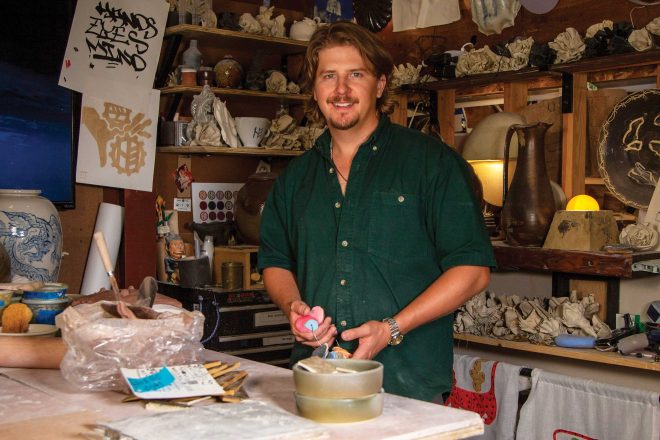
When clay artist Lori McMinn decided to make ceramic bowls from local cactus, the first thing she did was to phone the Arizona Department of Agriculture.
“They assured me that a cactus lying in the street is considered garbage, and I could take it home with me,” she recalls. “I hated hearing these beautiful plants referred to as trash.”
McMinn studied ceramics at Phoenix College; her new body of work was inspired by a trip to DeGrazia Gallery in the Sun Museum in Tucson, where she saw a display of Arizona artist Ted DeGrazia’s famous cactus bowls.
“DeGrazia would saw the tip off a saguaro, make a mold out of it and press clay into it. I thought, ‘I want to do that!’ I use a blowtorch to burn off the cactus needles, and acrylic paint or ceramic glaze to make each bowl different.”
McMinn, always ready to rescue bits of cactus she finds in local gutters, keeps a plastic bin and a pair of leather gloves in her car. “I imagine getting pulled over and a police officer asking me why I’ve got a kill kit in the trunk of my car,” she laughs.
Before she retired, McMinn worked in creative production, making things that other people had designed. “I wanted to be a maker in my own right,” she says. “So, one night I hauled a cactus to ceramics class with me and said, ‘Here’s what I’m doing next.’”
McMinn, who’ll be attending a workshop this summer to learn how to combine papier-mâché and clay, says she hates discarding parts of cacti once she’s used them to create her molds.
“I have to remind myself that I’m doing this to celebrate the saguaro,” she says. “Not to destroy it.”
– Robrt L. Pela


Fritz the G.O.A.T.
As the Arizona heat rises, a break from a traditional Southwestern summer is what the Sigler Western Museum’s Vivid Portraits and Violent Color: The Art of Fritz Scholder exhibition seeks to provide. Famed Luiseño artist Scholder created paintings that challenged traditional stereotypes of Western art and Native peoples. “Fritz Scholder’s art in Western American museums such as Sigler helps to transform the story of the American West, breaking the tradition of romanticized cowboys and sanitized Native images,” says Tricia Loscher, the chief curator at Sigler. “[He depicted] the West as a changing, dynamic place where Native history, modern expressionism, pop culture, and Western symbols converge.” Located in historic Wickenburg, the Sigler (previously known as the Desert Caballeros Western Museum) includes many other renowned works of Western art and frontier scenes, which “spark dialogue and questions about whose stories are told and whose voices have faded or been erased,” Loscher says. The exhibition will be on display until February 2027, and will then be added to the Sigler Western Museum’s permanent collection. westernmuseum.org
– Sommer Bailey