Over the decades – at least since Vampire’s Kiss back in 1988 – Nicolas Cage has developed the screen persona of a wild-eyed, unstable nutjob. Some of the appeal in this, probably at least partly by design, has been the sense that this is reflective of Cage’s real personality.
His new vehicle The Surfer is a big helping of Cage in extremis. He plays the title character, although for most of the film we don’t get to see him on a board. He’s an American who tries to take his teenage son for a surf on a stretch of beautiful Australian beach. Before they even get near the water, he’s aggressively confronted by local hooligans who drive him away with the repeated assertion, “Don’t live here, don’t surf here.”
This doesn’t sit well with him. He gets the son home, but then comes back and keeps hanging around the beach’s parking lot. Turns out he did grow up in the neighborhood, and is on the verge of realizing a lifelong dream by buying his father’s old house overlooking the beach. The surf with his son was supposed to be a celebration of this, at a time when his marriage is ending.
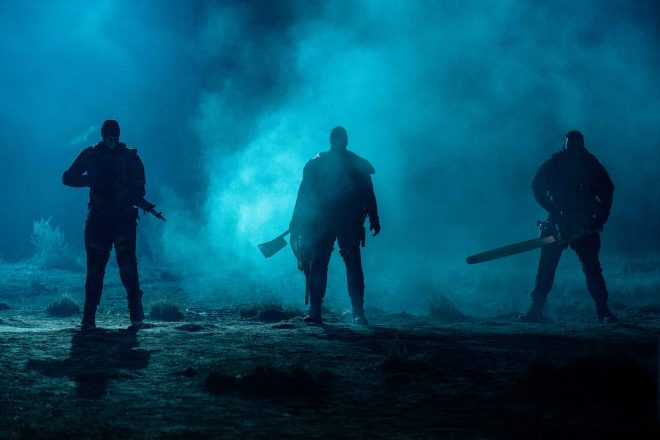
He keeps clashing with the beach bullies, losing every time. He loses his surfboard and his phone, his car battery fails, his real estate deal is about to fall through. Very quickly he ends up stranded, reduced to a filthy, babbling derelict, heartlessly taunted by the locals, who, it seems, are not just random goons; they’re part of a creepy men’s-movement cult.
Directed by Lorcan Finnegan from a script by Thomas Martin, The Surfer has the flavor of a ’70s movie, with dreamy music and lingering shots of bugs and lizards and kookaburras to remind us of how thin the line is between human and animal. And Cage is terrific, as he usually is when he gets the chance to fling himself into furious, agonized paroxysms of this sort.
But I have to admit that The Surfer sort of gave me a headache. Well-made as the movie is, the spectacle of this man getting degraded wasn’t that much fun for me to watch. Even at the beginning, the character seems like a bit of a douchebag, and maybe Finnegan and Martin want us to take pleasure in seeing a self-satisfied yuppie having his illusions of ascendancy shredded.
It also becomes hard to sympathize too much with a character so obtuse, so unfamiliar with the concept of the tactical retreat. But the guy really just seems desperate and sad, frantic to impress his family with achievements that only matter to him. And the compassion-free world in which he finds himself was no place I wanted to stay.
I will also admit, though, that the pitiless bullies – especially the grinning, falsely conciliatory leader, played by Julian McMahon – are truly loathsome villains, and I did invest in the movie insofar as I wanted to see them get theirs. And to that degree, at least, the last 20 minutes or so of The Surfer provides some satisfying payoffs.
∗ ∗ ∗
Florence Pugh has a larcenous streak. She stole 2021’s Black Widow from Scarlett Johansson, and she stole Greta Gerwig’s misfired 2019 version of Little Women from Saoirse Ronan. She didn’t exactly steal Oppenheimer, but she was tragically memorable among that high-powered cast.
With Thunderbolts* (I’ve been warned that the asterisk is an essential part of the title), Pugh herself is the star. Nobody steals the movie from her.
She’s back as Yelena Belova, her character from Black Widow, a high-powered assassin with a scrumptious radio-comedy Russian accent. Yelena finds herself thrown together with several other back-bench superheroes who have been sent to kill each other. Before long, they sort themselves into the ad hoc team of the title; the name has been used in Marvel Comics since the ’90s for various combinations of D-list supertypes.
The key to the comedy is the team’s lack of prowess – they’re incredibly strong and fast and durable compared to ordinary humans, but not by the standards of more celebrated superfolk. A couple of times they say it right out: “We suck!”
Directed by Jake Schreier from a script by Eric Pearson and Joanna Calo, this is just more Marvel silliness, in this case a sequel to the recent, and less satisfying, Captain America: Brave New World. The other members of the team, including Winter Soldier (Sebastian Stan), a middle-reliever Captain America (Wyatt Russell) and a woman who can pass through solid objects (Hannah John-Kamen), are serviceable but forgettable. It’s Pugh who carries the film, making us care about her jaded world-weariness but always keeping it funny.
Which is not to say that there’s no other good acting in Thunderbolts*. David Harbour plays it very broadly indeed as Yelena’s ebullient father, aka Red Guardian, and his shameless Soviet clowning wakes the movie up every time it’s in danger of nodding. As the principal villain, Julia Louis-Dreyfus takes her Veep persona a shade darker to excellent effect, and Geraldine Viswanathan has a nice supporting turn as her conflicted sidekick.
And then there’s Lewis Pullman as Bob, a mysterious amnesiac who falls in with the Thunderbolts but turns out to have a wild backstory of his own. Pullman is endearing as usual, but… didn’t he just play a mild-mannered fellow in Top Gun: Maverick who, while all the other pilots had cute nicknames, was known simply as “Bob?” Apparently, he just looks like a Bob.