Paid coaches, livestreams and sponsorship deals are giving young athletes a pro-style platform – and pushing mere amateurs off the field.
By Jimmy Magahern | Illustration by Luster Kaboom
Beneath a vast white canopy at Arizona Athletic Grounds in Mesa, the stars of the Carvana Professional Pickleball Association (PPA) Tour enter the championship court to adrenalized rock music and bursts of theatrical fog. Even with September temps nearing 105 degrees, spectators fill aluminum bleachers on all four sides as a hyped-up announcer calls the action and television cameras carry it to FOX Sports.
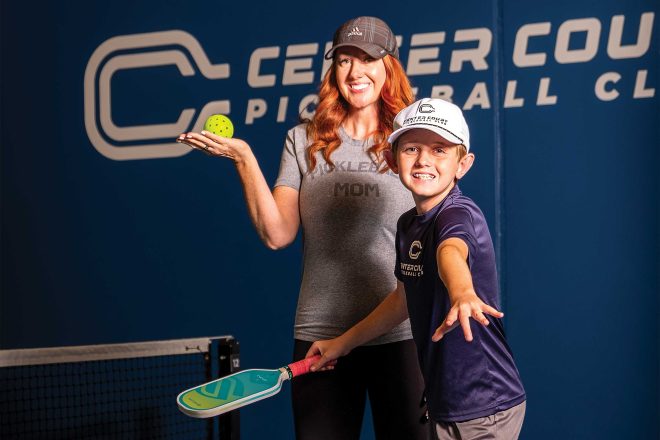
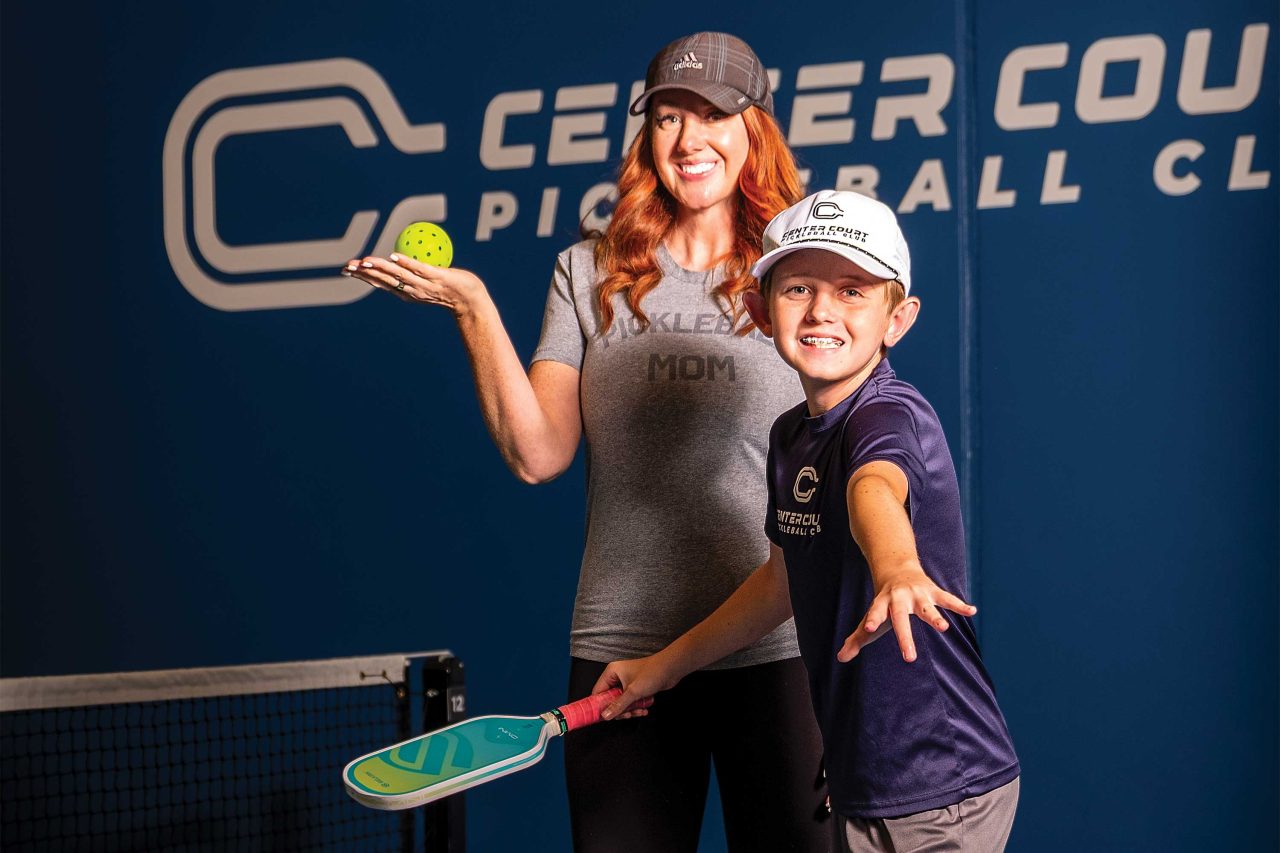
It’s quite the spectacle, but Mandy Holmes is focused on a different match. Beyond the big tent, on one of 41 uncovered courts spread across the roughly 10-acre pickleball campus, her 12-year-old son, JZ, and his doubles partner, Matthew Pak, are competing in the Junior PPA semifinals. Their match is self-officiated, and – besides Holmes and her husband, James – the only spectators are the fathers of the other three players.
Holmes calls to her son and extends a portable fan over the padded rail between rounds to apply SPF to his face and neck. “Our jobs are just keeping them sunscreened up,” she says. “And cool, and all the things that they don’t think about.”


For a moment, the scene seems borrowed from a yesteryear version of youth sports: a mother fussing over her son between games, a few dads leaning against a chain-link fence and children calling their own shots beneath the sun.
But this is no Norman Rockwell painting. Contrary to appearances, the amateur pickleball match happening in front of us is closely related to the televised spectacle beneath the canopy. As a PPA-sanctioned event, it’s part of the same corporate organism – more like a developmental tour than a classic youth sports league, offering the strongest players a route to the pros.
And like other club-style youth sports, it ain’t cheap.
Across the sporting spectrum, and especially in Greater Phoenix, childhood competition increasingly operates like a scaled-down version of the professional product – with club dues, specialized coaching, national travel, sponsorships and the constant pursuit of exposure. Parents still handle the sunscreen and rides, but increasingly, they also finance, promote and manage their children’s athletic careers, helping fuel roughly $40 billion in annual family spending on youth sports, according to industry estimates.
Who can afford to remain in that pipeline – and what the youth-sports machine asks of families and children, from time to money to the churches they attend – has become part of the competition.
JZ (short for John Zachary) is already well into that system. He’s currently ranked No. 1 nationally in his age group, travels to tournaments two or three weekends a month and, according to his mom, hopes to turn professional by 15 or 16.
For her part, Holmes isn’t simply following him into the big tent. Drawing on her background in publishing, advertising and public relations, she’s applying the same tools she once used to market businesses to market her son.
“I walk around to every sponsor tent at every tournament and connect with them on JZ’s social media,” Holmes says, flashing his Instagram page on her phone, which she manages. “Then I can stay in touch with them after the tournament for future sponsorship options.”
Holmes has built an unusually balanced portfolio for her 12-year-old. Idaho-based Selkirk Sport supplies JZ’s paddles and other gear, while his remaining sponsors range from a personal trainer and an Arizona sun-sleeve company to local contractors. Center Court Pickleball Club provides practice space and, in a particularly sweet deal, cuts the kid a monthly stipend.
“Yeah, I get $1,000 a month,” JZ says. “I just have to represent them at tournaments by wearing their shirts and getting their name out in the world.”
“They use JZ just like a little employee,” adds his mom. “He’s had to learn how to pay taxes, and he can’t blow it on Roblox or Minecraft things. It has a very specific use.”
At the elite travel level, flights, hotels, rental cars, tournament fees, private training, uniforms and meals can push a family’s annual expenses well into five figures. Holmes estimates that fully funding JZ’s current schedule could cost as much as $10,000 a month.
To help close that gap, Holmes has packaged her approach into Sponsor My Athlete, a Scottsdale business that teaches parents how to pitch companies on supporting their kids’ sports. “We’re not going after brands like Adidas and Gatorade,” she says. “We are going after local brands.”
Her first lesson is to stop presenting the request as charity. “This isn’t supposed to be a donation. It should be a marketing partnership.”
Partnerships, of course, come with obligations. Holmes recalls one afternoon when JZ would have preferred staying home with his iPad to visiting a sponsor’s smoothie shop.
“I said, ‘No, we have to go eat the smoothie,’” she says. “‘It’s in your contract.’ That was the first time I was like, ‘Oh my gosh, we have to go do something that he would rather not do!’”
The money and time families now pour into competitive youth sports can turn parents from good-humored cheerleaders into demanding customers – and, occasionally, belligerent fans.
Buckeye resident Mike Evenson has seen parents verbally abuse referees, shout at opposing teams and even fight in the stands. A former college athlete, youth coach and sports parent with more than 20 years in ticketing, sports marketing and customer engagement, Evenson sees a connection between the money families put into the system and what some expect it to produce – and not only in the high-priced club teams, which typically start at around $300 per month but can run much higher.
“I feel like it happens at all levels,” he says. “There are always people who are just, frankly, a bunch of assholes. But the shift from volunteers to coaches for hire is significant.”
The relationship changes when children move from parent-led rec leagues into club programs with paid coaches. Families can begin expecting results from the people they’ve hired. “Any time you pay someone something, you expect something in return, right?”
And it’s not just the coaching families are paying for. Walk-up songs, live statistics, livestreamed games and other trappings of professional sports have become the norm in club sports – even some neighborhood leagues. At travel tournaments, showcases and high-school competitions, families may also pay for subscription streams, highlight reels and online recruiting profiles.
One Valley sports parent who asked for anonymity recalls the first time he was charged admission to attend one of his 12-year-old son’s weekend basketball games at a North Valley high school – this on top of a $300 monthly club fee. “They’re just squeezing you at a certain point. Is another $8 going to break the bank? No, but it’s irritating and unethical anyway. Nobody is coming here for the level of play. We’re just supporting our kids. We’re a captive audience, so it feels like extortion.”
An admission charge makes parents paying spectators in addition to their duties as chauffeurs and cheerleaders – but it can also make a weekend game look like a preview of the career they hope lies ahead. A glimpse of their child’s imagined future can make another charge easier to swallow. For Evenson, that makes the emotional stakes more combustible than those of an ordinary spectator.
“If you go to a Diamondbacks game, and you spend 200 bucks as a family of four, you are there for the entertainment,” he says. “This is an investment in your own child. So I don’t think it’s entertainment. I think it’s ROI.”
Certainly, the returns for athletes are greater than ever, accelerated by new NIL (name, image and likeness) rules that blur the classic line between professional and amateur competition. No longer are young athletes merely competing for roster spots and college scholarships. Paydays are also at stake – sums that can set them up financially for life before they’ve even left home.
Seven-figure NIL payouts for top college football and basketball recruits are a matter of public fascination; less known are the rank-and-file deals handed to non-starters and tertiary-sport athletes in college. For instance, a low six-figure payout for a backup freshman linebacker at a Division I school would hardly raise any eyebrows in today’s NIL free-for-all.
Naturally, even the slim promise of such returns can raise the temperature on the sidelines. “As the level goes up, the competitive juice seems to just increase and increase,” Evenson says.
Once the family has invested that much, quitting can feel like more than the child’s decision. Evenson has seen highly ranked young athletes burn out by 13 or 14. For some of the young players interviewed for this story, however, walking away could be complicated by everything their families have invested.
At a Center Court practice before the PPA tournament, JZ’s friends and fellow competitors are asked whether they would feel comfortable telling their families they wanted to quit.
“I think it would be kind of hard to tell them because of how much they’ve done for me in my journey so far,” says 13-year-old Noah Elbyr.
Knox Seader, 14, gives much the same answer. “I think it would also be hard telling them I don’t want to play anymore, but they support me for whatever I want to do so I think they’d be OK with that.”
Clearly, a sense of obligation can accumulate without any adult issuing an ultimatum – through coaching bills, hotel rooms, long drives, missed weekends and the knowledge that the family has reorganized its life around a child’s ambitions. Evenson says that leaves parents with a responsibility extending beyond paying the bills and driving to tournaments.
“If you’re going to put your kid in a situation where there are all these external pressures,” he says, “it’s upon you as a parent to make sure you’re helping them navigate that.”
A whole network of clubs, training centers, tournament operators and sponsors is now built around youth sports. Arizona Athletic Grounds, a massive, multi-sport facility which was known as Bell Bank Park before its founders went to prison for defrauding investors, says it secured 15 multiyear agreements with sports organizations in 2025, while adding hotel partners including Holiday Inn, Hampton Inn and DoubleTree. In August, the Mesa complex announced a seven-year, multimillion-dollar PepsiCo deal covering drinks, advertising and promotional rights at its tournaments and events. The families gathering around the courts are also customers for the businesses surrounding them.
Center Court Pickleball Club, which opened four Valley locations in a little more than two years and is still looking to expand (“Do you know of a building?” jokes CEO Tim Keightley), sees young athletes such as JZ as both players to develop and ambassadors who can help build the business.
“The best thing that could happen for us is to see JZ on ESPN competing for a world championship,” says Ryan Trefry, Center Court’s vice president of operations and a two-time national champion himself. “We won’t truly know, probably for another eight to 10 years, but we’re all in.”
Trefry says the club noticed JZ’s skill and demeanor while he and his parents were members. It also noticed that he was competing beyond Arizona – and that his mother understood promotion.
“When you sponsor young adults, it’s also a relationship you have with the parents,” Trefry says. “Mandy’s very active in the Phoenix business area.”
At the higher levels, youth sports increasingly sort children by family income as well as talent. A 2026 AP-Ipsos poll found that children from six-figure households were far more likely to participate in organized sports than their less well-heeled peers – 70 percent versus 40 percent.
The club fee is only part of the bill. Phoenix Rising FC Youth Soccer’s Scottsdale program lists $2,400 in registration and club fees for players in its under-13 and under-14 divisions this season, supporting coaching, fields, insurance and administration. But tournament entries, coaches’ travel and uniforms cost extra.
Beyond those bills, competing requires airfare, hotel rooms and the freedom for a parent to miss work or spend a weekend cultivating sponsors. Professional know-how and community connections can further help a young athlete get noticed.
For families priced out of the club circuit, the pickings are increasingly slim, particularly in the Valley, which has embraced the club-sports revolution with at least as much gusto as any American metro. Anecdotally, the options for affordable community youth sports are richer in the Midwest and Northeast, where public services are more deeply embedded in the culture.
It makes for a somewhat grim situation for poorer youth athletes – especially those attempting to compete in the pre-high-school twilight of adolescence, when Little League-style community sports options thin out dramatically. Municipal recreation programs can fill the gap, but access to them also depends on how cities allocate the fields and courts.
“Our city policy ensures resident leagues – especially youth and adult recreational groups – receive first priority,” says Phoenix Parks and Recreation spokeswoman Teleia Galaviz. The city then allocates remaining space to clubs and tournament organizers “based on availability, historical use and community benefit.”
Scottsdale allows its sports complexes to support both local recreational needs and regional and national sporting events, although deputy Parks and Recreation director Chris Walsh notes one important limit: “The city does not allow sports organizations to charge admission fees at the sports complexes.”
Some affordable alternatives operate outside the parks system. CCV Stars, the youth-sports ministry operated by Christ’s Church of the Valley, charges $145 for an eight-week flag-football season, plus $20 for a uniform.
But as a faith-based sports league with an unabashed religious agenda, CCV Stars arguably profits from its athletes in other ways.
A former CCV Stars coach in Buckeye says that price and the program’s proximity kept his family involved for years. He asked not to be named because he still lives in the community. “This was just so convenient for us,” he says. “That’s the main reason we did it.”
The atmosphere also spared his sons some of what he had heard about other leagues – coaches cussing, parents screaming and adults turning children’s games into their own competitions. “You didn’t get any of that stuff,” he says.
The benefits, however, came with the ministry’s religious expectations, which began with the coaches’ questionnaire. During an interview with a pastor, the former coach says, he was asked, “What’s your relationship like with Jesus?” Another question was even more personal: “Did you have premarital sex?” He declined to answer that one. (CCV Stars did not respond to interview requests.)
“After every practice, you were expected to lead the group in prayer,” he says. Coaches received cards with Christian lessons, and head coaches were expected to attend CCV services on Sunday – a policy he says cost him his position after five years of head coaching when a church member demanded to take over his team.
He came to view the league partly as a recruiting arm for the church. “They’re not trying to develop professional athletes,” he says. “They’re trying to increase church memberships.”
Even so, he considers CCV an affordable neighborhood alternative to the travel and uglier sideline behavior surrounding club sports. For children hoping to advance, however, the more expensive programs offered something CCV did not: “The quality of the competition in those other leagues was better, especially on the club teams.”
Accessing elite competition is one hurdle for motivated young athletes. Getting noticed is another.
At Scottsdale’s Legendary Prep Academy, some families have taken that pursuit onto reality TV. A new Paramount+ series, executive produced by Kim Kardashian, packages elite youth baseball’s grueling schedules and family friction into bingeable entertainment. But the show’s title, Team Moms: Baseball, offers a clue about who else gets a turn in the spotlight. (In the pilot episode, Scottsdale mom Nina Scoffone calls one of her son’s teammates a “little bitch,” prompting LPA heads to consider canceling her in-house team Pilates classes).

Youth sports businesses already trade on parents’ hopes for their children – and sometimes their vanity. Reality TV adds another draw: Alongside the dream of raising a star comes the possibility of becoming one.
“Personally, I’d always felt our family needed a TV show,” says Dallas Baldri, an “award-winning global entrepreneur” by his own description whose wife, Rylee, was a 2022 Mrs. Arizona pageant winner. Nevertheless, he describes their involvement in the show as a way to advance their son’s athletic career.
“The real reason we agreed to participate was the opportunity to showcase Salvatore, his hard work and help build his brand,” says Baldri – who, as the show reveals, has also launched a wine label named Salvatore. “We’ve taught him since he was very little that you have to brand yourself.”
Baldri says talent alone is no longer enough for a child aspiring to play professionally. “You could be the best player in the world, but that doesn’t guarantee anyone finds you or knows who you are,” he says. “You need all of it to actually maximize the opportunity.”
The academy already has a connection to baseball’s talent evaluators – on its own coaching staff. Hitting coordinator Joe Dunigan is credited as the signing scout for pitcher Kyle Nicolas and outfielder Kameron Misner, both of whom reached the majors after signing with the Miami Marlins. Neither player needed a Hollywood television crew to realize his baseball ambitions; instead, the players merely relied on an industry of talent evaluators that number in the thousands nationally. But getting evaluated and getting an audience are different pursuits.
Tommy Wolczik, whose son, Cole, also appears in the series, talks a more cautious line about making a child’s athletic ambitions part of a marketing plan.
“There’s a fine line between giving a kid opportunities and turning every game, workout and social-media post into part of some five-year career strategy,” says the insurance exec. “The minute it feels like a job he didn’t apply for, we need to reevaluate.”
That caution isn’t keeping Wolczik and his wife, Erin, out of the spotlight, however. With fellow cast members Trina and Joey Taylor, they co-host Bleachers & Bullsh*t, a podcast extending the show’s sideline drama into episode recaps and behind-the-scenes commentary. Among Wolczik’s contributions: a review of Baldri’s Salvatore wine, which he quips “tastes like ass.”
Apparently, the children aren’t the only ones competing.
But when it comes to the kids, Wolczik worries about what happens when getting attention becomes a measure of success.
“I think social media, recruiting exposure and all the attention surrounding elite sports can become unhealthy if the child starts believing their value is tied to rankings, followers, statistics or what college is watching them,” Wolczik says.
“They’re still kids. They should be able to have a terrible game, eat a cheeseburger afterward and move on with their lives.”
THE WEEKEND SHIFT
For Tommy and Erin Wolczik, elite youth sports turn the family calendar into a season-long relay race.
- Their three children play club sports, along with several recreational teams.
- On weekends, Erin usually takes the girls’ events while Tommy handles his son’s baseball.
- Making every game can require an hour-plus drive from one field to another.
- A baseball tournament packs three to five games into Friday through Sunday.
- The family arrives home Sunday night exhausted – and, on a good weekend, carrying another tournament ring.
- “We know this is a season in our lives,” Wolczik says, “and it will be gone in a few years.”