A look at what happens in our bodies and minds when we swap jeans and sneakers for robes and slippers.
By Jessica Dunham | Illustrations by Kim Salt
At first, it seems silly. Eyes closed, a sheet draping you, silence in a darkened room, you’re told that seven bowls handmade from metals like copper and titanium will be laid gently, one by one, on your body. One bowl for each chakra. Okaaay.
Varying in size and shape, the bowls will elicit different tones when the practitioner strikes them, a series of vibrations meant to lull you into a state of deep relaxation. As the practitioner begins the sound bath – dings, chimes, hums and thrums, an impossible-to-follow sonic landscape not unlike an orchestra warming up – your mind runs through the week’s to-dos, emails to send, a mental note to pick up coffee creamer…
Bong!
A gong booms just above your head. Your eyes flutter open and a calm voice says: “That’s it for our session. How do you feel?”

You don’t recall falling asleep. And yet. An hour has passed. You’re more rested than you’ve felt in years. Singing bowl sound therapy? Not so silly after all?
Day spas. Wellness centers. Salon-spa hybrids. The spectrum of “how to spa” spans far and wide, the services offered even more diverse. Some are familiar: massages, facials. Some are trending: scalp scrubs. Many honor ancient cultural traditions, like Chinese medicine’s acupuncture. And some are just plain wild: beer baths, fish pedicures, being massaged by snakes.
All spa treatments, though, promise the same thing – to make us feel better.
“Imagine that your nervous system has two modes: fight-or-flight versus rest-and-restore,” explains Brook Choulet, M.D., founder of Choulet Performance Psychiatry in Scottsdale. “Many [people] live in fight-or-flight response. A spa day stacks signals telling the brain it’s OK to engage rest-and-restore mode.”
Evolutionarily speaking, there’s a reason for fight-or-flight. When the brain senses danger, it readies the body for action, unleashing a torrent of the stress hormones cortisol and epinephrine, which then trigger a blood pressure surge, increased heart rate, rapid breathing and tightening of the muscles. In the short term, it’s an effective survival skill. In the long term – or “living” in flight-or-flight, as Choulet says – it’s destructive to overall health. The key to shifting out of danger mode: stimulating the vagus nerve. Lovely and complicated and crucial to the parasympathetic nervous system, the vagus nerve regulates the body’s everyday functions. Awaken this little beauty with “we’re safe” signals, such as what one might get at a spa, and the body downshifts into rest-and-restore stasis.
But among the dizzying number of treatments available, it’s hard to discern which ones actually initiate rest-and-restore and, more importantly, how they do it. Let’s start with those that rely on that most life-giving element – water.

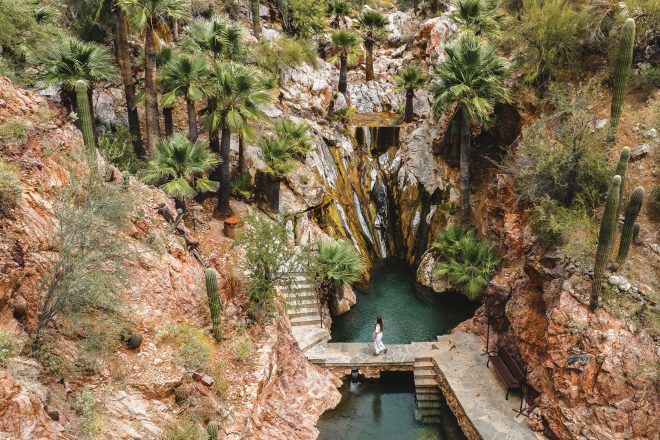
There’s a mantra at Castle Hot Springs: Soak early and soak often. The luxury resort tucked in the Bradshaw Mountains about an hour drive northwest of Phoenix is home to three geothermal soaking pools comprising 120,000 gallons of mineral-rich water that nourishes everything on property, from the veggies at the on-site farm to the bodies of the guests who visit. Soak early and soak often because, the belief goes, the springs’ healing benefits know no limits.
Picture it: a rock-hemmed soaking pool whose surface gleams like glass and whose depths are naturally warmed to 108 degrees. You float, buoyant. Your eyes drift upward to note palm trees leaning amiably into the blue canvas of a cloudless sky. Your breath deepens. Tension melts.
It could be the resort’s lush scenery soothing the nerves.
It could also be the lithium.
“The water here has the highest lithium content of any hot springs in the country,” explains Bevin Fulton, the resort’s springs experience manager. Fulton manages all springs-based treatments, such as guided soaks and watsu therapies.
Low doses of lithium – a light metal on the periodic table of elements – activate calming neurotransmitters like serotonin and regulate stress hormones like cortisol. Castle Hot Springs’ pools are also abundant in magnesium (a mineral key to healthy neurologic functions benefiting sleep and mood) and sodium bicarbonate (a mineral that opens blood vessels for improved circulation). Transdermal absorption helps your skin gulp it all in like it’s the latest electrolyte beverage. In fact, Castle Hot Springs served as a rehabilitation center in the 1940s for World War II servicemen recovering from injuries; among the patients was future U.S. president John F. Kennedy.
But science says the real good-for-you factor in a hot-water soak is, well, heat. Or rather, the alchemy of heat and water together. Raising the body’s core temperature through a hot-water dunk supports essential physiological processes. A 2025 study at the University of Oregon’s Bowerman Sports Science Center discovered that soaking in a hot tub lowered blood pressure, improved how the body handles stress and stimulated the immune system – results researchers found to be more impactful than when participants sat in a dry or infrared sauna, and with effects that continued after the soak session.
In the findings published in the American Journal of Physiology, researchers said hot-water immersion offers the most impactful changes in core body temperature because of the body’s lack of contact with the air. Submerged in water, the body’s cooling mechanism – i.e., sweating – just isn’t as effective.
“There is strong data behind heat therapy,” says Susan Sorosky, M.D., founder and chief medical officer at Desert Spine and Sports Physicians in Phoenix. “When paired with standard care, such as physical therapy, heat can be very effective for healing and recovery.”
Then there’s marrying heat and cold therapies. This is the premise behind the hammam bathing ritual, or the Turkish bath, a centuries-old spa tradition from Northern Africa and the Middle East that bookends skin exfoliation with a humid steam and a cold deluge.

Joya Spa at Omni Scottsdale Resort & Spa at Montelucia is the only place in Arizona offering an authentic hammam. The experience begins in a warming room. Here, in the heat, an attendant exfoliates your skin – briskly, in circular motions – with African black soap and a coarse mitt called a kessa before a warm-water rinse. Then you steam. You hot tub. You douse yourself in 55-degree water. You repeat. By the end, your body is somehow, and somewhat incongruously, both limp with relaxation and buzzing with invigoration.
Sorosky explains. “Heat is vasodilating,” she says, “so blood vessels expand and blood flow increases.” Blood pressure lowers, and the boosted blood flow helps with nutrient- and oxygen-delivery to tight muscles. That limp-with-relaxation feeling.
“Then cold therapy is vasoconstricting,” Sorosky says. “Blood vessels get smaller.” Vasoconstricting lessens pain signals to the brain, hence, why an ice pack feels great on a swollen knee. But also, that initial shock of cold water? It sends the body into fight-or-flight followed instantly by a counteracting flood of mood-boosting endorphins. The body buzz.
Joya anchors its services around the hot-and-cold bathing ritual, and the commitment to preserving its authenticity can be found everywhere in the 31,000-square-foot space, from the jade-green tiles imported from Morocco to the kessas sourced from a traditional company.
“The context of a spa can amplify the placebo effect,” Choulet says. “And maybe, it’s not really placebo if people associate the spa experience with rest and relaxation, making them more intentional about staying present in the moment. Placebo doesn’t have to mean imaginary.”
When it comes to spa-ing, if placebo can be reality, then skeptics can be proven wrong.
The benefits of a treatment like massage therapy (stress relief, pain reduction) are well-documented. The results of a 2024 study by Baylor University – the largest and most comprehensive ever conducted on the subject – found that massage therapy is a mainstream therapeutic modality that “merits wider integration into the community of health-care professions.”
Sorosky knows this firsthand.
“We make use of a specialized massage called neuro-muscular massage. There’s a moderate certainty of evidence that supports it, especially for chronic low back pain. Direct action on muscle tissue reduces muscle guarding, improving the way pain is processed. For patients, this helps with more movement, function and better nervous system regulation.”

So, let’s return to that sound bath with the singing bowls. It involves zero massage and no evidence-based, blood-pressure-lowering, hot-water soaks. Only a litany of tones promising to restore health. A nonbeliever might have doubts.
Admittedly, singing bowl therapy appears “woo-woo” on paper, but it’s simply a meditation practice. It relies on frequencies and vibrations produced by different instruments to alter brainwaves from beta (a normal, waking state) to alpha (alert yet relaxed), theta (REM sleep) or delta (deep, dreamless sleep). The vibrational mechanism is similar to, say, the moment a music note hits a pitch just right to shatter glass.
Once the brain shifts into alpha, theta or delta, the body follows suit. The heart rate slows. Blood pressure lowers. Cortisol levels drop. Rest-and-restore is activated.
The Fairmont Scottsdale Princess’s Well & Being Spa offers a 60-minute singing bowl therapy as its own treatment or as an add-on to massage. Licensed practitioner Jill Branscum has worked at the spa for four years, training with Red Rock Healing Center in Sedona in sound bath therapy. She says most clients opt for more familiar treatments rather than the sound bath. But she wishes they’d give it a try.
“The effects are profound,” Branscum says. “I’ve never had someone who didn’t feel changed after this therapy.”
Profundity may be tricky to define, even harder to scientifically quantify. But seeking meaning out of our overstimulated and hyperconnected lives is often why people flock to spas in the first place.

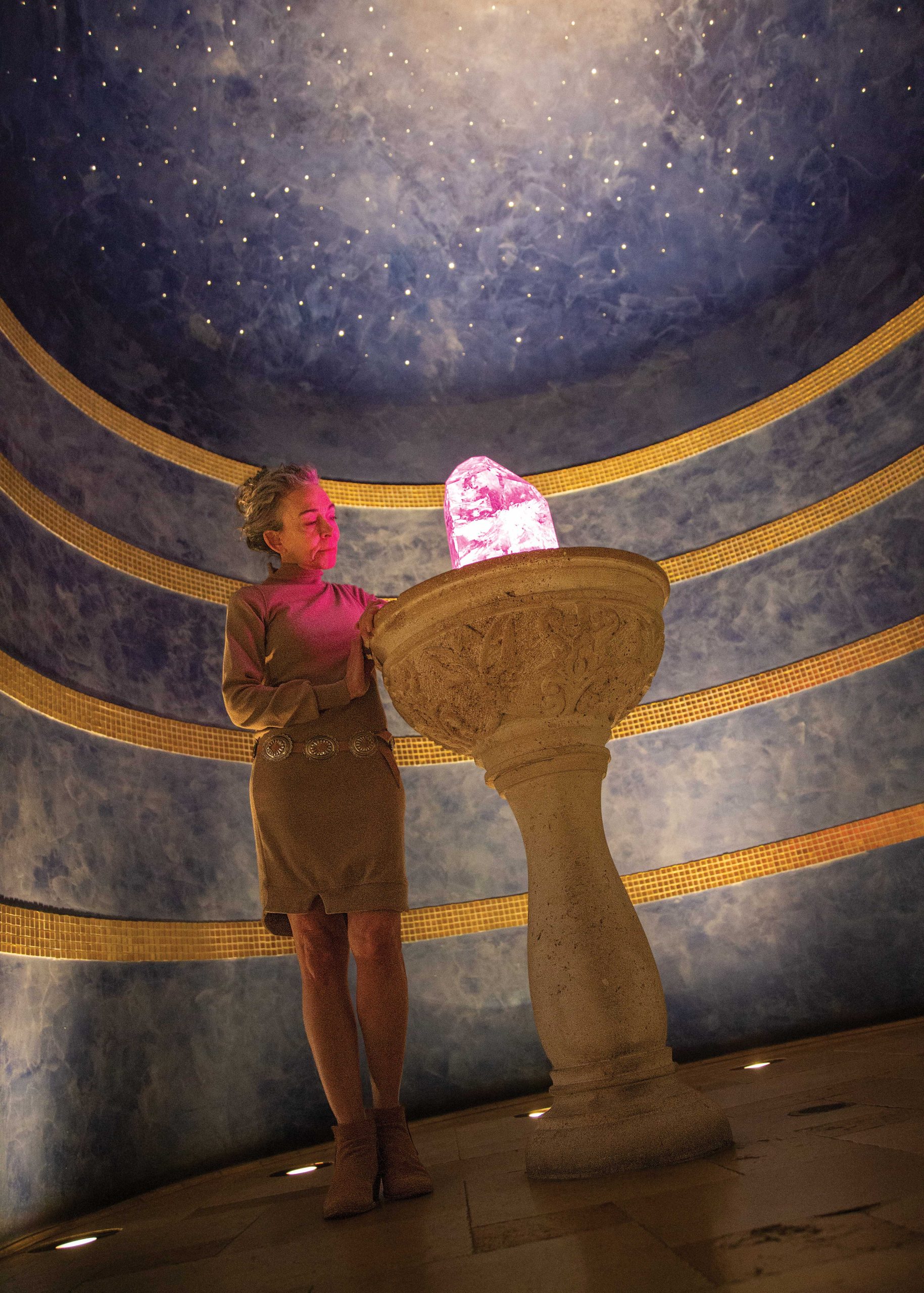
Mii amo in Sedona does meaning-making better than anyone. The spa programming is designed as a holistic approach to well-being – mind, body and spirit. Treatments range from reflexology, energy clearing and intuitive massage to all-inclusive “journeys” curated and led by your very own guide. This intentional process to spa-ing begins from the moment you arrive, where the Crystal Grotto greets you – a circular room with a pedestal of petrified wood and an illuminated quartz crystal inviting quiet reflection.
“Stress reduction is not just about providing temporary relief,” explains Mii amo therapist Adrian Ealy. “It’s about providing guests something deeper, longer lasting and more significant. Something that gives space for meaningful change.”
Ealy cites the cranial sacral treatment as embodying this ethos. Using a feather-light touch, your therapist feels for subtle rhythms in the membranes around your head and spinal cord – a gentle nudging with fingertips that eases tension in the connective tissues. Your body sinks into rest-and-restore mode, yes. You’re relaxed, absolutely. But the treatment also encourages your body’s own ability to heal, ideally initiating a shift that lingers long after the treatment.
Is there proof of this? Maybe. Maybe not. Sorosky says it might not matter.
“The mind and body connection is intertwined tightly,” she says. “When your mind feels relaxed, that benefits the body. Likewise, when the body feels well, that eases the mind. So, if someone goes into a treatment believing it’s good for them, and they walk out feeling good, that’s a win in my field.”
Choulet seconds this: “The psychological experience itself is the [medical] intervention. A ‘successful’ spa experience includes feeling safe, in control, cared for and being offered a predictable environment. The body responds to meaning, safety and context as much as it responds to the physical treatment itself.”
OK, then. Who’s up for a snail-mucus facial?
A Word on Spa Design
Spa-goers might not notice the precise curve of a staircase or how a shaft of sunlight slants on a wall. But it’s details like these that subconsciously set the tone for a spa experience. Enter Sylvia Sepielli. Renowned as a master of spa design, Sepielli has lent her talents to the looks and layouts of notable spas around the globe, from Maui to Bali, from Ojai to Malaysia, and to Mii amo in Sedona and Joya in Scottsdale. We talked to Sepielli to learn why the design of a spa matters as much as the services rendered within.
Q: What aspects of design are crucial for a calming space?
A: The key is to direct the flow and isolate noisy spaces from the quiet spaces. Sound abatement through the entire spa is critically important.
Q: How do you create spaces that foster a mind-body connection?
A: Every tactile engagement has an impact. How do your feet feel on the locker room floor? Is the room temperature comfortable? Design removes the speed bumps, so with each subconscious touch point, the guest becomes more relaxed, trusting the “letting go” process.
Q: What design aspect at Joya are you proud of?
A: The star of the show is the rich architectural and interior elements of Islamic, Moorish, Spanish and Moroccan influences that permeate every detail.
Q: What design element at Mii amo are you proud of?
A: In every project, I try to create an experience that will be uniquely associated with a particular spa, and one that’s not easy to replicate. Mii amo’s is the Crystal Grotto.
Q: Is there a philosophy that guides your spa designs?
A: Place leads design. And place is inhabited by people. I make it a point to meet the people who live in the region, whether there’s an Indigenous connection to the land or it’s an urban setting like New York.
Salubrious Spa Indulgences
“Deep Serenity”
Sanctuary Camelback Mountain
Guided breathwork commences this two-hour treatment ($230-$485) that incorporates skin exfoliation, full-body application of a hydrating serum, body wrap and massage therapy.
5700 E. McDonald Dr., Paradise Valley, 844-390-4754, sanctuaryaz.com
Hammam Experience
Joya Spa at Omni Scottsdale Resort & Spa at Montelucia
This 110-minute ritual (from $580) utilizes both heat- and cold-therapies during a meditative self-guided circuit through steam room, whirlpool and icy deluge.
4949 E. Lincoln Dr., Scottsdale, 480-627-3200, omnihotels.com/hotels/scottsdale-montelucia
“Mustangs and Massage”
Aji Spa at Sheraton Wild Horse Pass
Saddle up for a 90-minute horseback adventure to spot the wild mustangs that roam the desert, then return to the spa for massage and lunch at Aji Café (from $370).
5594 Wild Horse Pass Blvd., Phoenix, 602-385-5759, ajispa.com
Singing Bowl Therapy
Well & Being Spa at Fairmont Scottsdale Princess
Using bowls as instruments by tapping, banging and striking the vessels, a practitioner bathes guests in harmonic tones to induce a state of rest and meditation (from $215).
7575 E. Princess Dr., Scottsdale, 480-585-4848, scottsdaleprincess.com
“Spirit of the Desert”
Civana Wellness Resort & Spa
A two-hour body-mind transformation ($435) begins with guided meditation and sound bowl therapy followed by a gentle massage using steam-warmed, herb-filled poultices.
37220 Mule Train Rd., Carefree, 480-653-9000, civanacarefree.com
Watsu
Castle Hot Springs
Floating weightless in mineral-dense pools, this guided water therapy (from $295) cradles, rocks and stretches the limbs while light pressure-point massage helps ease stiffness.
5050 N. Castle Hot Springs Rd., Morristown, 855-270-0441, castlehotsprings.com
Cranial Sacral
Mii amo at Enchantment Resort
A one-hour treatment ($265) dedicated to releasing built-up tightness in the fascia – the body’s connective tissue – in the head and neck using ever-so-gentle pressure.
525 Boynton Canyon Rd., Sedona, 844-763-0470, miiamo.com


Spa & the Body
Chest/Heart
Blood pressure lowers, heart rate slows and breathing deepens when the vagus nerve is stimulated, jumpstarting the parasympathetic nervous system. Best treatments: hot-water soaks, hot-stone massage.
Abdomen
The adrenal system gets much-needed support to help it reduce cortisol levels and boost feel-good hormones like serotonin and dopamine. Best treatments: aromatherapy, reflexology, massage.
Skin
Waste-filled lymph fluids travel to the lymph nodes for processing – aka, cleanup! – to reduce fluid buildup, often the cause of chronic swelling. Best treatments: dry brushing, exfoliation.
Feet
The grounding force for the entire body, feet do it all. Therapies that alleviate tension in the dozens of nerves and muscles in the feet improve blood flow and soothe aching joints throughout the body. Best treatments: reflexology, hot-cold therapies, pedicures.
Head
Brain waves shift from beta (alert) to the restorative states of alpha (relaxed) and theta (deep meditation).
Best treatments: sound bath, meditation.
Neck/Shoulders
Coiled muscles unravel and tight knots release to ease tension and boost mobility and movement. Best treatment: deep-tissue massage.