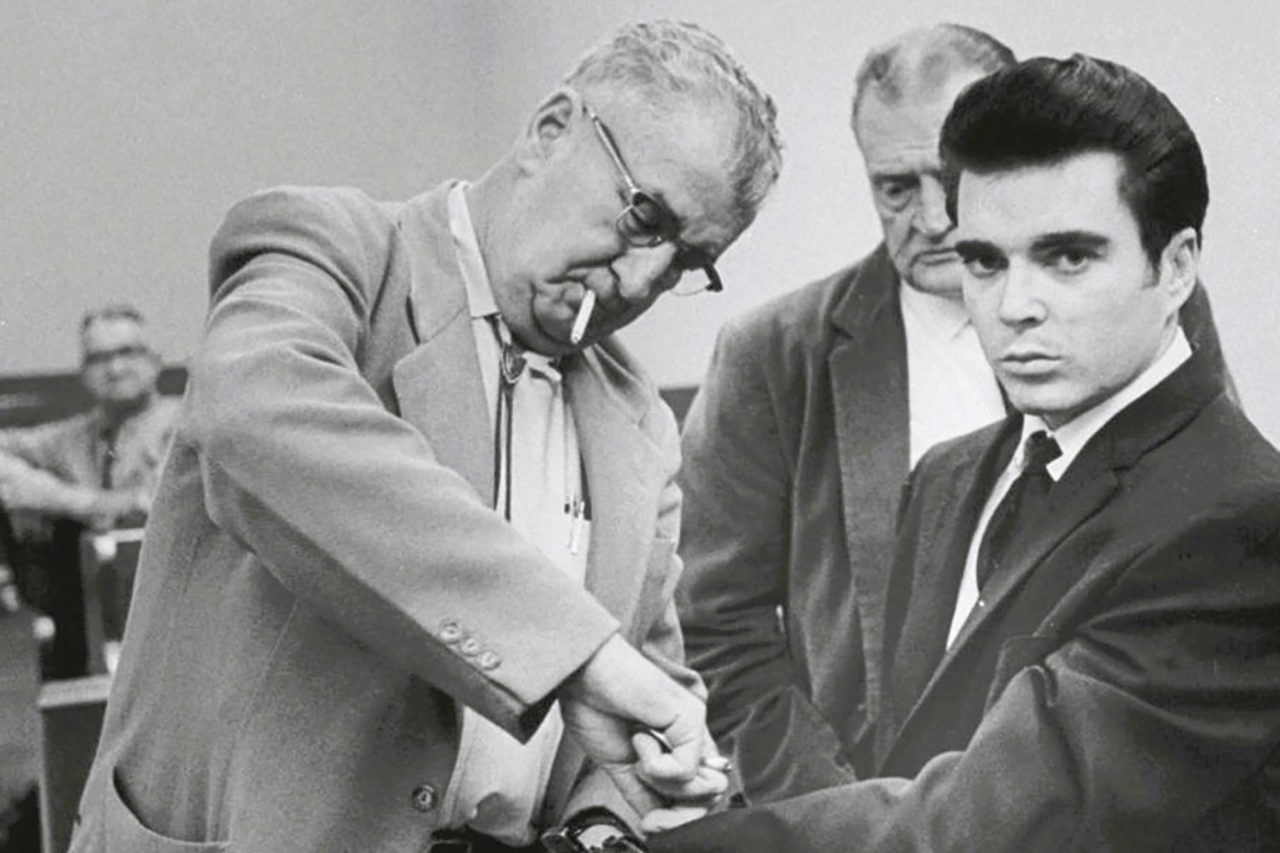
“The Pied Piper of Tucson” induced acolytes to assist in a brutal murder that ultimately led to him killing two more teenage girls in crimes that shocked the nation.
Fifteen-year-old Diane Lynch felt pure joy after marrying the man she loved in 1965. “The kiss we shared after the justice pronounced us man and wife was the happiest moment I have ever experienced in my life,” she says. “I wish every woman could have that rush of euphoria on her wedding day. He was perfect.”
Lynch’s life was shattered 17 days later by a knock on the door of their house near the University of Arizona, where Tucson Police arrested her husband, Charles “Smitty” Schmid, for the brutal slaying of two teenage sisters in the house where Lynch lived with Schmid. Lynch was in disbelief, but Schmid, soon to be dubbed “The Pied Piper of Tucson” in a 16-page LIFE magazine article for the spell he cast over his maladjusted followers, had a heinous past.
Schmid was adopted at a young age by a Tucson couple who owned a nursing home. He later led his Tucson High School gymnastics team to the state championship, but eventually dropped out and fell into a rut of odd jobs and arrested ambition.
Spoiled by his overbearing mother, Schmid led a weird, rebellious life. He used shoe lifts to hide his short height, dyed his hair and wore makeup to impress teenagers as a wannabe Elvis Presley. Girls were attracted to his swagger, penchant for poetry and sleek gold 1964 Falcon Sprint.
At a hamburger stand, the 23-year-old introduced himself to Lynch, the second-oldest of nine children, who was skipping school. Their whirlwind courtship culminated in a wedding a little over a month later in Nogales, Mexico, because the bride was underage. Lynch, now 75, describes Schmid in a telephone interview as smart, funny and quirky. “He was never boring, that’s for sure. Smitty was the perfect gentleman and went out of his way to make me feel special.”
That wasn’t the case with his previous girlfriend, 17-year-old Gretchen Fritz, to whom Schmid confessed a gruesome deed. Earlier that year, Schmid had murdered 15-year-old Alleen Rowe after expressing a desire to kill a girl for the thrill of it to friends. He bludgeoned Rowe with a rock during a double date, and he and his friends buried her body in the desert.
Gretchen – who, according to Schmid’s friends, thrived on drama and had a volatile relationship with Schmid – threatened to reveal his secret. During an argument at his house, Schmid strangled Gretchen and her 13-year-old sister, Wendy Fritz, with his bare hands. He buried their bodies near the remains of his first victim, in an area of the desert where he would often take Lynch during their courtship.
“These were beautiful moments for me,” she says. But in hindsight, “why he took me there is beyond me.”
Despite some odd behavior by her husband, Lynch initially believed Schmid was set up by his friends, who later struck deals with law enforcement in exchange for their testimonies against her husband. “Together, they were like a powder keg, a combustible mix of lonely and dysfunctional people who brought out the worst in each other when they were together,” she states in the book, Smitty: My Marriage to Serial Killer Charles Schmid, the Pied Piper of Tucson, cowritten with Marshall Terrill in 2025.
These disturbing killings drew international media attention and were the subject of profiles in Newsweek, Playboy and TIME. The murders brought to light the city’s toxic teen subculture of desert parties with sex initiations and violence. Prosecutors tried Schmid in Tucson, and he was found guilty. In 1966, the judge sentenced him to the Arizona State Prison in Florence, where he was to be executed in the gas chamber.
The case ignited passions in the Old Pueblo. Once, Lynch took her husband’s car to the grocery store. “On the way home, I heard a loud boom, and the back window shattered; they said it was a bullet.” Afterward, the couple decided, for Lynch’s safety, to get a divorce so people in Tucson would leave her alone. But the couple’s bond remained unbroken, she says.
Famed defense attorney F. Lee Bailey defended Schmid in his second murder trial involving Rowe, which ended with a plea deal. What ultimately saved Schmid’s life was the U.S. Supreme Court’s decision to outlaw capital punishment in 1972. Later that year, Schmid escaped from prison and had a quick final encounter with Lynch in her vehicle near Casa Grande. “We hopped in the backseat and made love for what would be the last time,” she says. “It was intense.”


After his capture and return to prison, Schmid became a model inmate. He took writing classes taught by author Richard Shelton, who helped publish his poetry. The serial killer was even trusted to leave the prison grounds unescorted for errands. But the Big House is always fraught with danger. In 1975, Schmid died at 32 after being stabbed by “friends,” Terrill says.
According to Terrill, there were alleged rumors that the killing was a Mob hit by the Aryan Brotherhood, financed by relatives of Schmid’s victims. “No one was necessarily looking for an answer because Schmid was so detested because of what he did to these young girls,” says the prolific biographer. “What fascinated me about this story was that Charles Schmid’s crimes totally robbed Tucson of its innocence.”
Lynch says that her late husband’s life was sordid, messy and convoluted, and she still has conflicted feelings about him. “There is no finality, no happily ever after, no way to wrap a bow around this story and give it a proper ending. No one connected to the crime or Smitty came out unscathed. Everyone’s lives were inalterably devastated.”
Wall of Shame
Three other notorious Arizona child-killers.

Robert Benjamin Smith
In 1966, the 18-year-old man entered the Rose-Mar College of Beauty in Mesa, and ordered five young women and two toddlers to move to the back room and lie down in a circle with their hands over their heads. After unsuccessfully trying to suffocate them with plastic bags, he shot and stabbed them, killing five and injuring two. Smith wanted fame and claimed inspiration from recent mass murderers Charles Whitman and Richard Speck. He died in 2024.

The Phantom Killer
In 1967, the mutilated body of a 7-year-old girl was found in Sierra Vista. A handwritten letter from “The Phantom” arrived at the city’s police headquarters, claiming responsibility for the crime. Later, a 6-year-old girl met a similar fate. William Huff, a 16-year-old high school student, was arrested and pleaded guilty to both murders. He was released to a halfway house in Tucson in 2016 but was imprisoned for violating his parole in 2019.

The Tison Gang
In 1978, Randall Greenawalt and Gary Tison escaped from the Arizona State Prison in Florence with the help of Tison’s sons Donald, Ricky and Raymond. During their 13-day break, they killed six people, including a family near Quartzsite. Donald and Gary Tison died during a police roadblock in Pinal County, while the others were captured, convicted and sent to prison. Greenawalt was executed by lethal injection in 1997.