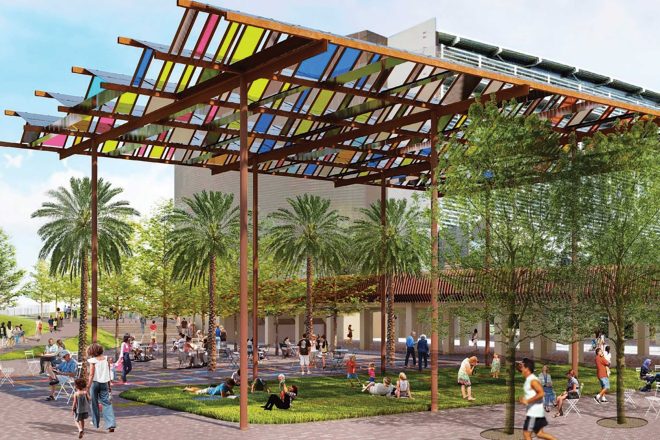
The new $60-million Shade Phoenix Plan takes on deadly temperature disparities with trees, structures and art installations.
In a city where summer temperatures routinely soar past 110 degrees, a row of big shade trees, like the mature olive and ash trees lining North Central Avenue, can feel like a luxury.
That’s the problem, says Jake Simon, director of Southwest urban forestry at American Forests, who sees the lush canopy in his own Scottsdale neighborhood as an illustration of privilege – especially compared to lower-income communities in South Phoenix that remain dangerously exposed to heat.
“We’re trying to change the conversation with cities to see trees not as a luxury but as critical infrastructure,” he says. “And I think that’s starting to happen, at least in the desert Southwest, where we’re on the unfortunate bleeding edge of climate impacts.”
Now the organization is helping the City of Phoenix launch the Shade Phoenix Plan, a $60-million, multi-year initiative (funded by dollars from the Biden administration’s American Rescue Plan and Inflation Reduction Act) to plant 27,000 native trees and build 550 shade structures – with a sharp focus on equity.
Phoenix Mayor Kate Gallego, who spearheaded the effort after the plan was unanimously approved by city council in late 2024, sees the lopsidedness in tree coverage throughout the Valley.
“We have neighborhoods along our canals and other areas where trees are really thriving that I think have become more desirable because of that landscaping – and in some cases, the trees may have brought more wealth to those communities,” she says. “With this plan, we are trying to plant trees throughout our city, including in low-income neighborhoods that have not traditionally had quite as much shade cover.”
According to Simon, the disparities are stark. “Lower-income communities in Phoenix have 36 percent less tree canopy coverage, and minority communities – regardless of income – have 45 percent less than wealthier, whiter areas,” he says.
“That heat disparity is life or death. More people die from heat in Maricopa County than from homicides in the entire state.”
Phoenix was the first city in the country to commit to American Forests’ Tree Equity Pledge, a national call for cities to ensure all neighborhoods have fair access to the benefits of tree canopy, and more than 90 percent of the Shade Phoenix Plan’s resources will be directed to low- to moderate-income areas. Simon calls the plan “a national model,” bolstered by tools like American Forests’ Tree Equity Score Analyzer, which helps identify specific parcels in need of canopy investment.
The plan also features creative elements, like ¡Sombra!, a collaboration with local artists and Bloomberg Philanthropies that transforms public art into functional shade. One installation resembles a desert tortoise; another incorporates patchwork quilt designs.
While the plan focuses on public spaces, Phoenix is also expanding shade on private properties through the Community Canopy Grant program, which provides free trees and maintenance kits to eligible residents in heat-vulnerable, low-income neighborhoods.
Gallego says she sees trees not just as beautification, but as public infrastructure. “We have seen pretty broad political support for this,” says the mayor. “Adding more trees in the desert seems to be a more widely held priority.”
Chillin’ Out
Adding shade isn’t the city’s only recent foray into promoting literal coolness. In January 2024, Phoenix launched the Chilled Drinking Water in Public Spaces Initiative, installing the first three in a series of smart water stations equipped with bottle fillers and heat-resistant technology. Strategically located in high-traffic areas near City Hall, the City Council chambers and along the Sonoran Bicycle Pathway, the fountains won the city a 2025 IDC Smart Cities Award in April.
“Having cool drinking water helps people stay healthy and safe during the summer,” Gallego says. The stations feature remote-sensing devices to monitor water usage and detect leaks and are maintained by volunteers from HandsOn Greater Phoenix. Since their installation, the pilot fountains have dispensed the equivalent of more than 116,000 average-size bottles of water.
HomeStat
1.3%
Year-over-year increase in the median sales price of a single-family home in Greater Phoenix in May 2025, according to Phoenix REALTORS data. The modest increase bucked a greater national trend across the U.S., which saw a 0.6% decrease in home values. The median price in Greater Phoenix rose to $485,000 from $479,000 in May 2024.
—Craig Outhier