After nearly 40 years and a diversity-sensitive reboot, do the James Beard Awards still matter?
You’re trying to make dinner, but the phone keeps ringing.
Mostly it’s your new friend Potential Spam calling. But then there are the endless text messages, the notifications that your Instagram feed has updated, and news that a friend has retweeted a post about that new boutique you keep meaning to get to. While you consider the contents of your refrigerator, emails are piling up and Messenger is pinging. Alexa has apparently overheard you discussing your thinning hairline and wants to chat about a special on Rogaine. The pile of packages from Amazon beckons from the vestibule.
By the time your spouse arrives home, dinner has not been prepared. “We’re dining out,” you announce. The usual discussion ensues about the best place to go.
You weigh driving distance and entrée prices and the possibility of gluten-free options. You remember that the best ramen café has closed, the good food truck is now parked in Glendale, and your favorite supper club, post-COVID, closes at six during the week.
Talk eventually turns to which restaurants have earned which awards. In 21st-century America, awards are shorthand for whether a place is “good” or not; whether we should eat there. This one has recently been handed a trophy for its dessert pizzas. That one – far across town but, you’ve been told, worth the drive – was recently on the short list for some kind of chef’s prize. And didn’t that Filipino place with the unpronounceable name just get “Best of Phoenix” for its kelp jerky or something?
What you almost certainly don’t discuss is whether there’s diversity awareness at the place with the fish tacos. You’re hungry, and what you need to feed are your empty stomach and your ego, which wants you to dine at an award-winning restaurant you can later mention on your Instagram feed. You’re probably not thinking about racial equality or whether room was made for the little guys to compete for the shiny trophies, too.
However, the nice people at the James Beard Foundation would like you to think about these things. Someone must have pointed out to them a few years ago that all of us are trying to be better about not excluding people who aren’t white and heterosexual and male, because the 34-year-old nonprofit named for pioneering chef and food writer James Beard recently retooled its mission statement. Once happy to honor cuisine and the people who make it with scholarships, conferences and an annual awards program, the James Beard Foundation is today, according to press materials, committed to “racial and gender equity, community, sustainability and fostering a thriving food culture.”
This is a good thing. Decent people want to live in a world where everyone, regardless of race, age, gender or sexuality, gets a chance to compete with other people for the pleasure of being considered better than those other people. But while the James Beard Foundation’s updated focus aims to reflect all humankind, it’s also – according to some of those still working in the local restaurant industry – kind of a sham. Some claim that all the politically correct inclusive stuff renders the awards useless. Still others fear that the foundation’s belated attempt at diversity is messing up the program’s more practical purposes: to honor hardworking chefs, and to tell people where to go when they want a memorable meal.
The James Beard Awards honor cookbook authors, journalists and television folks, but its restaurant and chef prizes get the most attention – and the process of selecting them is long, complex and opaque.
Organizers say anyone can nominate a favorite chef or restaurant, whose recommendation is vetted by a subcommittee that comes up with a list of semifinalists in each of 12 regional contests. (Arizona currently competes for honors with New Mexico, Nevada and Oklahoma as part of the Southwest region, though in past years we’ve gone toe-to-toe with the likes of Texas and Colorado.)
The foundation, which will announce this year’s winners at a June 10 ceremony in Chicago, whittles down that regional list of semifinalists with votes from a hand-selected group of local culinary professionals – more than 600 nationwide participate – to come up with five official “finalist” nominees. Then a new group of judges scores each nominee on criteria specific to that category, based on tastings and discussions, organizers say. Following more alleged tastings and still more group discussion, winners are determined by judges and subcommittee scores. They receive a medallion etched with James Beard’s face and a whole lot of national publicity.
“But right now, the James Beard Awards are in the middle of a learning curve,” says acclaimed chef and former Rancho Pinot owner Chrysa Robertson. “And they’re stumbling badly.”
She’s referring to the concerns of local culinary types about a new Beard Awards judging system that’s maybe a little too fixated on whether the organization appears inclusive enough and less concerned with awarding food innovators and pioneers. And there are whispered allegations that Southwest region voters are routinely asked to choose among restaurants they’ve never visited and chefs whose food they’ve never tasted.
Such was the case in 2022, according to one Arizona voter who asked to remain anonymous, when voters from the region’s four states assembled on a Zoom call to share their impressions about the region’s finalists – in particular, the five finalists for Best Chef: Southwest.
“[The foundation] sent us online documents, and we voted based on how we felt after the Zoom call,” claims the voter. “It felt like a shot in the dark. The award that was most shocking [was] the New Mexico guy [eventual Best Chef winner Fernando Olea]. Only one of us had eaten at his restaurant, and it sounded like that judge had only eaten there one time.”
James Beard vice president of awards Dawn Padmore says this couldn’t have happened. She didn’t offer information about how it’s possible for so many judges to dine at so many restaurants, only that they must, and that they do.
“Judges,” Padmore insists, “are required to eat at the restaurants they score. Because of this requirement, judges are given a stipend for dining out.”
The anonymous Phoenix judge concedes they were given a stipend, but it was “like $300” – not quite enough to fly around the Southwest on a food tour.
Robertson is less worried about all this voting procedure stuff than she is that the James Beard Foundation may have forgotten its original purpose: to celebrate truly special food. Besides, she says, the Beard people have lately been acting a little weird.
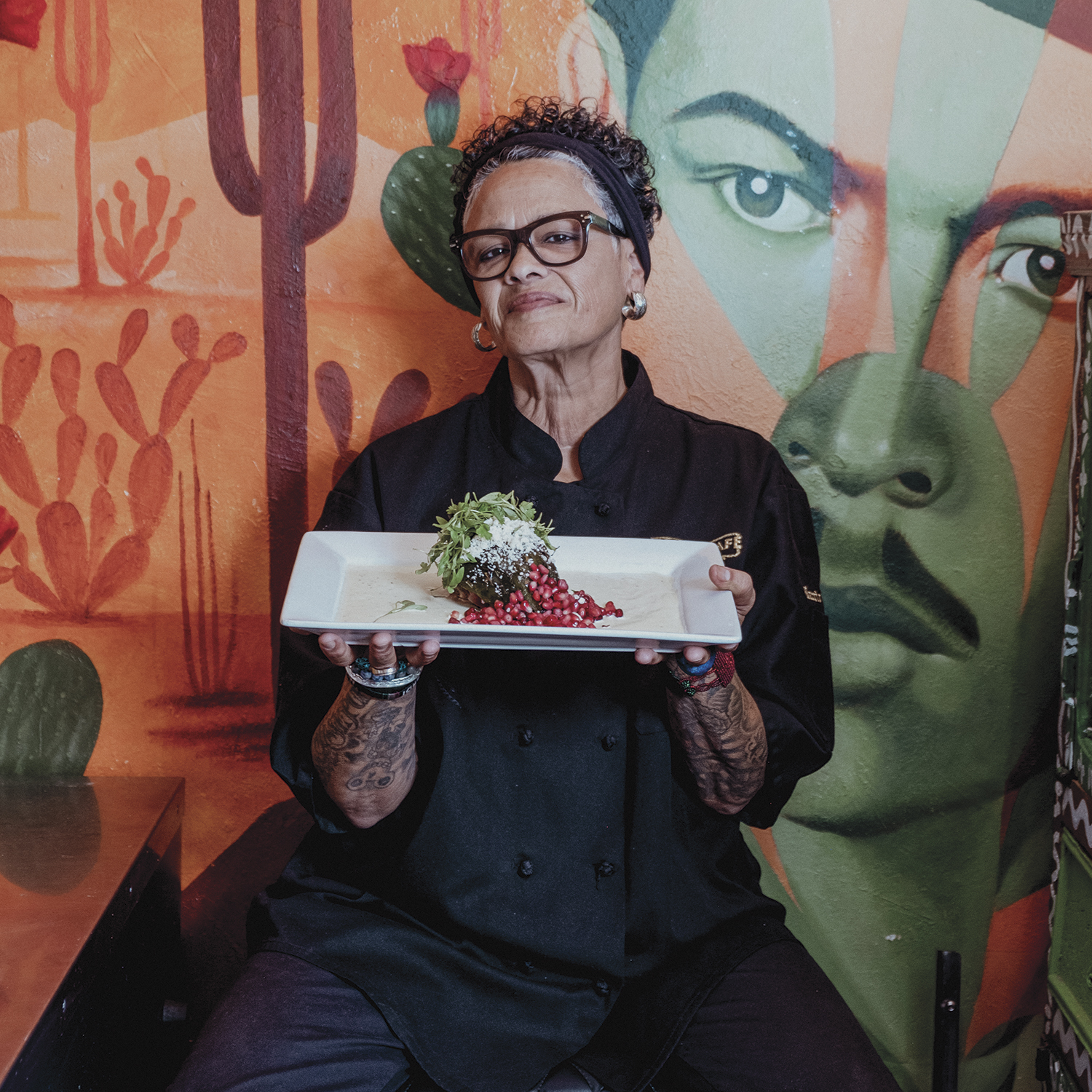

“It used to be that chefs got a phone call congratulating them for getting nominated,” she says. “Now, I hear they’re getting phone calls from someone saying, ‘We saw on Yelp that you yelled at a customer.’ What does that have to do with anything? Why are the James Beard people monitoring behavior? I think it’s because there’s no clear mission anymore.”
Robertson was a finalist for a James Beard Award in 2020, that loathsome pandemic year when restaurants were shutting down, sometimes for good. That was also the year, according to Padmore, that the organization’s policies and procedures were audited “for the purposes of removing systemic bias, increasing the diversity of the voting body,” and a lot of other very worthy 21st-century inclusive ideologies. The goal, Padmore says, was to create an awards program accessible to more workers in the culinary world.
2020 was also the year Robertson was told the awards ceremony would be virtual and was asked to record a video acceptance speech in case she won.
“It was horrible,” she says with a laugh. “I had to act like I’d won and answer a bunch of dumb questions about myself. Silvana [Salcido Esparza of Barrio Café] was also a finalist, and she’s such a good chef, I thought [for] sure she would win.”
Robertson never got to find out, because that was the year the Foundation canceled its awards program. The finalists remained finalists.
“They never even called to tell me,” Robertson says, still laughing. “Which was fine, especially now that they’ve gone totally wacko with the inclusion stuff, so you have to check all the politically correct boxes in order to be considered. Forget it.”
Robertson is referring to the notion – shared by some members of the local culinary scene and by at least one Beard Foundation judge – that the organization’s interest in inclusion is getting in the way of honoring its most accomplished members.
“I want inclusivity,” says another anonymous food industry worker too scared of culinary-world repercussions to see her name in print. “But they’ve taken a lot of heat for the race issue, which is why you’re seeing little bakeries, little [mom-and-pop] restaurants, little ethnic places win most of the Southwest region nominations since 2022.”
That’s the year the now-presumably-more-compassionate awards returned, after asking each of its judges and voting committee members to watch a series of short videos ostensibly designed to make them more inclusion-aware.
“I think they were 10-minute videos,” the anonymous judge says. “I know we watched at least five of them. One was on gender bias, and one was about confirmation bias. There were others. The confirmation bias one I actually thought was worthwhile, because yes, admittedly I do tend to like expensive restaurants run by white guys. So, it gave me some awareness of that.”
There’s no evidence that any Beard judge was asked to diversify their semi-finalist list, but the message was at least implied by the group’s new approach: “We’re a kinder, gentler organization now. Watch this video to find out how.”
Perhaps in 2020, the James Beard folks were recalling the then-recent #OscarsSoWhite controversy that led to boycotts of the Academy Awards. Then again, Beard had no long history of handing prizes exclusively to white guys. While only two of Arizona’s 12 all-time best chef finalists have been women, and if a little more than half of them is Caucasian, consider this: A Harvard Gazette study recently found that of 147,434 chefs working in the U.S., 25 percent are women, and 55 percent are white.
None of that is relevant, according to renowned chef Silvana Salcido Esparza, who for more than two decades owned Phoenix’s Barrio Café.
“I never expected to even be nominated since their history was rooted in white, cisgender male supremacy,” she says of the Beard Awards. “Once I was nominated, I never expected to win. Never. Why? Their history.”
In 2019, as keynote speaker at a Beard Foundation event for women in the culinary arts, Salcido Esparza called out the organization from the podium for its “elitist white-male centrism.”
“That felt good,” she says. “I also called out their lack of queer representation. James Beard was queer, but at that time the foundation that honors his name did not have LGBTQIA2S+ representation.”
Nonetheless, Salcido Esparza, an out queer Latina, says she found the Beard Foundation’s subsequent efforts at inclusivity offensive.
“It was performative,” she says. “A way to earn cultural currency without doing the work.”
Had she won that Best Chef Southwest award in 2020, she had a plan.
“I wanted to go to Chicago that year. I would have told them off from their stage and would have dedicated the award to the field workers that are in the shadows of the industry. ‘Farm to table’ is white privilege. It never gives tribute to those migrant workers.”
Robertson, who’s white, knows how she sounds when she carps about the Beard awards.
“I’m all for inclusion,” she says. “And it’s not sour grapes on my part. I hate awards, and they’re not why I opened a restaurant. But I’m remembering when James Beard Awards went to chefs like Christopher Gross and RoxSand [Scocos McCreary of RoxSand Restaurant and Bar], and not given to people who run a hush puppy booth on the bayou, because we need to include little ethnic places because they’re little and ethnic, and not because their hush puppies are any good.”
Longtime Valley restaurant critic Howard Seftel also remembers those white-linen-table-cloth days.
“When James Beard first started, it was kind of a Michelin Guide thing, and not for mom-and-pop diners or ethnic food. Then in 2003, Chris Bianco won Best Chef Southwest, and the reaction was, ‘You gave it to the pizza guy?’”
But giving the prize to the pizza guy was a good thing, Seftel thinks, because it signaled that the Beards were celebrating good food and not just fancy five-star contenders. Where the Beard foundation went astray, he says, was in focusing on its contest.
“People love a contest,” he says. “But the competition part has far overshadowed the idea of honoring people who are making good food. That’s not a great thing.”
Seftel blames the popularity of television cooking shows. The Beard Awards took off just as the Food Network was catching on, he says. When viewers tired of watching Bobby Flay flash-frying hearts of palm, competition shows like Chopped and Iron Chef, which pitted chefs against one another, became the new standard.
“The contest shows changed the way people thought of chefs, and the way people saw awards like the Beard Awards,” Seftel contends. “Now, when a lot of people hear about chefs, they think about food as a contest.”
Where food contests are concerned, local culinary artists have scored high with James Beard. Or at least they used to. Between 1990 and 2007, Arizona racked up an impressive nine Best Chef wins – Bianco, Gross and Hai Noon’s Nobuo Fukuda were among them. But then came an 11-year Sonoran dry spell finally broken by FnB’s Charleen Badman in 2018, the last Arizona chef to win. (This year’s Arizona finalists are Rene Andrade of Bacanora, who’s up for Best Chef Southwest, and Valentine’s Crystal Kass, nominated in the Outstanding Pastry Chef or Baker category.)
“There were great chefs working here those years we weren’t winning,” Gross says, citing Matt Carter of Zinc Bistro, James Porter of TERRA Farm + Manor and Rochelle Daniel of Atria in Flagstaff. “But if your name doesn’t make the ballot, you don’t get to play.”
Seftel thinks that if some of our more deserving local chefs haven’t gotten past the qualifying heat for a while – Beard largely depends on local food writers to scout and promote a given state’s list of semifinalists, then different experts to vote on the full regional list – it may be for a simple reason.
“Judges are people,” he points out. “Some judges have agendas or prejudices they can’t look past. Some of them are going to vote for their friends, and some aren’t going to vote for the best chef in the world if they don’t like that chef personally. Welcome to Planet Earth!”
For this reason, it’s possible that Arizona has done badly in recent Beard contests because its semifinalist scouts, organizers and voters were simply out of sync with each other, relative to other states.
Seftel recalls judging a recent big-deal foodie competition where one of the judges was an environmental activist. She hated every entrée she didn’t deem “sustainable.”
“But they asked her to be a judge,” Seftel says. “A contest is a contest is a contest, and judging is part of any contest. And then there’s a winner.”
A win like this one can change your professional life, according to Gross. “When you win, you’re noticed nationally,” he says. “That’s great for business, and it lets you afford more truffles and foie gras. I always think of an award as being flattered by my peers.”
Yet Gross isn’t convinced that the changes at Beard are all that.
“They’re not necessarily looking for the best player anymore,” he says. “Now they look for a talented chef who fits into all these other categories that aren’t about pure talent.”
Casting a wider net might not be entirely fair, Gross thinks, because pitting small up-and-comers against the likes of a superstar like Kevin Binkley at Binkley’s – which announced its closing shortly before this issue went to press – or new hot spots like Dom Ruggiero’s Fire at Will doesn’t always make sense.
“There might be a really great, talented chef at a new place,” he reasons, “but if you nominate them because you’re looking for a smaller [place with a] lower price point, you’re not helping them out. Maybe they’re more of a café than a fine dining place, and they shouldn’t have to compete with a chef who’s been cooking for years.”
Always quick to be fair-minded, Gross says that on the other hand, the revamped awards may have gained in meaning by including lower-budget restaurants in the mix.
“But then, when you’re honoring smaller places, you’re honoring the people who work at less-expensive places. I spoke with the foundation, and I said, ‘You can’t just acknowledge the big places, the Michelin three-star places.’ Maybe they listened.”
Seftel agrees that there’s no downside to broadening any search for “best.” But he worries about adjusting standards for the sake of being woke.
“We’re living in an age of restaurant buzzwords that have positive connotations but don’t actually mean anything,” he says. “But if you say those words, people respond: ‘Indigenous, local, seasonal, authentic.’ We should be careful about celebrating without thinking about the matter at hand. In this case, that’s good food, not whether we’re being inclusive enough. Whatever that means.”
Robertson is concerned about the foundation’s legacy.
“What are they celebrating?” she asks. “James Beard was a gourmand and a bon vivant. He wanted everyone around his table, regardless of gender or age or where they came from. The group that’s using his name are trying so hard to be ‘good’ that they’ve lost the message of the award. And that message should always just be, ‘Look at who made the best food last year.’”