Next year’s Super Bowl is bringing the issue of sex trafficking to the fore in Arizona. The truth is more complicated: It’s been with us all along.
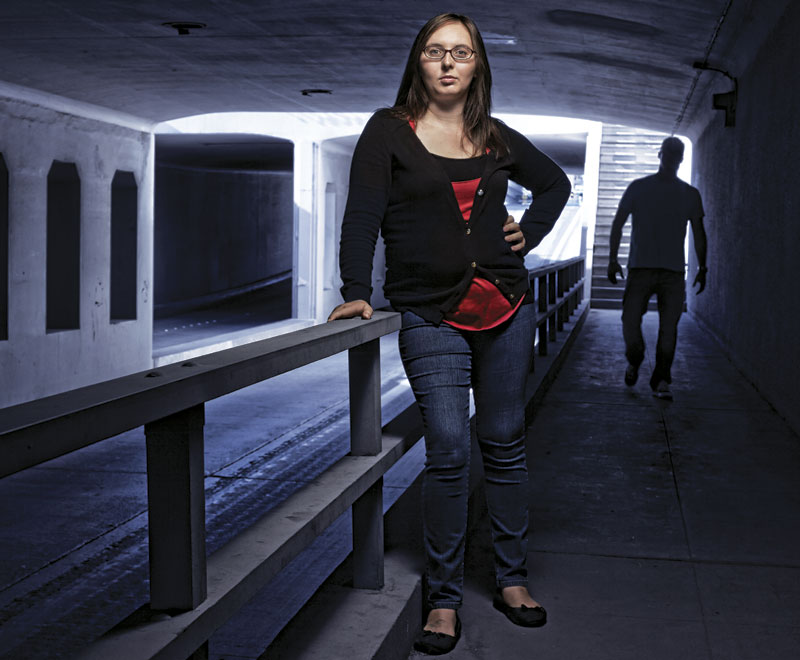
Savannah Sanders doesn’t stand out in the crowd at her office’s sunlit café. Like many a busy modern woman, the wife and mother of four fields phone calls while eating a salad – juggling her job with volunteer work and graduate school. Her cherubic face and soft-spoken, direct demeanor do not whisper of trauma. None of the businesspeople breezing by would suspect she was sex-trafficked at 16.
Like most kids snared into this sordid underworld, Sanders was raped at a young age. Spiraling in silent shame, she dabbled in drugs, sliced herself with razors and ran away repeatedly. Vulnerability wafted from her like perfume. One night at a sleazy sex club, a pimp caught the scent. He invited her to his place, sat her on his couch, placed his hand on her back, “and he told me I’d be working for him,” she recalls. “By the time I was trafficked, that’s all I thought I was good for.”

The pimp put his finishing touches on her total objectification. While he trained her to service men, he forced her to sleep behind a couch and ask permission to use the bathroom or even speak. He promised her monetary independence, but when men paid to have sex with her, he pocketed the cash. He said she’d have her own place but dragged her to different apartments, his grip on her tight as a blood pressure cuff. “I just never ran,” she says. “I was scared to death of him.”
Today, when Sanders talks about human trafficking – at government conferences, on TV, in line at the grocery store – people pepper her with questions: That’s smuggling people over borders, right? Doesn’t that only happen in Thailand? No, she tells them.
Human trafficking – which can consist of labor or sex trafficking – is forcing a person to work against his or her will. It is 21st-century slavery. Borders are not necessarily involved; people can be trafficked from their homes. The Department of Justice estimates around 80 percent of sex trafficking victims are American citizens. “I’m a perfect example of it happening here,” Sanders says. “I lived here [in Phoenix], and it happened to me here.”
Worldwide, human trafficking generates an estimated $32 billion annually – more than Google, Nike and Starbucks combined. Every year in the U.S., as many as 300,000 children may become sexually exploited, according to the DOJ. The average age a child is sex trafficked in America is 13.
No one knows how prevalent this epidemic is in Phoenix, since only a fraction of crimes are reported. But the Valley is believed to be a sex trafficking hub because it has all the risk factors: It’s a large urban area with convenient transportation corridors that attracts tourism and major events, including the upcoming Super Bowl, once considered the country’s No. 1 hotbed for sex trafficking. Arizona State University researchers say one in 20 men in metro Phoenix solicits online sex ads, and many of the “escorts” are trafficked.
Cloaked by the Internet, the scourge is spreading rapidly through suburban homes, schools and posh resorts. It will take more than an act of Congress to abolish this 21st-century slavery. Fortunately, numerous Valley organizations have a plan.
 Walk around the StreetLightUSA shelter, and you will see cottages with names like Hope and Believe encircling a grassy area with a jungle gym. You’ll see young girls hanging out and laughing, looking like students at any junior high or high school. A bubbly girl with baby-fat cheeks doing ballerina twirls as she chatters away. A serious girl trying to shoehorn in questions about her classes. Bashful girls waiting for their conversational cues.
You will see all these things, because you are not a sex trafficker. This Glendale shelter – the first and largest of its kind in the nation – offers temporary housing, schooling and counseling to sex-trafficked girls ages 11 to 17. So only a few days or weeks ago, a trafficker looked at each of these girls and saw one thing: prey.
Media like to portray traffickers sharking through malls, preying on pretty innocents with magazine-cover dreams. The sentiment behind that scenario is technically true: This can happen to anyone. But pimps are unlikely to target self-respecting daughters of happy families. If they wanted to work hard, they wouldn’t be pimps. “I’m not saying it doesn’t happen,” Sanders says, “[but] I actually don’t know anybody that’s been picked up in a mall.”
Rather, the majority of exploited children are at-risk: homeless, runaways, foster care kids, gang-affiliated kids, sexually abused kids, kids from broken or neglectful homes. A shocking number of girls and boys are trafficked by their parents.
Like lions looking for the weakest in a herd, traffickers scope out the hungry, the emotionally drained, the addicted, the abused, even the disabled. There’s an 11-year-old special-needs girl at StreetLight who couldn’t comprehend she was being trafficked via her smartphone. People she met online asked her to film herself performing various acts, then sold the videos.
When trapping their prey, traffickers focus on pressure points: trust, low self-esteem, the need for something – love, attention, independence. They’re often gentle at first. Then when they need to, they push the pressure points to bring their victims down. Take the girl at StreetLight who at 12 years old had been repeatedly bullied. A 20-year-old predator flattered her and pretended to be her boyfriend. Then he told her that if she loved him, she had to be with his friends (read: customers). He expected her to have sex with more than three men a day. If she refused, he beat her.
Traffickers psychologically padlock their victims through tactics like trauma bonding, demoralization and threats: If you leave me, I’ll just get your little sister. “There are probably a lot of traffickers who know more about psychology than the average psychology professor,” says Kimberly Klein of the O’Connor House, a social justice nonprofit.
They also know about abuse and captivity. The majority of victims are beaten, gang-raped or tortured by pimps and johns. In an unusually bloodcurdling case in 2005, Phoenix police found a 15-year-old who’d been locked in a dog crate for 42 days and forced to have sex with more than 200 men. This was not a “working girl.” And her pimp wasn’t “ghetto fabulous,” as Jay-Z sang in “Big Pimpin’.” She was a slave. And he was a slaver.
All of this is why advocates discourage the term “child prostitute.” Invoking the world’s oldest profession suggests victims choose this as a job. But multiple studies reveal about 90 percent of prostituted women want to escape. “We talk about prostitution being a victimless crime,” Klein says. “But if a high percentage of individuals who are engaged in commercial sex are defrauded or forced or coerced into it, is it a victimless crime?”
It’s something to keep in mind while perusing Backpage.com, the best-known site for commercial sex ads. Many of the women – and some look younger than their professed 18 – express their fondness for pleasing men, accessorizing their enthusiasm with smile-and-wink emoticons. But how many of these girls are actually being trafficked?
That’s one of the questions ASU’s Office of Sex Trafficking Intervention Research posed in its investigation of the 2014 Super Bowl. And they were surprised by what they found.
The Super Bowl is “commonly known as the single largest human trafficking incident in the United States,” Texas Attorney General Greg Abbott announced when Cowboys Stadium hosted the event in 2011.
Journalists pounced on the statement like linebackers on a quarterback, and awareness spread like a stadium wave. Numerous states started tackling human trafficking, with Arizona emerging as a national leader. In the last four years, the number of anti-trafficking organizations statewide has jumped from about 25 to nearly 150. Thanks to their efforts, Phoenix is now “light-years ahead” of other cities when it comes to combatting trafficking, Klein says.
In 2011, the Arizona Attorney General’s office formed the Underage Sex-Trafficking Coalition, which is currently enlisting local sports figures to speak out against purchasing kids for sex. In April 2013, Governor Jan Brewer and Cindy McCain co-created a statewide Task Force on Human Trafficking. That December, Phoenix Mayor Greg Stanton initiated a trafficking task force in the Valley, in anticipation of hosting the Super Bowl this February.
Recommendations from Brewer’s task force spawned HB 2454, which went into effect this July. The law increases penalties for traffickers, prevents johns from claiming they “didn’t know she was under 18,” regulates advertisements for massage therapists and escort services, and makes using an image of a minor in a commercial sex ad a Class 2 felony.
Then last spring, ASU released its game-changing study (see sidebar). Though the researchers acknowledged that commercial sex solicitation – and other crimes – spikes during major events, they “found no evidence indicating the 2014 Super Bowl was a causal factor for sex trafficking.” Rather, sex trafficking is a perennial problem with tendrils that touch every corner of the country, every day.
So the Super Bowl was off the hook. But by then the anti-trafficking juggernaut was unstoppable. At a press conference in July honoring HB 2454, Vice Mayor Jim Waring stressed that the law and task forces did not start – and would not stop – with the Super Bowl: “This [law] is to make sure that human trafficking is not acceptable at any time, at any place in the state of Arizona… We want to be a model on this issue for states around the country.”
That zero-tolerance thinking is the idea behind the O’Connor House’s new SAFE (Safeguarding Adolescents From Exploitation) Action Project to keep trafficking out of Arizona hotels.
 Up until 10 years ago, sexual commerce clotted along infamous avenues and in sleazy motels. Now it pulses through cyberspace. “There are multiple websites where you can place your order [for a person] like a pizza,” says Sarah Suggs, President and CEO of the O’Connor House. Men can click on characteristics like toppings – age, hair color, ethnicity, body type – press send on their smartphone, and have someone show up at their room almost as quickly as pizza delivery. There are even john boards that feature Yelp-style reviews of rentable girls and boys.
As a result, commercial sex spread to posh resorts, to suburbia, to “wherever you are and wherever you’re willing to meet,” says Klein, SAFE Action Project manager. “We know of cases in the little mom-and-pop 10-bedroom motel off I-17 all the way up to your five-diamond resorts.”
“The customers are from every ZIP code and every socioeconomic level,” Suggs says.
This makes crackdowns difficult for law enforcement. So the O’Connor House is training hotel staff throughout Arizona to be the eyes and ears for the vice squad. This spring, the SAFE Action Project conducted 10 trainings of 660 hospitality staff; their goal is to complete 60 more before the Super Bowl. Next, they want to expand education to rental car corporations, taxi companies, airport employees – and you. Their Socially Responsible Traveler initiative, which they hope to unveil in October, will educate regular people to spot the warning signs of sex trafficking and take the appropriate steps to report it. “We want to make sure we’re putting together a whole community of people working on this,” Klein says.
But despite Arizona’s armamentarium of resources in awareness and law enforcement, victims of sexual slavery still lack the support they need.
It’s 7 p.m. at StreetLightUSA, and Lea Benson sits in her tiny, shared office, texting her husband that she’ll be late again. On her desk is an open can of fruit – all she’s had time to eat today. “Serving as president and CEO, I’ve done that 5 percent of my time,” she says. “Most of my time is with the girls. Because we don’t have enough staff.”
StreetLight gets volunteer offers, but working here isn’t for everybody, Benson says. “This is a very emotionally tiring job. A female teen is drama. Each caregiver has eight. So when one escalates, it’s a lot of work. It can be four to six hours to get that kid to de-escalate.”
Someone is sexually assaulted in America every two minutes, according to the Rape, Abuse and Incest National Network. Most of us know someone who has suffered sexual abuse and must live with the aftermath. But few of us can fathom the anguish of these girls, who have been raped hundreds or thousands of times.
“The girls test you when you first get here,” Benson says. “They want to know you care. So they throw every obstacle in front of you, tell you they hate you… They’ve been through so much, so they want to know that if they put their trust in someone, it’s going to be someone that’s gonna stick it out.”
Girls stay here an average of four months, going to school on- or off-site. Since most have never had decent role models, they often need to be taught hygiene, life skills and even basic anatomy. The shelter partners with the community, so Phoenix Children’s Hospital does weekly medical treatments, ASU and Mayo Clinic’s Obesity Solutions partnership teaches them nutrition, and Aveda does their hair. But much of the focus is on building hope and self-worth through art, creative writing, counseling and sisterly support.
“We help them understand trust again, because they’ve not known trust,” Benson says. “We help them understand what love does mean. [We tell them] ‘You do matter.’”
They’ve had successes – honors students and girls who go on to college. But Benson says, “We measure success in many different ways. If a child was never able to smile before, and we got her to smile. If we got her to say, ‘I understand there are people who care.’ These are success stories, just as much as the ones who are in college.”
StreetLightUSA needs to expand, Benson says, but they can’t afford their current intake of girls, much less a full-time fundraiser or grant writer. They’d like to buy surrounding acreage and add another 32 beds to their current 48; a treatment center, which would give them the licensing status to make counseling compulsory; a multipurpose educational facility; a vocational school; and transitional housing so girls can continue to feel supported and act as mentors to newcomers.
Meanwhile, they soldier on. In 2013, StreetLightUSA provided refuge for 131 girls. Given that each trafficked girl is expected to perform up to 10 times a day (sometimes more), the shelter estimates they prevented a staggering 65,000 rapes that year. This year, they hope to help twice as many girls escape sexual slavery.
Savannah Sanders stands out in the crowd at the HB 2454 press conference – as a survivor.
Speaking in front of a gathering of politicians, media and fellow advocates, she celebrates how far the system has come in the decade since she was trafficked: “In 2003, there were no services for underage trafficking victims, and there were no laws protecting us… Because of the perceptions around prostitution, and not seeing victims as victims, it was very possible for us to get picked up by police, taken to jail and charged. And the person that would be waiting for us outside of jail were the pimps.”
Sanders has also come far in the last decade. Today, she works for several anti-trafficking organizations, including TRUST, a collaborative effort to fill gaps in Arizona’s resources. Some of the biggest gaps, she says, are prevention education in schools, shelter beds for women ages 18 to 25, and any support for male victims. She also helped increase the number of service providers and law enforcement officers responding to the National Human Trafficking Resource Center hotline throughout Arizona. She is writing a book about her journey, Sex Trafficking Prevention: A Trauma-Informed Approach for Parents and Professionals, to be published in April.
Most importantly, Sanders has freed herself from 21st-century slavery, with the help of her loving husband and children. “I know how important it is for survivors to get the support and love they need,” she announces to the assembly. “I was able to get it in my own life… I have a life that I love, which I never thought was possible. And I feel that with the momentum we’re making and the changes that are occurring, we can really bring the freedom to other survivors that I’ve had the opportunity to feel myself.”
National Human Trafficking Resource Center hotline: 888-373-7888
Super Bowl Study
For 10 days surrounding the 2014 Super Bowl in New York, ASU researchers placed decoy sex ads in New York, New Jersey and Phoenix. Their results:
1,457: voicemail or text contacts from the New Jersey/New York ads
978: voicemail or text contacts from the Phoenix ads
38: websites advertising suspected underage sex trafficking victims
83.7: percent of ads in northern New Jersey whose subjects were likely to be victims of commercial sexual exploitation
Some Warning Signs of Sex Trafficking at Hotels
>> Non-guest minors who are dropped off at the hotel or visit repeatedly over a period of time.
>> Minors dressed inappropriately for age or weather, and/or wearing lower-quality clothing than companions.
>> A minor who appears to be with a significantly older “boyfriend” or in the company of older males.
>> Excessive foot traffic in and out of a room.