I wasn’t surprised to hear, earlier this year, that Steve Schumacher was on the hunt for a children’s book about the founding of Phoenix. I figured that, as the mayor’s office official historian for the city, Schumacher was always looking for such things.
“Not really,” he tells me. “It came out of a conversation with Mayor Kate Gallego, right after she appointed me. She said, ‘I want my 6-year-old son to understand the city he’s growing up in.’ I had a vision of her sitting on a couch, reading this book to him, and I went looking for it.”
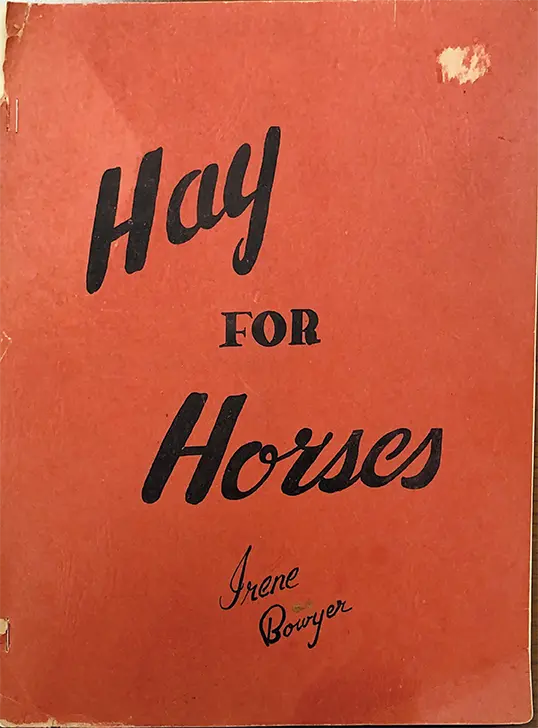
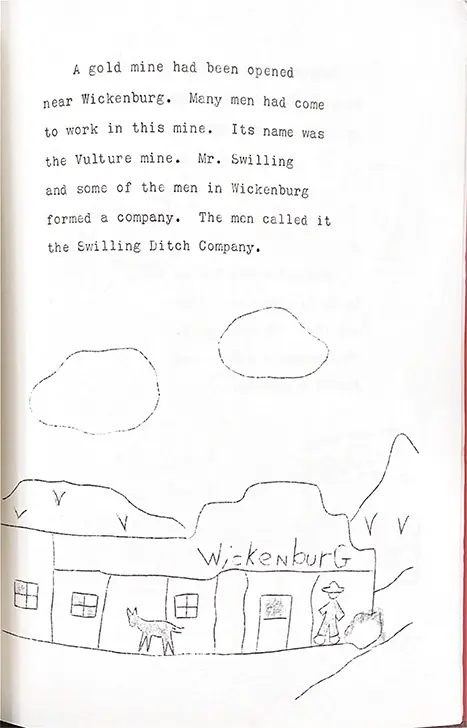
Schumacher was surprised to discover that there was no such book out there. What he eventually found – on eBay, of all places – was Hay for Horses, an unpublished, handmade book about the founding of Phoenix, written in 1950 by a schoolteacher named Irene Bowyer and illustrated by two of her students. The line drawings, done by an 8-year-old and a 10-year-old, are basic – stick-figure people and horses, simple sketches of bales of hay – though the first-page portrait of the Capitol building is pretty keen.
The story mostly gives credit for the city’s founding to rancher Jack Swilling, with a couple of sentences about the Native Americans (referred to in the text as “some Indians”) who’d created the canal system around which Swilling built Phoenix.
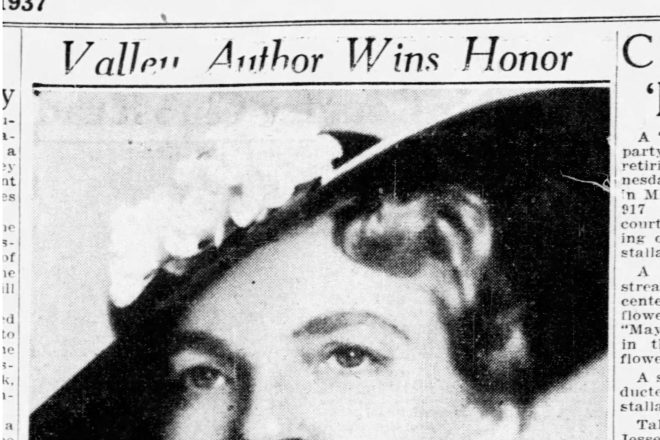
“It looks like it might have been a school project,” Schumacher tells me about the book, which the eBay seller found at Phoenix’s VNSA Used Book Sale a few years ago. “Irene Bowyer worked at I.D. Payne Training School at Arizona State Teachers College, which later became ASU.”
Schumacher made copies of Bowyer’s book and took it to a pair of local school districts. He thought children would like the idea of drawings of Phoenix made by kids 75 years ago. The district folks agreed, and Schumacher has taken the book to classrooms at Garfield, Maie Bartlett Heard and Capitol elementary schools, where a district employee reads it to them.
“The response has been great,” Schumacher says. “The kids love seeing a book that’s about where they live, and one that looks like something they would have made.”
He doesn’t know what became of Bowyer or her students, Beverly Watkins and Noel E. Frank, who illustrated this book. “I think I found the boy,” he says. “He owns a mechanic shop in Texas, but he hasn’t answered any of my emails.”
Schumacher hopes Hay for Horses will be adopted by all local districts next year. In the meantime, he’s glad he’s gotten to share it.
“If I don’t accomplish anything else in my life,” he says, “I’ve gotten to share this little bit of our history with children. And, let’s face it, they’re the people who will be running this city pretty soon.”
– Robrt L. Pela
Read it: Forgotten Phoenix
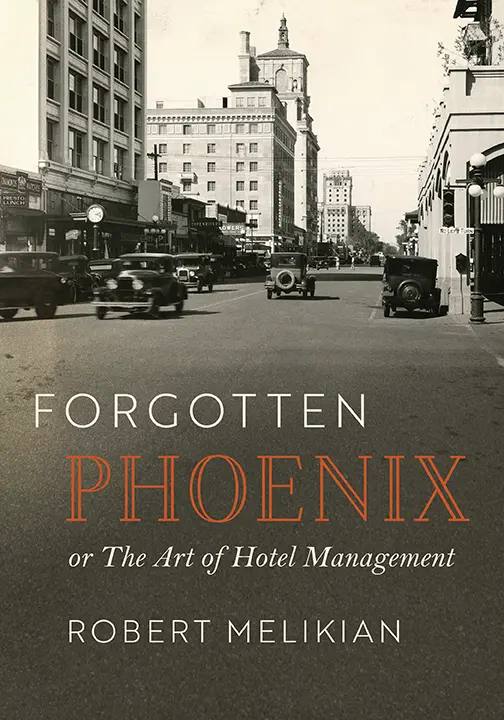
With its extreme heat and extreme sprawl, Phoenix does not rank among the country’s most walkable cities. But that wasn’t always the case, says Phoenix lawyer and historical preservationist Robert Melikian. In his latest book, Forgotten Phoenix or The Art of Hotel Management (Martin Book, $24.95), Melikian delves into his personal history along with the city’s to reveal an urban center that was once bustling with foot traffic at all hours. After moving to Phoenix from New York City, Melikian’s parents purchased the historical Hotel San Carlos in 1973. He shares family photos along with reminiscences of a waning Downtown viewed from the hotel’s front desk and from his nightly walks in the 1970s. Melikian contrasts the city core of that era (and from today) with historical photos and stories of its buzzy beginnings in the 1920s. Forgotten Phoenix is a must-read for urban studies enthusiasts, local history lovers and anyone who wants to understand the evolution of Downtown Phoenix. It’s available at Changing Hands, Phoenix Art Museum, Arizona Capitol Museum and online.
— Leah LeMoine