by Leah LeMoine | Photography by Jill McNamara
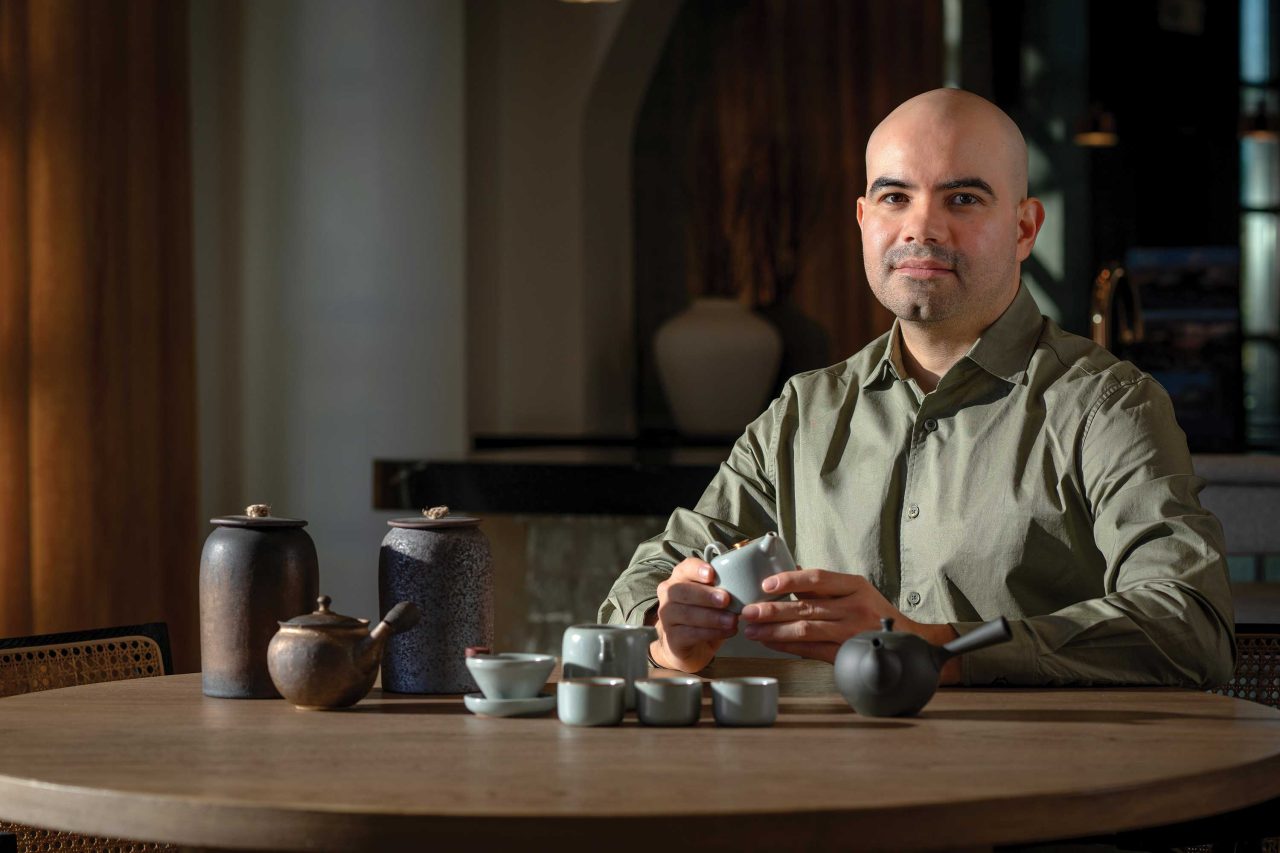
Don’t offer Jorge Rizo iced tea. “Hot tea always,” he says emphatically. As a certified tea sommelier, Rizo has dedicated his adult life to the world’s most consumed beverage (beyond water). “Tea is an incomplete art,” he says. “So, we approach it constantly when we create a teacup, when we create tea, when we serve it, when we do the process, when we slow down.” Rizo has pursued this ever-evolving art around the world, studying tea rituals in China and Japan and working on a tea plantation in India. Now, he lives in Scottsdale and serves as a tea consultant for restaurants (Phoenix’s Valentine) and cultural institutions (Mexico City’s Museo Franz Mayer), hosts a tea podcast and even authored a book on the history of tea in his native Mexico. Rizo chatted with us about everything tea, from food pairings to mindful preparation.
What started your journey with tea?
The link that I have with tea started when I was very little. The family of my father is from Chiapas, Mexico. That is [on] the border with Guatemala, and there are a lot of Afro descendants in the area – a lot of Santería, a lot of remedies, herbal remedies. My aunts are midwives, and a lot of my uncles are into Santería. So, for me, since I was very little, I started to connect with herbal remedies… I saw tea always at home. And tea has this beautiful understanding that it’s always home, that it’s always a remedy, that it’s always something cozy that your mom gives you to feel better.
How did tea come to Mexico?
Once the Spanish conquered Mexico, the contact with Asia started. [Chinese merchants] accepted only silver for the trade, and the Mexican silver had a lot of quality, [so] in the middle of the 1700s, tea arrived to Mexico. The late 1800s was the first blooming of tea in Mexico, because all these big temperance movements around the world that started in England also [spread] here in the United States, and then in Mexico, to build a more sober society. How will we bring all these men to the table around these families in a sober way? Tea was the way.
Tell me about your work with restaurants.
With Valentine, I had a session [where I advised on] how to bring two or three more options that aligned with the menu… but also to grade the tea that they have, so they can see if they are paying for what they get… It’s [also] very important to store tea correctly, depending on the type of tea and the amount of tea that you will have, and also how to train the staff. You can have an amazing tea, but if you don’t prepare it correctly, it’s lost.
Any favorite tea pairings?
Japanese green tea is great for sushi, great for white fish, great for sashimi… We see matcha everywhere, but it can be paired with sweet desserts, for example, like marzipan desserts, nuts, things like that… If [black tea] is a little smoky, that is my favorite. Like a lapsang souchong – you can pair it with red meat. Assam, that is the specific black tea from India, can be paired with blue cheese and very strong cheeses. With mild cheese, I recommend white tea… It can be [served with] something with peach [or other fruits], because it’s very peachy, white tea.
Is it challenging to get coffee-obsessed Americans to open their minds to tea?
Definitely it is. But I think that the way to approach tea here in the United States culture is the slowdown… to slow down, to really appreciate the moment, to let the culture of tea get into your life. The [Japanese concept of] ichi-go ichi-e – one moment, one time, one meeting, this irrepeatable moment in life that we all have. And also the wabi sabi, the imperfection – the beauty in imperfection.