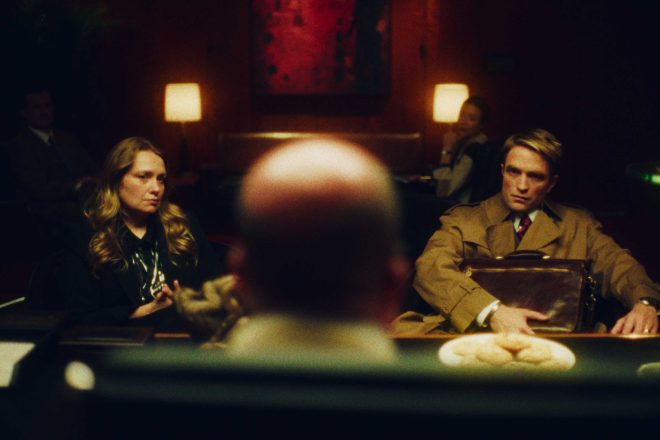
Here are three of the big movie releases opening on Christmas Day:
Babygirl–Nicole Kidman plays Romy, head of some Amazon-like company. She’s married to a sweet theatre director (Antonio Banderas) and they have two daughters and a penthouse and a country house. But she’s unfulfilled in her sex life with the gentle, unadventurous husband, and sneaks off to watch domination porn by herself after they make love. It isn’t all that surprising when she stumbles into an affair with a much younger intern (Harris Dickinson) at the office, and he’s soon got her on all fours, eating doggie treats out of his hand.
This may not seem like the most opportune moment in our history to make a movie about a powerful woman getting in touch with her inner submissive. But what a person finds hot is what they find hot, and it’s important not to over-politicize sexual fantasies and, above all, not to lose our sense of humor about them.
And indeed, Babygirl is at its best when it’s funny. The movie is a self-conscious homage to ’80s and ’90s erotica like 9 1/2 Weeks or Basic Instinct, which the talented Dutch writer-director Halina Reijn reportedly adored, rather guiltily, as a youth. Reijn’s dramatizing of how such fantasies might actually play out in reality between two mortified, sheepish but still turned-on people is amusing, but also somehow plausible.
Babygirl has some strong scenes, and it stays with you because of this filmmaking intelligence, and because of Kidman’s witty performance; Romy is simultaneously game and hilariously inhibited. But it also feels slow and oppressive and cautionary. It’s too much of a tease to qualify as Bergmanesque drama, but Reijn doesn’t seem to want to let the movie swing far enough into campiness to be sustainably a hoot. Romy finds satisfaction in her outrageously reckless affair, but we in the audience may find it a little, let’s say, anticlimactic.
Nosferatu–There’s a nerviness to remaking a unique masterpiece like F.W. Murnau’s Nosferatu: A Symphony of Horror. The 1922 silent – an unlicensed adaptation of Stoker’s Dracula, with the characters’ names changed– is probably the original vampire movie, and it remains one of the greatest horror pictures, with a bleached-bone atmosphere of inescapable dread that has rarely been matched. The bald, rodent-faced look of “Count Orlok” (Max Schreck) has been borrowed and/or parodied by films and TV shows ranging from Salem’s Lot to What We Do In The Shadows.
Werner Herzog, nervy as ever, remade it as Nosferatu the Vampyre in 1979, with a peerlessly heartsick Klaus Kinski as the bloodsucker. It’s a creditable effort, if not in the league of the original. And now Robert Eggers, known for chillers like The Witch and The Lighthouse, has taken it on as well, simply as Nosferatu.
As before, a young German real estate agent (Nicholas Hoult) is sent to an isolated castle in the Carpathians to close a deal with the Count (Bill Skarsgard) on some new digs. Orlok’s real object, however, is to prey upon the agent’s exquisite young wife (Lily-Rose Depp) with whom he already has a psychic connection. He also brings his new town a wake of plague-bearing rats. Misery and terror ensue, along with noble self-sacrifice.
It’s an impressively eerie-looking piece of work, shot in sepia tones by Jarin Blaschke. The film generates a nightmarish atmosphere, no question, and the dialogue and supporting performances are strong. But this Nosferatu cheats itself, and cheats its leading actor, by distancing us from the Orlok character. We barely get a look at him for a long while, and his voice is ridiculously stylized; a booming rumble in the manner of Tom Hardy’s Bane in The Dark Night Rises. Kinski was allowed to turn the role almost into Shakespearean tragedy, but poor Skarsgard is reduced to a bellowing animatronic in a Halloween haunted house attraction. A missed opportunity.
The Fire Inside–If adulterous kink or pestilential vampirism don’t quite strike the note of holiday cheer you’re looking for, you might consider this inspirational sports drama. It’s a chronicle of Claressa “T-Rex” Shields, a transformative figure in Olympic Women’s Boxing.
Even in this one, the setting is pretty bleak; the economic wasteland of Flint, Michigan looks like Count Orlok could have been on the loose there. Claressa (Ryan Destiny) lives with her troubled mother (Oluniké Adeliyi) and two younger siblings who she does her best to care for. A local amateur coach, Jason Crutchfield (Brian Tyree Henry) trains her, and eventually he and his wife (De’Adre Aziza) serve as her surrogate parents.
Shields, who gained her nickname because of her disadvantageously short arms, competed in both the 2012 London Olympics and the 2016 Rio Olympics, and the movie, directed by Rachel Morrison from a script by Barry Jenkins, relates her story skillfully and cleanly, according to the standard underdog sports saga template. The infuriating twist comes after her triumph, when she finds that her supposedly unladylike image shuts her out of major endorsement deals, though she needs this money more than most of her fellow athletes for her family. It stings when she walks through a dreary Flint grocery store and sees the likes of Michael Phelps staring at her from Wheaties boxes.
This unflashy, straightforward movie – Morrison’s style recalls the modest, gritty naturalism that John G. Avildsen brought to the original Rocky and The Karate Kid – wins us with its warm, convincing performances. Destiny and Henry have an unsentimental but loving rapport, and you may find yourself feeling as protective toward Shields as Jason does.