Becoming a living organ donor is a deeply personal decision with the power to save lives — whether it’s a loved one or, as in Donna Dalton’s case, a complete stranger. What began as a journey to help her husband transformed into an inspiring story of hope and healing that extends far beyond their own lives.
Donna and Mike met in Illinois in their early twenties and eventually went their separate ways. In 2010, they reconnected on Facebook and were married a year later. Together, they have built a wonderful life in Arizona, but their happiness was soon overshadowed by a life-altering diagnosis.
In 2013, Mike was diagnosed with lung cancer. To fight the encroaching disease, his doctor recommended he undergo treatment. It was a long, arduous road to recovery, but Mike ultimately won his battle with cancer. However, a routine positron emission tomography (PET) scan, a diagnostic tool used to detect and monitor cancer, uncovered a new challenge: his kidneys were full of cysts. Mike had polycystic kidney disease.
Polycystic kidney disease is a genetic disorder that causes clusters of fluid-filled cysts that develop within the kidneys. Over time, these cysts enlarge the kidneys and impair their ability to function properly, often leading to kidney failure. “We discovered that nearly all of Mike’s siblings had polycystic kidney disease,” recalled Donna. “From then on, we began working with a nephrologist to keep an eye on his kidneys.”
Over the next few years, Mike’s nephrologist closely monitored his condition, paying close attention to his estimated glomerular filtration rate (eGFR), which measures the kidney’s ability to filter waste and toxins from the blood and is often shown as a percentage — 100% being a fully functioning kidney. Unfortunately, Mike’s condition continued to decline, and it became clear that a kidney transplant was his best option. “We were told that to be transplant-eligible, Mike had to be under 20% eGFR. But, if he fell between 15% and 10%, he would need dialysis,” said Donna. “As soon as he hit 20%, I called Mayo Clinic.”
Mayo Clinic is a global leader in transplantation. In fact, since 2021, Mayo Clinic in Arizona has delivered more lifesaving organ transplants annually than any other transplant center in the U.S. In addition, Mayo Clinic’s living donor kidney program is also among the largest and continues to grow. “Everyone that I knew who had any experience with kidney transplants said, ‘Go to Mayo,’” said Donna. And that’s what they did.
In late 2023, Mike had his first appointment at Mayo Clinic in Arizona where he and Donna were asked if anyone was willing to become a living organ donor. Without hesitation, Donna and, later, her sister volunteered. Both underwent rigorous evaluations and testing, but neither was a match. “Naturally, you hope to be a direct match, which would simplify the process,” said Donna. “But it turns out, I didn’t have to match to still help my husband.”
Undeterred, Donna chose to participate in the National Kidney Registry’s paired exchange program, which facilitates paired kidney exchanges to overcome donor-recipient incompatibility. This and similar programs have the potential to create lifesaving donation chains.
“National Kidney Registry’s paired exchange allows both compatible and incompatible living kidney donors to maximize their generous gift by facilitating chains to help others, and by helping the intended recipient find their best possible match,” said Carrie Jadlowiec, M.D., surgical director of the Kidney Transplant Program at Mayo Clinic in Arizona. These chains can support anywhere from two to 30 transplants.
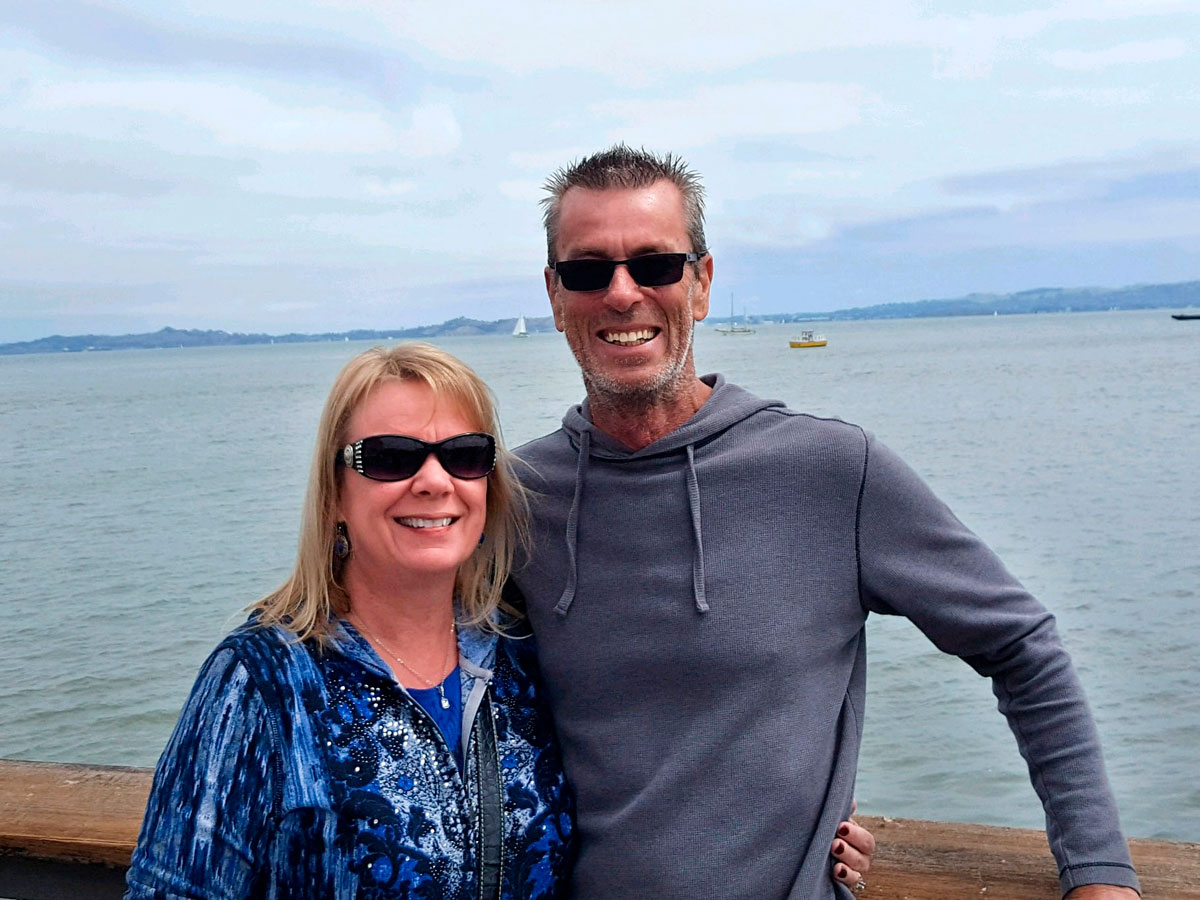
After thorough testing and preparation, Donna was matched with a recipient in New Mexico. In February 2024, an experienced transplant team at Mayo Clinic in Arizona performed Donna’s laparoscopic donor nephrectomy, a minimally invasive surgery for removing a donor’s kidney. Donna recovered swiftly, resuming her regular activities, including leisurely walks with her husband around their neighborhood. It was only a matter of time until they received news of a match for Mike who was now eligible to receive a living organ donation as part of the paired exchange program. By mid-March, Mike returned to Mayo Clinic to receive his new kidney.
Now, almost seven months later, Donna and Mike are thriving, grateful for their health and excited for their future. Donna’s decision not only saved her husband but also extended a lifeline to another patient facing the challenges of kidney disease. “You can’t put a price on the gift you’re giving someone. There was nothing that would have stopped me from doing this. It’s such an amazing thing to do.”
Donna’s story is a testament to the profound impact of living organ donation. While many patients can wait up to several years to receive an organ from a deceased donor, a living organ donor’s selfless gift can offer immediate hope and a chance at a healthier life for one person, or even a chain of people anxious to find their match.
To learn more about becoming a living organ donor and how your gift can help save lives, visit Mayo Clinic.

Myths and facts about becoming a living organ donor
Myth: I won’t be able to maintain an active lifestyle after donating a kidney.
Fact: Most living organ donors go home within 24 to 48 hours after surgery and report feeling back to normal by 2-3 weeks. After full recovery, kidney donors can resume their normal activities without any long-term restrictions.
Myth: The cost of donating is too high.
Fact: The kidney transplant recipient’s insurance covers preliminary testing, surgery and more. Transplant Centers also provide additional resources to assist donors with the cost associated with taking time off from work or recovery.
Myth: I’m not a match. Therefore, there is nothing I can do to help my loved one get a transplant.
Fact: If you’re not a match for a loved one, you can participate in a paired exchange. This allows you to donate a kidney to someone else who has a living donor but is also incompatible, they in turn donate a kidney to your loved one. Mayo Clinic partners with the National Kidney Registry, the largest paired exchange program in the U.S.
Myth: If I donate a kidney, I’m at increased risk for health issues later in life.
Fact: A living kidney donor’s risk of developing kidney failure following donation is less than 1%. Living kidney donors typically follow up with a primary care physician yearly to maintain good health.