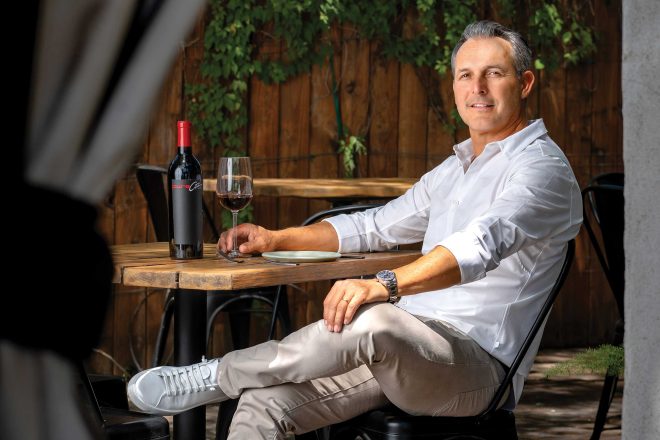
VAI Resort CEO Grant Fisher is building the ultimate retreat for young elites. Are there enough of them to sustain the investment?
It’s not hard to imagine Grant Fisher and his girlfriend Sarah Trott relaxing on a yacht in Greece or jamming to an EDM DJ at a beach club in the Caribbean.
Fisher, the 28-year-old president and CEO of VAI Resort, and Trott, a former broadcast journalist and The Bachelor contestant who now handles marketing and brand development for VAI, say the inspiration for their long-in-construction 60-acre resort just across the street from State Farm Stadium came from their own travels to such exotic locales.
“100 percent,” says Fisher, employing the phrase he routinely uses as an affirmative. “We wanted to bring the vibes of Mykonos and Tulum, the beaches of Miami and the entertainment of Las Vegas right here to the heart of Glendale.”

“You’ll literally be able to have your toes in the sand and enjoy a nice meal on the beach right here,” adds Trott, navigating the busy construction site. “You won’t have to fly to Mexico to enjoy those kinds of offerings. You can just have them.”
What’s harder to imagine is the West Valley joining the ranks of such lifestyle capitals, drawing on a rarefied demographic to sustain a $1 billion retreat basically built for wealthy young folks. The plans for VAI (slang for “a state of awesomeness,” Fisher says) certainly promise the ultimate staycation experience for Gen Zers and Millennials, with a sprawling man-made beach, party island, scores of restaurants and a rockin’ outdoor concert stage.
Grant’s father, Fisher Industries president Tommy Fisher – whose construction companies had a slab in building most of Phoenix’s freeways and, more recently, secured $2 billion in federal contracts to build former president Donald Trump’s ill-fated border wall – has described his son’s passion project as a five-star family fun park but “geared a little bit more to the 21-and-over crowd.”
The younger Fisher doesn’t see VAI, which the company took over after its original developer, Crystal Lagoons, fell out, merely as a playland for his peers. “I don’t know if it’s so much demographic age,” he counters. “I think it’s psychographic.” But, he adds, “I think I have a really good sense and pulse on the next generation of affluent travelers.”
Certainly Fisher’s background gives him a well-qualified vantage point. His grandfather, Gene, founded the Fisher Sand & Gravel Co. in Dickinson, North Dakota, in 1952. In the mid-’90s, Tommy expanded operations to Arizona, moving the family to Phoenix when his son was just 3 years old. Grant grew up in the old-monied Arcadia neighborhood, where he now owns a $2 million home.
“My dad, being second-generation leader of a family construction company, saw that infrastructure boom happening in Phoenix, and he wanted to be a part of that,” Fisher says. His timing was right: The company and its subsidiary, Southwest Asphalt, went on to literally pave the way for expansions of the I-10, I-17 and state routes 202 and 303, among others.

Fisher says he “dove headfirst” into the family business by age 12, “picking up a shovel, learning how to shovel dirt.” After graduating from Brophy College Preparatory and Arizona State University, he rose through the ranks of the company, working in quality control, civil engineering, “all the way up to running half-billion-dollar projects for the federal government.”
He was the company’s vice president at the time of the border wall, telling reporters, “Build the impossible, it’s what we do.” But today he shakes off questions about that divisive project, preferring instead to talk about the unique entertainment venue he’s bringing to the Valley.
“In times like these, where the country does feel so divided, entertainment builds a sense of community,” he says. “When you see a concert, the stranger next to you becomes your true neighbor for the next three hours, and everyone’s having a great time.”
The planned amenities definitely lean into the good vibes. Scheduled to open in phases beginning next year, the property will feature a 5-acre “swimming oasis” surrounded by a temperature-controlled white sand beach. “The same kind they use for Pebble Beach sand traps,” Fisher says. “It won’t get over 80 degrees.” At the center will be Konos Island, “the largest man-made party island in the world,” Trott says, filled with double-decker cabanas, a DJ booth, a dance floor and a 130-foot-tall sky bar.

For young families, there’ll be the world’s first Mattel Adventure Park, with Hot Wheels go-karts, a three-story Barbie Beach House and a roller coaster winding through the building. “It’s where all our childhood toys are coming back as life-size versions,” Fisher says.
But perhaps the centerpiece is the attraction scheduled to open first: VAI Amphitheater, a $50-million venue that will feature a state-of-the-art concert stage facing more than 8,000 seats and, uniquely, a wrap-around guest tower, one of four on the property.
“It’s the first of its kind,” Trott says. “Nowhere else can you have a hotel room where your balcony is a private skybox to watch your favorite music artists.” On this, VAI designers have even thought ahead: The balconies will be backed by tinted glass and dimmed in-room lighting to keep everyone’s focus on the stage – and not on adventurous honeymoon couples.
“It also solves the problem of what do you do after that last encore ends, and you’re one of thousands of people scrambling for the parking lot,” Fisher adds. “How many times have you just said ‘no’ to a concert experience because it’s such a hassle? Our whole mantra is: Live for the encore. Nine of our 12 restaurants will have some sort of live entertainment after each concert, so the party doesn’t have to stop.”
Of course, this won’t come cheap. Room rates will use dynamic pricing, ranging from $500 to $900 per night, based on the drawing power of the artists booked (Live Nation and C3 Presents are tapped as partners).
Some music industry insiders, including Valley concert promoter (and former Live Nation head) Danny Zelisko, are skeptical as to how the novel concept will work. “These younger audiences, how many are gonna want to pay $500 to $900 to see a concert from a mile away in their hotel room?” Zelisko asks. “I wouldn’t – and I can afford it!”
The city of Glendale is confident they’re out there, granting VAI a 25-year government property lease excise tax exemption in exchange for the $811 million in sales and bed tax revenue the city projects over that period.
Does Fisher believe that if he builds it, they will come?
“Absolutely,” he says. “100 percent.”