A prestigious New York City jeweler sent Holocaust survivor Samuel Soldinger to Chandler to teach Native Americans the art of diamond cutting.
It seems incomprehensible that Samuel Soldinger, a Polish Jew who miraculously survived the horrors of the Holocaust and lived to become a legend in the Arizona precious gem community, would consider a Nazi Party member to be the most extraordinary man he ever met. But the person in question was Oskar Schindler, the German industrialist who famously saved 1,200 Jews during that time – including Soldinger. The story of Schindler’s heroic actions was brought to life in Steven Spielberg’s 1993 film Schindler’s List.
“He [Schindler] was dashingly handsome like a movie star, elegantly dressed and wearing a beautiful diamond ring, holding a cigarette,” Soldinger wrote in recollections that his daughter Laura Soldinger Yotter compiled with writer Valerie Lee in the 2023 biography, Death and Diamonds: The Story of Samuel Soldinger. “I could tell he could not hurt us. He was a friend. He had a magic way about him… I couldn’t believe a German could be so nice and kind.”
But Schindler figured in only one chapter of Soldinger’s amazing life story – a story of brutality, resilience and unlikely fortune that brought him to Arizona from his roots in a Polish city that suffered some of the worst atrocities of World War II. Ultimately, the final chapter would unfold in Arizona’s Native American community.
Soldinger grew up in a working-class family in the Jewish Quarter of Kraków, Poland. In 1939, at age 14, his life changed when Germany invaded Poland to start World War II and launched a six-year campaign of mass detention of Jewish Poles in Nazi concentration camps. Soldinger was one of them.

Along with other Jews and political prisoners, Soldinger endured beatings, hunger, lice and the constant threat of death from brutal German SS troops. With chutzpah and luck – and a fortunate crossing-of-paths with Schindler – he overcame long odds to survive seven death camps. After being liberated by the U.S. Army in 1945, Soldinger still faced a bleak future, as everyone in his immediate family had perished.
An uncle helped him relocate to Belgium, where he learned to cut diamonds. In 1950, Soldinger immigrated to New York City to continue his career.
A dozen years later, he had a life-changing interview with jewelry titan Harry Winston, the “King of Diamonds.” When Winston – also Jewish – saw Soldinger’s concentration camp tattoos, he made him an enticing offer.
Soldinger was to launch an Arizona diamond processing facility employing tribal members. “Harry chose me and had faith in me because he figured if I survived the Holocaust, I would be empathetic to the plight of Native Americans,” he wrote. U.S. Senator Barry Goldwater worked with the Bureau of Indian Affairs, which funded half the venture, to provide 100 jobs mainly for Pima-Maricopa tribal members. Harry Winston Minerals of Arizona set up a shop where Indigenous artisans turned dull, oddly shaped crystals into brightly faceted diamonds, a rare mineral that doesn’t occur naturally in Arizona. Employees cut, weighed and polished mostly lower-grade diamonds used for industrial purposes.
This extraordinary Arizona business opened amidst tight security in the then-sleepy farming community of Chandler, located between the Gila River and Salt River Indian communities. Armed guards patrolled the building, which had reinforced walls, barred windows, and a holding cell at the entrance. The operation’s raw materials and finished products were subject to meticulous accounting. At quitting time, its manager received a police escort to deposit the day’s work at the nearby Valley National Bank, now SanTan Brewing Company’s home.
But for one young girl, it was just another place to have fun. “I remember playing and hiding underneath the desk of my dad’s secretary,” Yotter says. “But I thought I accidentally hit a ‘panic’ button there. I kept looking out the front window, terrified that the cavalry would pull up. But two buttons needed to be activated to summon the police, so I was OK.”
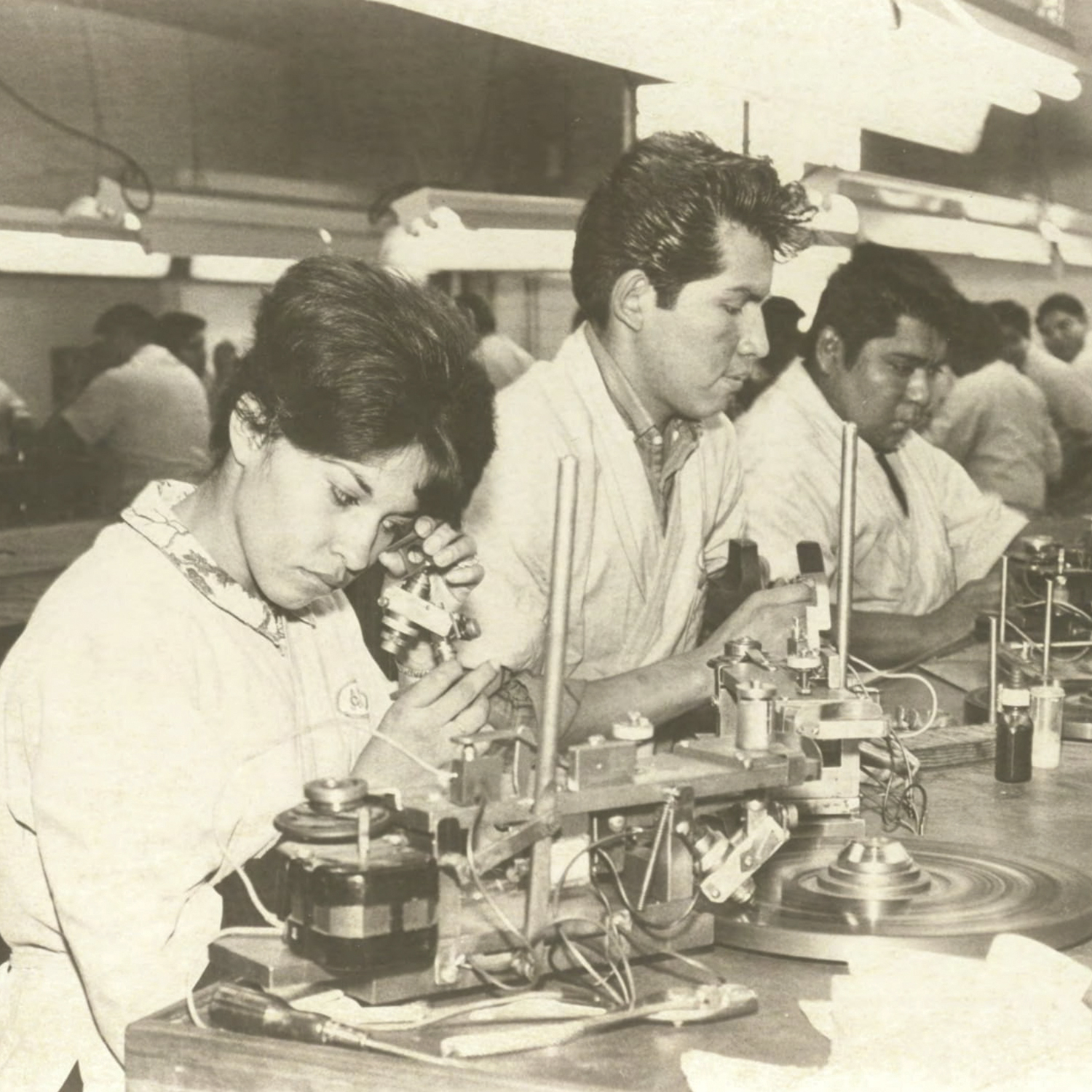

“Diamond cutting and polishing is more than a job; it is an art,” Soldinger wrote. “Only a genuine craftsman with a special feeling for his task can prove satisfactory in this fascinating industrial operation. It is intricate and precise, and a worker must have infinite patience.” Soldinger encouraged a convivial workplace, bonding with employees on breaks by playing ping-pong, a sport at which he excelled. “We lived in Phoenix, so my father would pick up platters from Cheese ’n Stuff for employee parties and hand out turkeys at Thanksgiving,” Yotter says.
Over one weekend in 1967, burglars stole raw diamonds valued at $100,000 from the fortress-like building. In the daring heist, thieves disabled an alarm and used an on-site dolly to move an acetylene cutting torch to burn the steel door off a 6-foot-high, 15,000-pound strong box, according to The Arizona Republic.
The business continued operating until closing in 1982, with ownership citing a poor economy. The Chandler Police Department currently uses the building at 576 W. Pecos Rd. as its property and evidence storage facility.
Harry Winston Minerals subsequently offered Soldinger positions in Manhattan or China, but he retired to stay in Arizona and make custom jewelry. A decade later, his life’s mission found him with the release of Schindler’s List.
While some Holocaust survivors wanted to leave the past behind, the movie provided a stage for Soldinger to publicly share his inspiring story until his death at age 76 in 2001. “My father didn’t shy from the spotlight, and he spoke at numerous churches and schools about surviving the Holocaust,” Yotter says. “He liked to tell his story because it was so important to him that this never happens again to any group of people. His message was to spread love, kindness, healing and hope.”
Phoenix Jewish Historical Sites
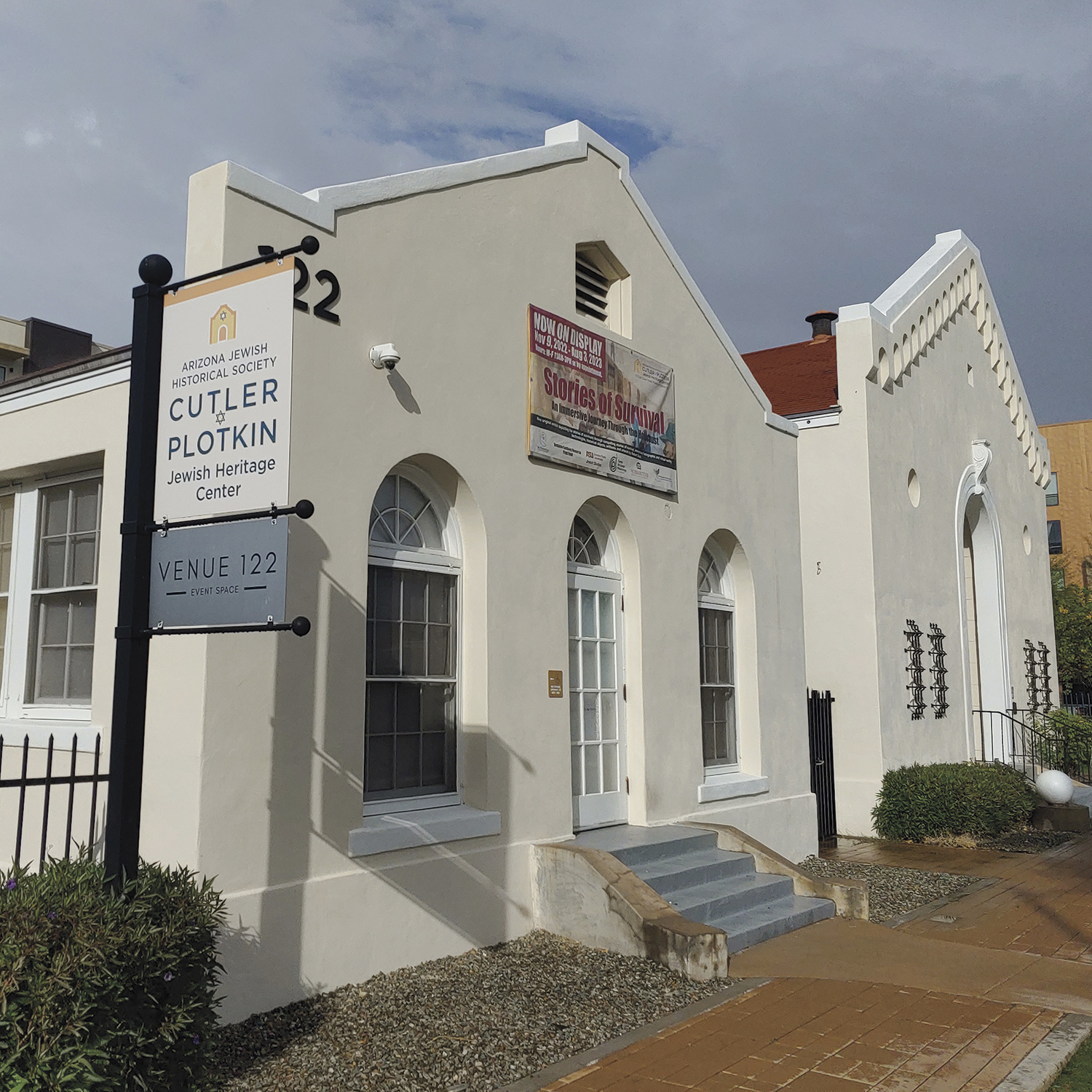
Cutler Plotkin Jewish Heritage Center
The center is located at 122 E. Culver St., which was once the home of Beth Israel, the Valley’s first permanent Jewish congregation. The synagogue opened in 1921 and moved in 1949. Afterward, a Baptist church used the building for services. In 2002, the Arizona Jewish Historical Society acquired the property and opened it in 2010 as a museum, educational center and event venue. The center recently announced the construction of the adjacent Hilton Family Holocaust Education Center, which will open in 2026.

Former Beth El Synagogue
Beth El opened at 300 W. McDowell Rd. in 1951 with the highest percentage of Holocaust survivors of any local Jewish synagogue. The complex included a 12-room Hebrew school and a rabbi’s residence. Beth El moved in 1967 after outgrowing the building, which a pawn shop now uses. Its basement has four underground tunnels heading to unknown locations, which are now blocked. “Synagogues often had secret passageways to escape because of anti-Semitism,” says former Beth El member Jerry Harris.

Former Beth Hebrew Synagogue
In 1955, Phoenix’s first Orthodox synagogue opened at 333 E. Portland St. in a distinctive building with “18” in many features, including windows on each side. Called chai – “life” – in the Jewish tradition, 18 is a spiritually significant number. The most famous congregant was movie director Steven Spielberg, who had his bar mitzvah there at age 13 in 1960. The congregation merged with Beth El in 1980, and the Phoenix Black Theater Troupe later owned the property. Michael Levine purchased the building in 2015.

Holocaust Memorial
A monument to the 6 million Jews who died during the Holocaust resides on the current Beth El campus at 1118 W. Glendale Ave. The aluminum sculpture represents “the brutal destruction of countless lives but also… a future of hope and peace,” said its designer, Valley artist Gale Dubrow, in 1981. The 14-foot-high structure consists of a 6-foot black cube on a pedestal containing an eternal light, with a hand at the top reaching heavenward. The cube contains camp names and the inscription, “Thou Shalt Not Forget.”