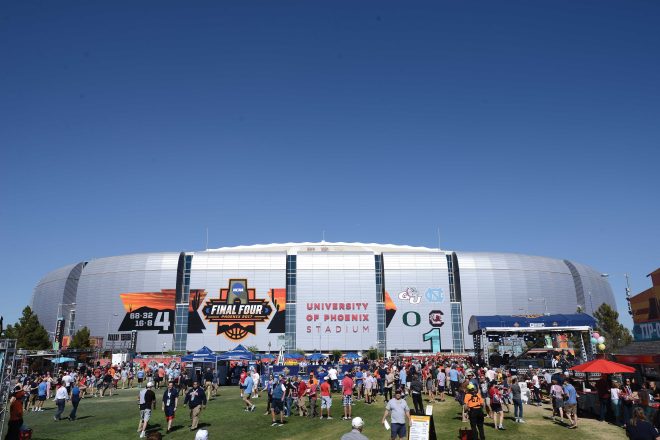
Little more than a decade after the game’s invention, college hoops officially arrived in the desert. The sport looked a lot different in 1904 than it does today.
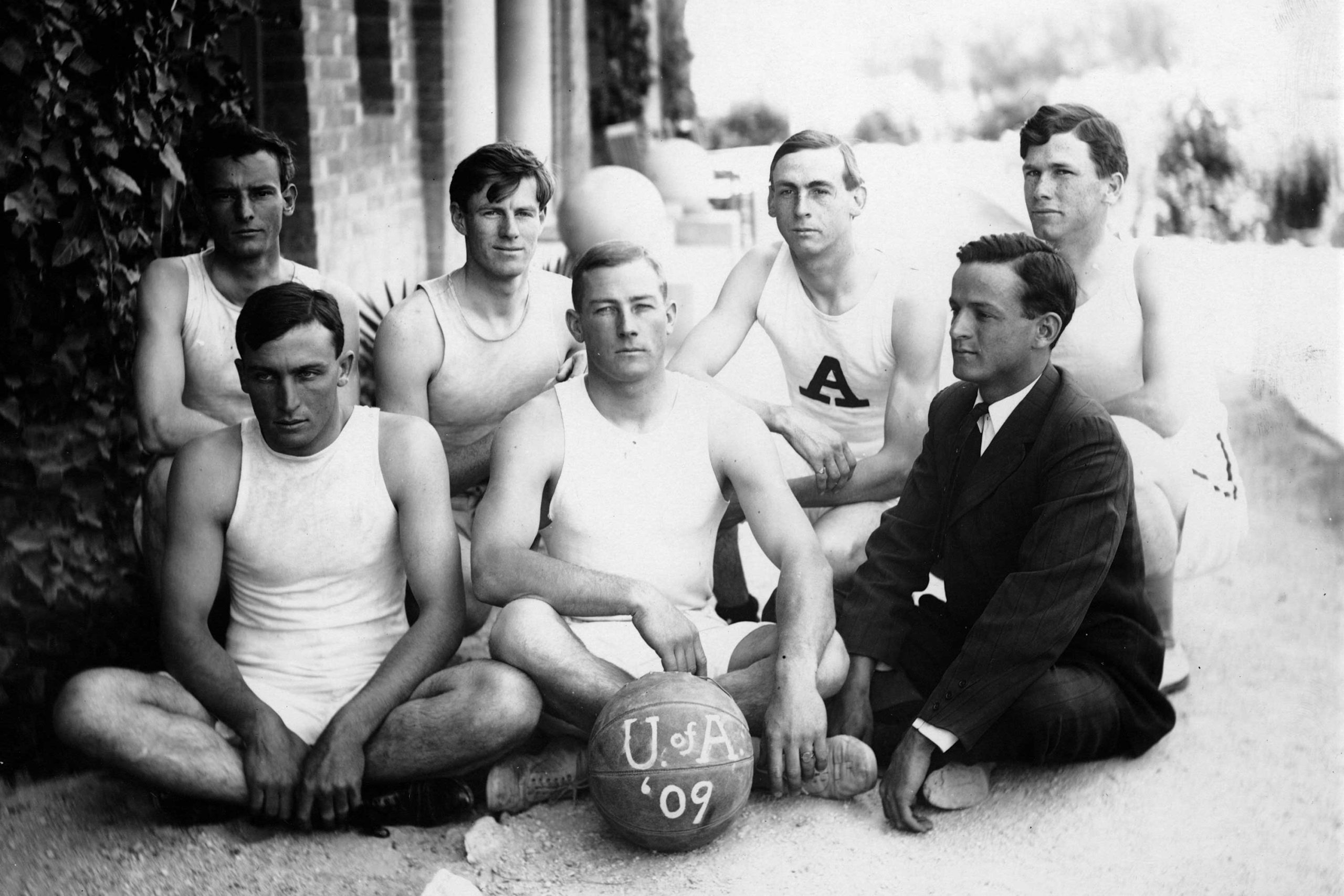
It’s not a stretch to say that Tucson has both grub and game. In 2016, the city’s thriving culinary scene became the nation’s first to reap the coveted UNESCO title of City of Gastronomy. Similarly, the University of Arizona men’s basketball team, nicknamed “Point Guard U,” has for 40 years been one of the nation’s elite programs, dishing out winning seasons and All-American players, capped by an NCAA championship in 1997.
The origins of Tucson’s food fame are a multi-cultural, calorie-dense rabbit hole compared to its well-documented hoops heritage. Eight years before Arizona became a state, UA fielded its first men’s basketball team, competing in the 1904-1905 season. Surprisingly, that squad set several standards, including going undefeated and snagging an obscure championship – a two-fer that none of the modern Top 20 powerhouse teams has matched. The catch: Their season consisted of but two games. Welcome to college basketball in Territorial Arizona, when the sport was more closely related to Dr. James Naismith’s iconic peach baskets than to the acrobatic, high-flying game that arguably is the UA’s most noted product.
There were few hints that the sport invented in 1891 by Naismith at the Young Men’s Christian Association in Springfield, Massachusetts, would go viral. Naismith only sought to keep boisterous youth busy inside a gym during inclement weather. “Basket Ball” was serendipitously named when a janitor brought him two peach baskets, instead of the requested boxes, to use as goals, which Naismith positioned 10 feet off the ground.
The inaugural game, however, went differently than Naismith planned. The players, nine to a team – who at the time were allowed to run with the ball without dribbling – “began tackling, kicking and punching in the clinches. They ended up in a free-for-all in the middle of the gym floor,” resulting in several black eyes, a separated shoulder and one player knocked unconscious, Naismith recalled in a 1939 interview.
After Naismith tweaked some rules to make the sport more convivial, basketball went nationwide courtesy of local community YMCAs. By 1896, it had bounced into Tucson, as evidenced by a notice in the Arizona Weekly Citizen. “The university boys will play a match game of Basket-Ball in front of the university building… All those interested in seeing the new game are invited to be present.”
The sport quickly caught on as a lunchtime activity at the school. “This game is decidedly popular and ranks ahead of other formerly popular games. It is exciting and full of interest,” stated the Arizona Daily Star. The available equipment, however, left something to be desired, a fact reflected in this deflating statement published in the newspaper two years later: “The bladders for the basket ball only lasted a game each.”
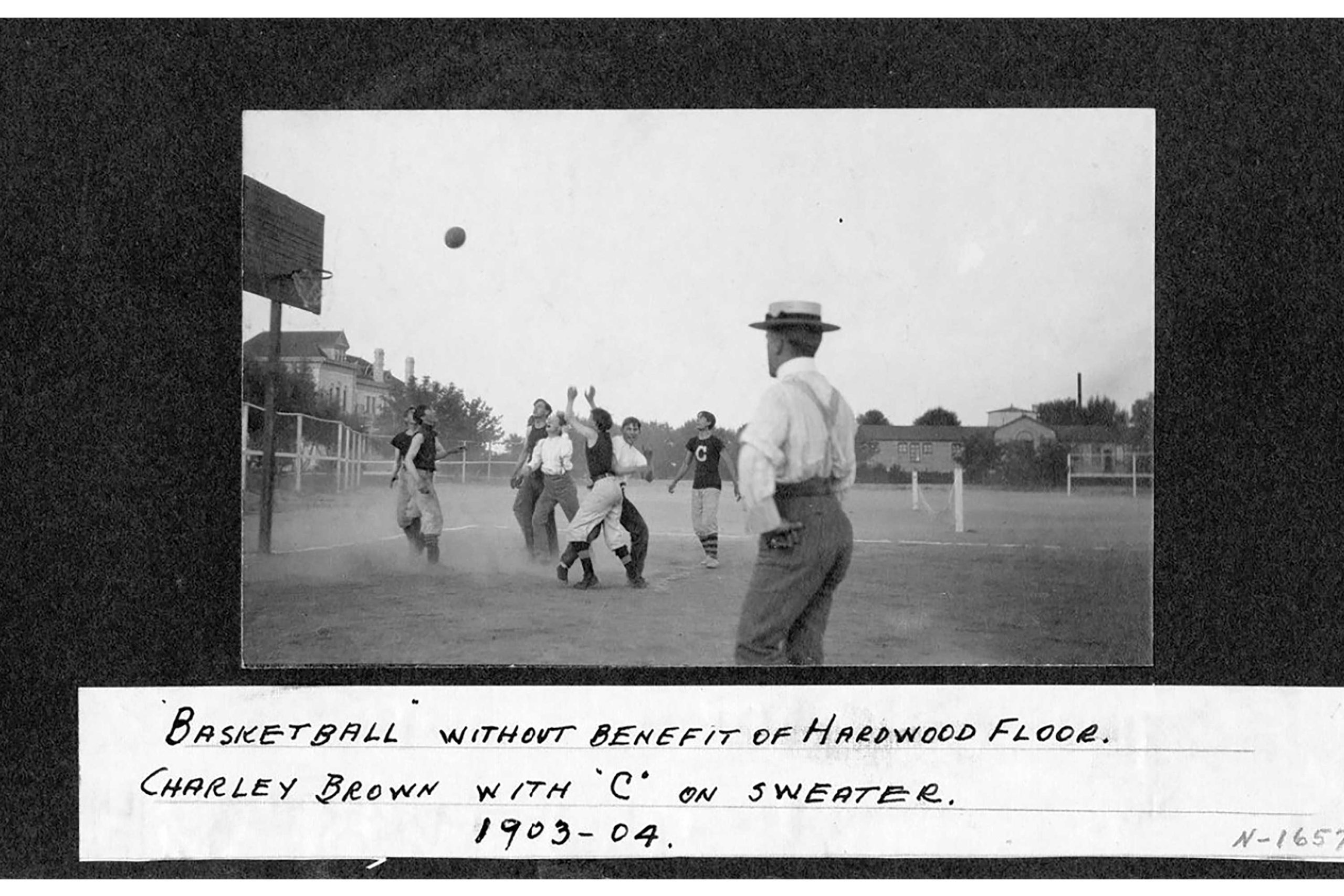
In 1904, the same year basketball became a demonstration sport in the St. Louis Summer Olympics, the first UA squad came together with a starting lineup of team captain Charles O. Brown, C. Wooddell, J.W. Lewis, H.L. Bradford, and J.H. Stewart. The players’ athletic backgrounds are unknown, but they surely weren’t the finely tuned hoopsters who today run the court at McKale Memorial Center. Orin A. Kates coached the team as well as the football squad and served as the school’s first athletic director. The team’s lone extant photo shows them playing outdoors in a scene reminiscent of dorm students blowing off steam before finals.
Paleolithic competitive basketball was a much different game than that which is played today. It lacked three-point shots, alley-oop dunks and shot clocks. A jump ball was held after every basket. There were no African American players – Hadie Redd would be the first at UA in 1951. Overseas recruits were still further down the pipeline. And forget about cross-over dribbles; players could only move the ball by passing. But that didn’t mean it was an easy sport to master. “Other games are strenuous, demanding a great deal of endurance exerted on the part of the player, but there is no game that has not slight periods of rest for breathing space, excepting basket ball,” declared the Daily Star in 1905.
The first UA team, then nicknamed the “Varsity,” proved it could hoop against older opponents from tough copper-mining towns. The school’s debut contest ended in a 40-32 victory over the Morenci YMCA on the road. “The University of Arizona basket ball team won a by no means easy game,” expressed the Tucson Citizen. “The playing of Wooddell was phenomenal. Once the ball was fairly in his possession, a goal was almost sure to result.” Two days later, UA followed up with another away contest against the Bisbee YMCA, which had three players from the University of Minnesota team that won the U.S. championship in 1898. The Daily Star reported that the game ended in a 19-19 tie.
A month later, a telegram from Morenci arrived in Tucson, informing UA that in the final contest of the round-robin competition, Morenci had defeated Bisbee, 26-17. According to the tiebreaking protocol, “The University therefore holds the championship of the territory of Arizona for 1905,” declared the Daily Star.
Controversy lingers, however, over the title. At odds with coverage in the Citizen, the Bisbee Daily Review reported UA’s victory over Morenci as 42-39. Moreover, it showed that the Bisbee YMCA actually defeated UA 20-19, describing the game as “… fast and snappy from start to finish.” Which city’s newspaper was guilty of duplicitous hometown journalism or just sloppy reporting remains a Sky Island mystery.
The team’s impressive debut initially failed to propel men’s basketball to a high profile on the Tucson campus. The following year, the Citizen noted that, “Work in basket ball has begun, and nearly every afternoon sees a lively match in the gymnasium,” but only intra-squad games were held that season. When play against outside competition resumed in 1906-1907, the basketball team compiled a composite 10-6 record over the next five years, with the coach listed as “unknown” in the Arizona Basketball Press Guide. The results are mostly unavailable for this period; the few known opponents include the Tucson Athletic Club, Tucson High School and YMCA teams.
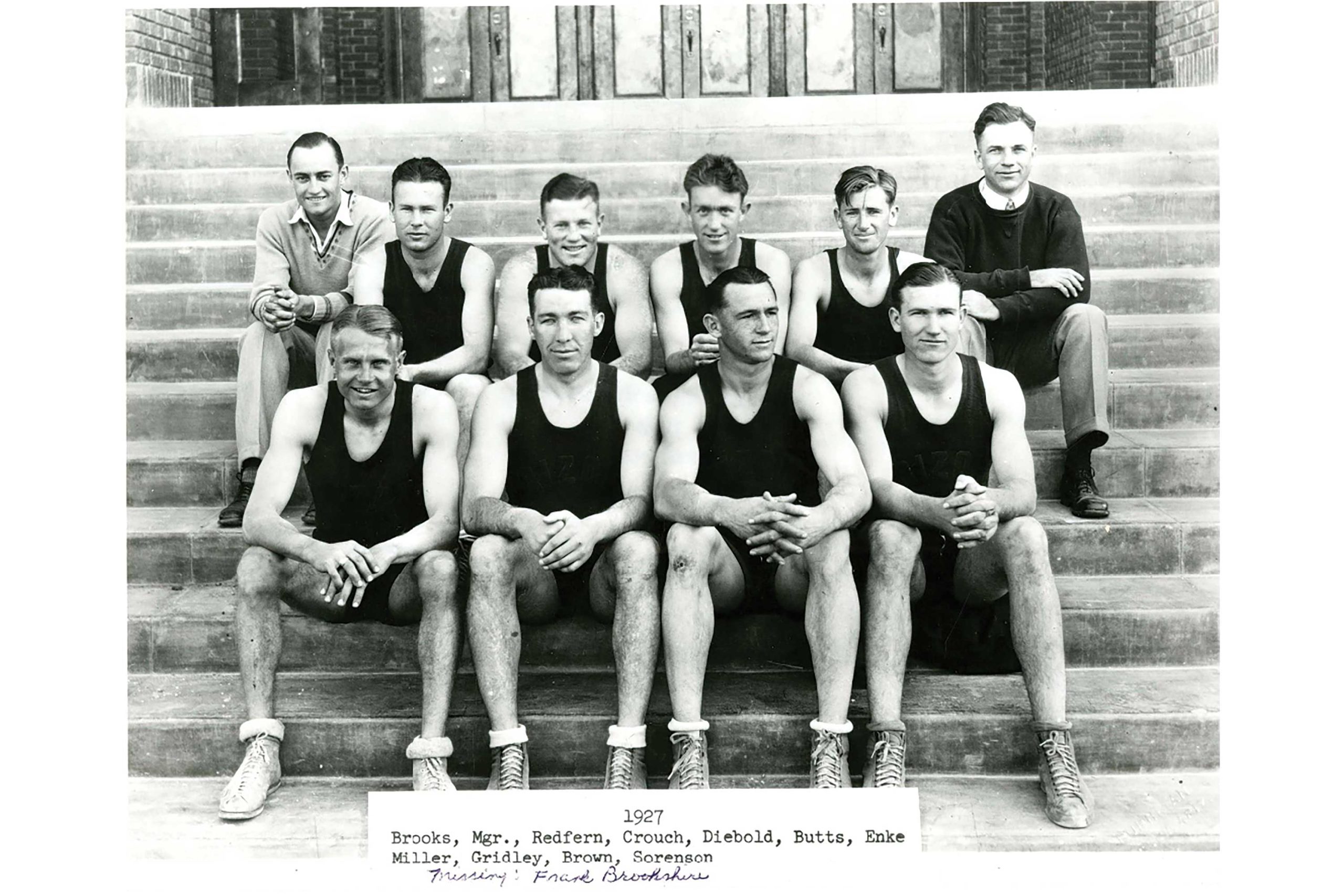
Men’s basketball would attain a more prominent status at UA when James “Pop” McKale embarked on a seven-year run as head coach in 1914, the same year the school’s mascot became the Wildcat. The coach, after whom the McKale Center is named, started his UA career with back-to-back undefeated seasons. In 1925, Fred Enke took over for an incredible 36 seasons as head coach, taking the team to the NCAA tournament for the first time in 1951. After a few lackluster decades, the program would fly even higher, becoming a basketball powerhouse in the late 1980s under head coach Lute Olson.
UA teams have received numerous accolades over the last four decades, but it was the 1904-1905 squad that went undefeated and snagged a coveted championship to start the ball rolling to big-time college basketball. Maybe it was destined, as the Daily Star said about the program in 1896, “Basket ball will become popular, and some brilliant work may be expected from the teams in the future.”