Ari and Athena Flicek at the Feeding Matters headquarters in Phoenix
For many families, the holidays are a time to gather around good food, often celebrating with elaborate feasts or even gifting a loved one their favorite snack.
For others, food-centric festivities can be difficult. For children with pediatric feeding disorder (PFD), the act of eating is an agonizing physical and emotional experience that can lead to refusal to eat and, ultimately, malnutrition and failure to thrive.
Phoenix-based Feeding Matters is the first organization in the world dedicated to serving children with feeding disorders, and its pioneering work is paving the way for widespread awareness. In fact, the Centers for Disease Control and Prevention recently established two stand-alone diagnosis codes for PFD in the ICD-10-CM manual.
These diagnostic codes will make a world of a difference for families like Phoenix resident Athena Flicek and her 3-year-old son, Ari, who has struggled with feeding since birth. She says the diagnoses will provide a more defined path toward getting the care they need with more accurate and predictable insurance coverage. Even more importantly, though, it signifies validation and recognition. Prior to receiving resources from Feeding Matters and a subsequent diagnosis, Flicek was often met with inaccurate diagnoses and unhelpful dialog. Common commentary from her community included, “He’s just a picky eater.” She felt like an inadequate mother.
“My heart would stop, and I’d be like, ‘He’s going to die.’”
“It’s just nice to have that there instead of all these wrong labels and coding that were there before. This one makes sense, this one is what the problem is, this one gives you a direction and a path of where to go,” she says of Ari’s diagnosis. “The other codes he has in his file don’t tell you what to do, they don’t help you, they just make you feel depressed and like a horrible parent.”
Now, she feels “excited and relieved” that Ari’s disorder is finally getting the attention it needs. But there is still work to be done, she notes.
“When you go to your pediatrician for a checkup every year, there should be a screening for autism, a screening for feeding disorders, a screening for all these things,” she says. “And people should have the resources to be like, ‘Hey, you have a feeding disorder. This is where you can go.’”
When Ari was born, he would not latch. Once he started eating solid foods, he would constantly choke and vomit. Flicek’s doctor told her it was “just spit up.”
“Everyone kept saying that. I’m like, ‘This child is projectile vomiting every time I fed him’ and it started the cycle of feeding him all over again,” she recalls. “I felt like I was feeding him all day long and he wasn’t getting anything. Clearly, something was wrong.”
Flicek quickly discovered that Ari was not chewing his food. “My heart would stop, and I’d be like, ‘He’s going to die.’”
When Flicek found out about Feeding Matters, she immediately called and took Ari in for a comprehensive evaluation. “Four amazing women sat him down and for 30 minutes, they watched his motor skills, checked his skin,” she recalls. “Then, they gave me a whole list of things I could do and places to start.”
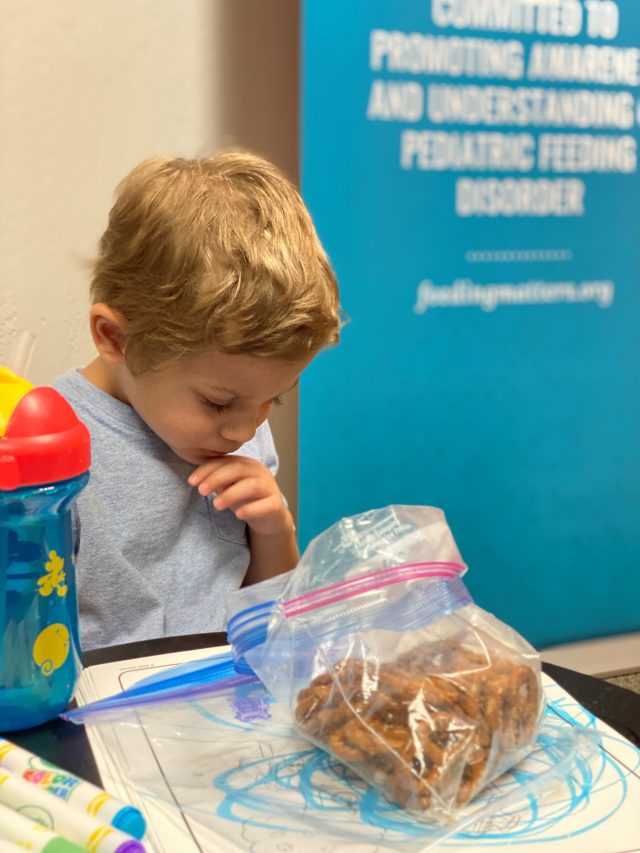
Ari enjoying a snack at Feeding Matters, which provides resources for children with PFD
Ari has now been in feeding therapy for a year and a half. At first, simply sitting in his highchair was hard. “The first month of feeding therapy was just his therapist trying to get him in his highchair safely, because he didn’t feel safe there,” Flicek says. “Once they start eating, it’s a little bit better, but just to initiate the process of feeding is the biggest challenge.”
Ari has made significant progress, Flicek says. “Now he’s pulling out his own chair, getting up in his booster, buckling himself in so he can eat. That was the first milestone,” she says. “He only used to eat five things. Now, that list is almost two pages long.”
Flicek says the taste and texture of certain fruits and vegetables are still a struggle for Ari. “But just the fact that he will even eat a strawberry or a grape or want to try something new now is a huge improvement,” she says. “For a year now, he hasn’t had any episodes. He’s so much happier, so much more confident when he’s eating.”
Ari’s journey has not come without emotional and financial obstacles, Flicek admits. “It’s still super stressful but it’s way less stressful than it used to be because we know what’s going on, we have some answers and we have a direction.”
Feeding Matters has been fundamental in finding answers for the Flicek family. “Now that I know so much more about the Feeding Matters organization and how amazing it is… I need to give back now. It’s my time,” Flicek explains. “Now that my kid is safe, healthy, happy and eating better… I’m trying to help get the word out because I just imagine all these other parents going through what I went through and it makes me sad for them and their kid and how they’re feeling. You don’t want anyone else to feel the way you did.”
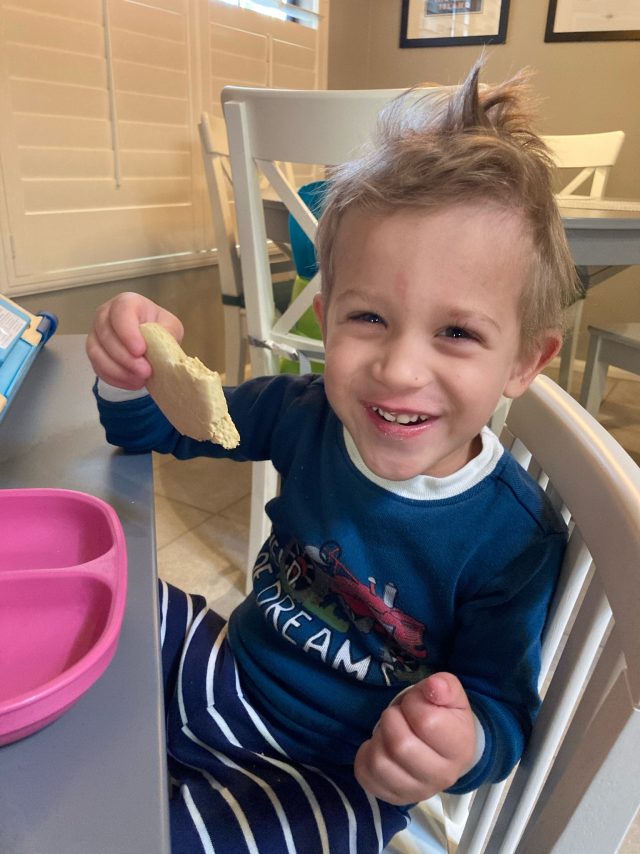
Ari used to eat a total of five foods. Now, the list of foods he will eat is two pages long.
The labels put on Ari extended to Flicek. There are many stigmas that surround a feeding disorder and terms like “unfit mother” plagued her. “Two things you have to do as a parent is keep your kid clean and sanitary and feed them. When you can’t do half of that… it’s really stressful,” she explains. “Developmentally, he’s so bright, but he’s ‘not thriving.’ Nutrition is a basic right of life.”
Every case of PFD looks different. “Some kids, if they walk into a room with a food they don’t like, they’ll have a breakdown and start throwing up. It’s horrible, what kids have to deal with and how traumatizing this can be for children,” Flicek says. “And no one talks about it. This is a problem, the fact that my kid had this disorder, but I didn’t learn about it until almost two years after. Now, he’s three and it’s finally being recognized.”
If untreated, PFD can turn into a life-threatening eating disorder like anorexia. Often, it is not a standalone disorder. Ari has allergies and eosinophilic esophagitis, a chronic disease that causes white blood cells to build up in the esophagus. But there is hope.
“I know it’s going to be a life-long challenge for him… but I also know that he has more tools now from his therapy to help him get through them easier,” Flicek says. “He might have some more obstacles to overcome, but I’ve set him up for success.”
623-242-5234, feedingmatters.org