Stuart Graff first discovered Frank Lloyd Wright as an 8-year-old on a field trip at the Rookery Building in Chicago. The building was “in a state of distress,” and it was unclear whether a lobby designed by Wright or another designed by his protégé William Drummond would be the ultimate survivor in the building’s renovations. The docent leading the tour favored Drummond. “I thought that was nuts, and I said so,” Graff says.
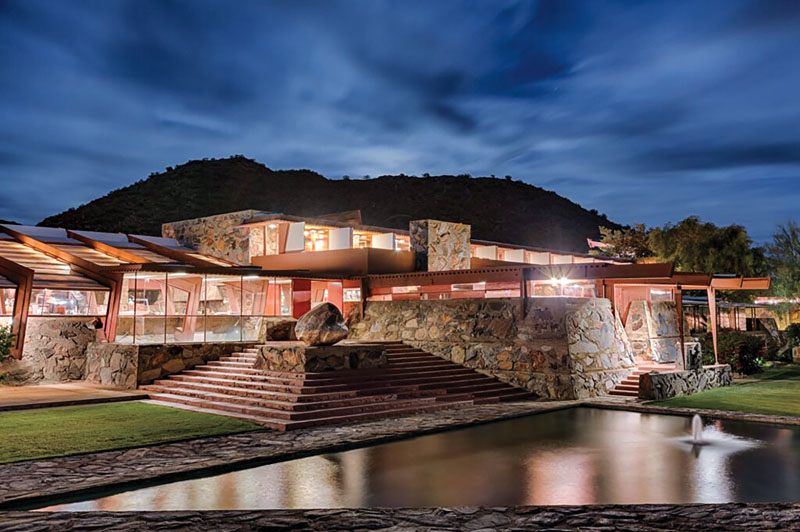
More than four decades later, Graff brings that same certitude to his role as president and CEO of the Frank Lloyd Wright Foundation, established by the storied architect himself in 1940 to preserve his work and legacy beyond his earthly life. The foundation oversees Taliesin, Wright’s estate in Wisconsin, and Taliesin West in Scottsdale, as well as Wright’s body of work and intellectual property. Graff was hired by the foundation in February 2016, during a time of transition.

“The foundation has a rocky history, financially, for lots of different reasons,” Graff says. “Wright was a great architect, but he was not great with money. He left us two sets of buildings in dire need of work, and here we are, 60 years later, and we’re still in dire need despite the fact that we’ve done a lot of work.” His first task was to put the foundation on “a solid financial course,” a natural challenge for Graff, whose background is in business and intellectual property law. To achieve this, he tasked himself with reinterpreting the sites – a particularly momentous move going into 2017, the 150th anniversary of Wright’s birth.
“When I arrived, I felt that the sites were only existing as house museums” or stuffy, look-but-don’t-touch, period-perfect edifices frozen in time, Graff says. “As a whole, the museum-going population, and in particular young museum-goers, they’re not interested in house museums.”
He hired a new director of education, DeDee Ludwig-Palit, who is expanding the foundation’s educational programming through outreach to local schools and summer art and architecture camps. “It’s really important to get out there and use the platform of Frank Lloyd Wright’s architecture as a way to teach not only STEAM – science, technology, engineering, arts and mathematics, which, when you add it all up, it sounds a lot like architecture,” Graff says. “But Wright’s work can also be interpreted as Transcendental poetry – the work of Whitman and Emerson and Thoreau, written in material form.”
To increase revenue, add value and honor Wright’s vision for “a community that was built around beauty in all of its forms,” Graff also re-opened Taliesin West’s two theaters – dark for the past 40 years – for a collaboration with Southwest Shakespeare Company and to host local and touring musical acts. The foundation makes some money from its tours (prices range from $9 for children on the Junior Architect tour to $75 for adults on the Behind the Scenes tour), gift shop sales and licensing of Wright’s image and work, but, like the majority of nonprofits, it exists largely because of the generosity of patrons. The responsibility to donors is ever-present in Graff’s mind.
“If all we are is a way for people to kill a couple of hours of time, hear a few amusing stories, we’re not doing our job,” he says. “We’re not justifying the investment philanthropists make in our work, because a donor gives you money because they want to help you make a difference in the world… They don’t want to just subsidize somebody’s pastime.”
To get to the heart of the Venn diagram of what donors want the foundation to do and what audiences really want, Graff circles back to the notion of evolving the properties to become living, breathing spaces.
“When you present the place as a house museum, it means we’re looking back at Wright as a dead man. But his ideas are alive,” Graff says. “I said during my interview process very passionately to the board that I didn’t want to serve as the high priest of the shrine of Frank Lloyd Wright. I wanted to advance Wright’s legacy to make a difference in the world… You can tell I get a little emotional about some of this stuff. I know it’ll be the day that I have to quit when I no longer choke up when I tell these stories.”