While the cause of autism remains elusive, a new hypothesis centers on the gut.
“Everyone’s always been intrigued that there’s a gut/brain connection,” says developmental pediatrician Dr. Raun Melmed. One theory is that those with autism may not be able to process the protein found in gluten and casein, causing gut inflammation that can potentially affect the brain.
Parents of autistic children have reported positive results with a casein- and gluten-free diet, Melmed says, and with probiotic supplements. However, medical support has not been robust. “When we’ve done double-blind studies to see if you could show differences when you manipulate the diet, the outcomes haven’t been very positive,” Melmed says. He may recommend trying the diet, but with that caveat.
A mom knows when something is off with her child. Shelley Sedwick Donald says she knew something was different about her son, Matt. As a baby, he never cooed or babbled. He didn’t make eye contact or play with toys. By age 3, he had never spoken.
When Matt was diagnosed with autism by a developmental psychologist at the Melmed Center in Scottsdale, Donald cried. “It was devastating.” She had waited several months for an appointment with the center’s founder, Dr. Raun Melmed.
Developmental-behavioral pediatricians (DPs) are doctors with training in assessing and treating developmental and behavioral difficulties, including dyslexia, Tourette syndrome, cerebral palsy and ADHD. Melmed was renowned for his work with this segment, and Donald was desperate for him to evaluate her son. “I’ll do anything. I’ll take any appointment,” she told his office.
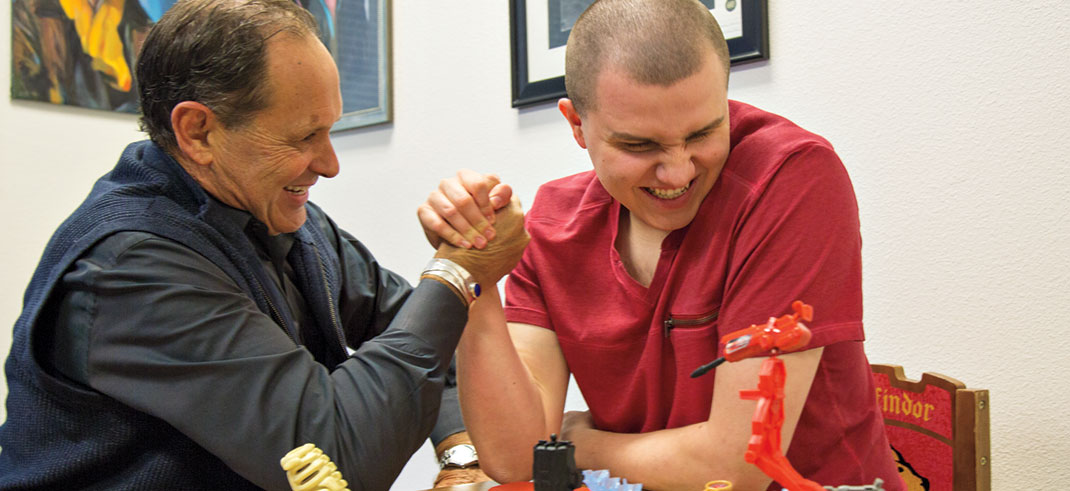
The wait was worth it, Donald says. Today, at nearly 20 years old, Matt is “amazing,” raves his mom. “He’s in a work-training program. He’s learning employable skills. He’s not on any medication. He has friends. He can buy his own groceries, make his own food. We have big hopes he will be living semi-independently someday.”
Early diagnosis is key. Because Matt was diagnosed at age 3, Donald says she was able to enroll him in a developmental preschool, speech therapy and occupational therapy. They acquired an individualized educational program, which ensures specialized education for children with disabilities.
For the 1 in 6 U.S. children with developmental disorders, according to the Centers for Disease Control, finding DPs is as easy as finding needles in a haystack. Healthgrades lists just 11 DPs within 100 miles of Phoenix. This excludes psychologists and psychiatrists, who can diagnose and treat developmental disorders, but who often refer patients back to pediatricians.
According to the American Board of Pediatrics, there was no certification for developmental-behavioral pediatrics until 2002, when 300 pediatricians were certified. That number has continued to drop – in 2015, 55 DPs were certified through the ABP. In comparison, 196 doctors were certified in pediatric emergency medicine that year.
Concurrently, the rate of developmentally challenged (particularly autistic) children continues to rise. According to current data, 1 in 45 children ages 3-17 has been diagnosed with autism spectrum disorder, creating an inflationary scenario. While there’s more demand for DPs, there is less supply.
Melmed believes doctors shy away from developmental specialties for financial reasons. “Everyone wants to be a plastic surgeon,” he says. “Cognitive specialties, child neurology and psychology are at the bottom of the totem pole. You’re not going to go into this to get rich… Do you want to work 70 hours a week for $110,000, or work half as much for five times as much?” Melmed also refuses to shorten his appointments, which can be 90 minutes long – a rarity in an age when doctors average 13-16 minutes with patients, according to online medical resource Medscape. “Having a long wait list keeps us busy, but it is not a good money maker in any way,” Melmed says. Even Melmed admits the wait times for appointments at his center are “ridiculous”: four months to get in; eight months to see him. That isn’t what worried parents like to hear.
Melmed says he refers patients who can’t see him to Dr. Robin Blitz at Phoenix Children’s Hospital or Dr. Sydney Rice in Tucson, though they have equally long wait lists. Meanwhile, pre-eminent Valley DP Dr. Daniel Kessler retired last year without being able to find and train someone to take over his practice. “[Blitz] has, I believe, two positions open for DPs,” Kessler says. “She hasn’t been able to fill them, either… The hardest part of my retirement was saying goodbye to parents without firmly recommending someone who can take over their child’s care.”