This kid, slogging through the repetitive drudgery of training, is Jagger Eaton, now 14 but just 11 when he became the youngest-ever participant in the X Games. Jagger has a half-dozen corporate sponsors, and has appeared on MTV shows like Ridiculousness. He’s been to China and Europe and South Africa, and he leaves in a few days for a video shoot in Brazil.
“Unless he keeps banging down his board,” mutters Geoff Eaton, scowling at his son. “In which case I’m taking the trip away from him.”
Discipline and opportunity of this sort are central to Kids That Rip, Geoff Eaton’s school for skateboarding and other “extreme sports.” Hundreds of students a week train on the school’s fortress-like ramps and half-pipes, but for an elite-level handful, like Jagger and his two brothers, Kids That Rip is their true alma mater. Top students are partially or entirely homeschooled, to make time for training, and for the travel that is, Eaton says, part of their education in itself, adding that the best X Games competitors can also make a good living. “My kids make better salaries than I do,” he claims. Top competitors, he says, can earn anywhere from $100,000 to millions a year.
But money isn’t the only appeal. “I’d do anything in the world to keep doing what I’m doing,” Jagger Eaton enthuses. “To practice all day, and hang out with my friends, it’s such a blessing.”
Kids That Rip dominates the strip mall at Gilbert and McKellips roads in Mesa. Founded in 1972 as Desert Devils Gymnastics by Geoff’s father, Mark “Stormy” Eaton, the school came under the purview of Geoff after his father’s death in 1995. In 2005, he came up with Kids That Rip, the name that now shares signage with Desert Devils Gymnastics.
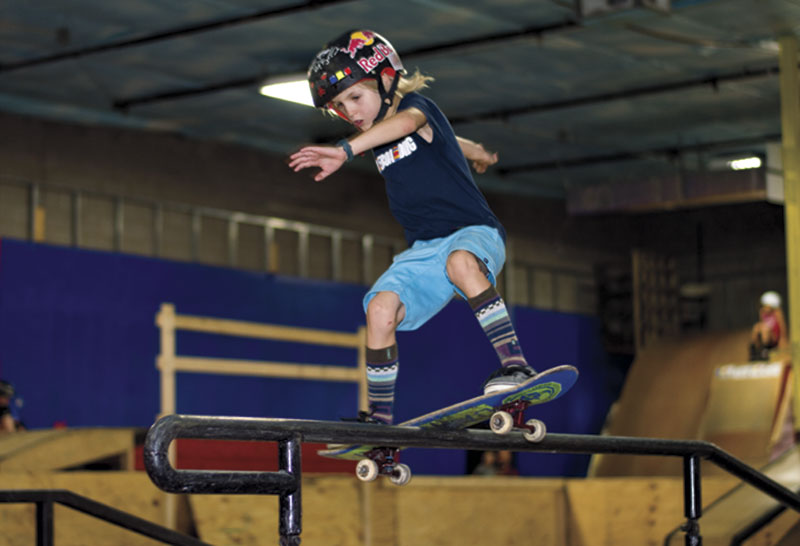
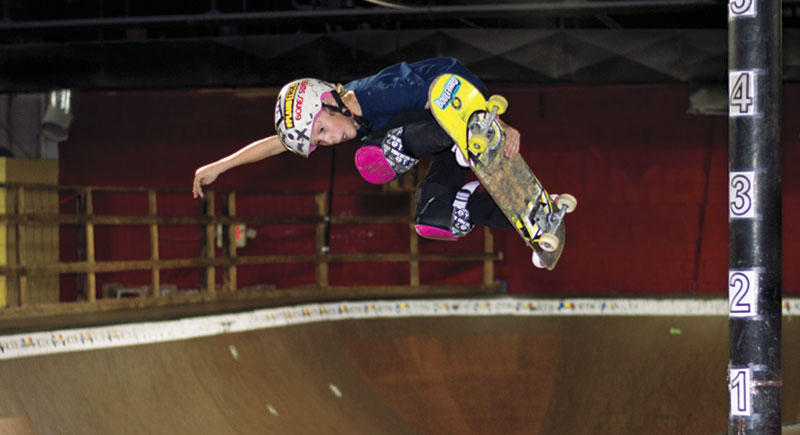
“My boys were six and four at the time,” Eaton says. “I wanted to introduce them to skateboarding, because I had skateboarded, and I loved it… but if you went to a skate park, what you came away with is what an inappropriate place for a child it is… you get a lot of riffraff, drug dealers, profanity. We needed an environment that was positive and safe, without bad people being able to get into kids’ heads.”
Enrollment at Kids That Rip fluctuates between 800 and 1,600 students during the school year, with tuition starting at $80 a month for one hour a week of training. Out of this student body, about seven students have “a modified schooling situation,” which allows them to spend hours a day falling on their butts preparing for global competitions.
But it’s uncertain how complete this education is, especially for a kid who might want to pursue a different career when his skateboarding days are over. “It depends on the quality of the homeschool experience,” says Dr. Kris Bosworth, a professor of education at the University of Arizona. “I’ve seen some terrific kids come out of homeschooling, and I’ve seen some kids with some big gaps.”
Eaton insists that world-class skateboarding is an education in itself. In 2013, for instance, his kids, in Germany to compete in the third stop of the Global X Games, did their lesson on World War II by visiting Dachau. “If there’s a better way to do it than that,” Eaton says, “I don’t know what it is.”
Skateboarding 101
At Mesa skateboarding school Kids That Rip, students “study” style and creativity in the following four areas:
Vert Ramp: Also known as a “half-pipe.” Transitions from a horizontal, flat-bottom plane (typically 15 feet high) to a vertical plane (6 inches to 2 feet).
Bowl Skating: “Like when they used to use backyard pools,” Kids That Rip owner Geoff Eaton says.
Street Skating: Utilizing skateboards on sidewalks, benches, handrails, etc.
Mega Ramp: “A 100-foot high roll into a 70-foot horizontal jump,” Eaton says casually. “You land that and go up a 22-foot quarter-pipe for another 16-foot vertical air.”