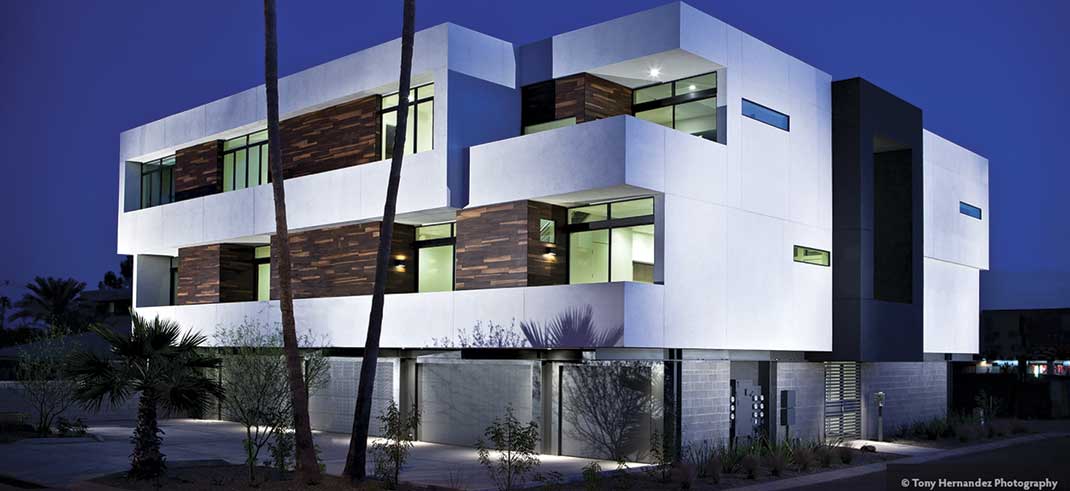
Arizona’s first “net-zero energy” townhomes were unveiled in Scottsdale last October. Designed by late architect Graham Downes (Hard Rock Hotel in San Diego) and constructed by Valley developer MODUS Icon, the townhomes at 7301 E. Minnezona Ave. – dubbed MZ – boast several energy-saving features (see key below). “Our goal,” MODUS Development president Ed Gorman says, “is to produce as much or more [power] than we consume.” That’s the technical definition of a “zero-energy” home.
While some green features – like automated thermostat and lighting controls, and orientating the building so all windows and doors face north and south – cost little to nothing, other components of a zero-energy building can give contractors sticker shock. “Individual line items intimidate contractors, but they will save money somewhere else,” Gorman says. Example: Spray foam insulation in a zero-energy home costs three times as much as regular insulation, but the air-conditioning unit for a zero-energy structure is 1.5 tons to the 4.5 ton-units typically found in traditional homes. Below is a breakdown of some key features of the new MZ townhomes, explained by Gorman, with per-unit construction costs.
1. Icynene Spray Foam
“Exterior walls and ceilings are filled with open-cell, soy-based spray foam to seal the building from air leaks.”
Cost per unit: $2,400
2. Sprayed Polyurethane Foam
“The roof is covered with two inches of Sprayed Polyurethane Foam, which provides a great barrier for insulation and water-proofing.”
Cost per unit: $2,200
3. Solar Panels
“Rooftop-mounted solar panels provide all of the required energy.”
Cost per unit: $0 (leased panels, included in HOA)
4. Hybrid Water Heater
“Heat pump technology absorbs the heat in ambient air and transfers it into water, resulting in savings of over 60 percent.”
Cost per unit: $900
6. PEX Plumbing
“PEX tubing does not transfer heat as readily as copper and therefore conserves energy. In addition, the PEX makes a direct run to each plumbing fixture and thereby saves water and energy to heat the water.”
Cost per unit: $2,400
7. 14 SEER Heat Pump
“The building is equipped with a high-efficiency 14 SEER (Seasonal Energy Efficiency Ratio) Heat Pump with variable speed air handler for its heating and cooling needs.” SEER pumps balance the amount of cooling a heat pump delivers with the watts of electricity used to power the pump, resulting in energy and cost savings.
Cost per unit: $3,900
8. Energy Recovery Ventilator
Exchanges the energy in the air exhausted by a home’s HVAC system and uses it to “precondition” (heat or cool) incoming outdoor ventilation air. “The load on the air-conditioner is reduced, thereby saving on cooling costs.”
Cost per unit: $600
5. LED Lighting
“LED lights significantly reduce energy consumption, lower heat output and last over 15 years.”
Cost per unit: $4,300