Not all of the vintage Looney Tunes are good. Some have aged poorly on a cultural level; others are just repetitive and lacking in edge. But the best of the Looney Tunes are little masterpieces, about as good as American movie comedy has ever gotten.
It’s always seemed like the greatness of these cartoons was strictly a product of their times. The passing of master directors and writers like Tex Avery, Michael Maltese, Isadore “Friz” Freling and especially Chuck Jones, not to mention the voice of Mel Blanc, along with the screwball sensibility that informed the era, meant that their great days were irretrievable. The latter-day attempts by Warner Bros. Discovery to continue the brand have felt second-rate and ersatz.
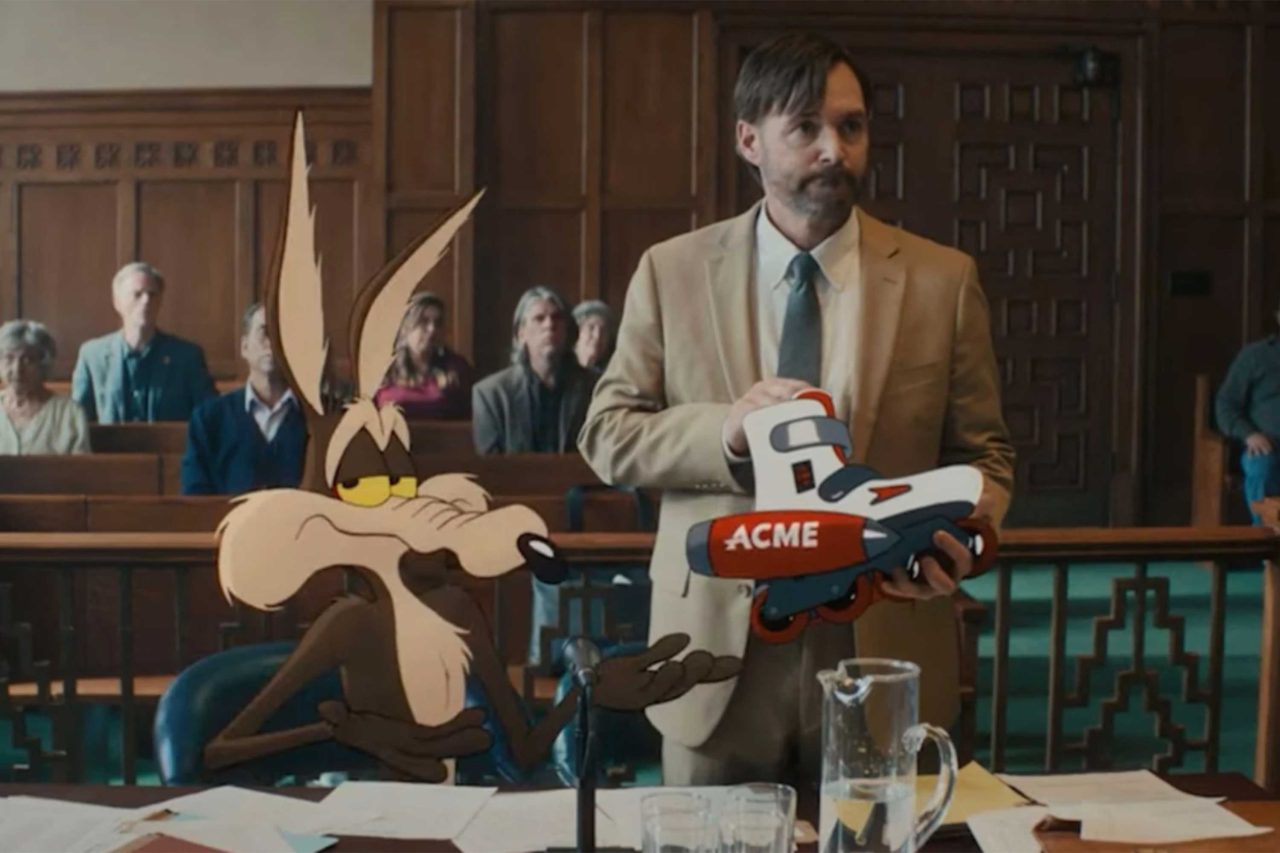
Until Coyote vs. Acme, that is. This new mixture of animation and live action, unfolding in a Roger Rabbbit-like world in which cartoon characters and three-dimensional humans coexist, is an unhinged underdog epic.
It stars desert dweller Wile E. Coyote, eternal, and eternally frustrated, pursuer of the elusive Road Runner. The Coyote’s Sisyphean fate is to hatch elaborate schemes to catch the bird. These often involve products – anvils, rockets, magnets, springs and the like – from a company called Acme, which invariably fail, causing the scheme to backfire and flatten the Coyote.
So in Coyote vs. Acme, directed by Dave Green from a script by Samy Burch and others (based on a New Yorker story by Ian Frazier), Wile E. decides to sue the corporate powerhouse. He engages a scroungy small-potatoes law firm in Albuquerque, Avery, Jones and Maltese, specializing in the slapstick personal injury cases of cartoons.
His lawyer, Kevin Avery (Will Forte), is a defeated, scruffy slacker who prefers to settle cases with Acme for chump-change nuisance sums. Wile E. is having none of this; he demands a trial, with the Road Runner as his chief witness to corroborate his humiliations.
Part of why Coyote vs. Acme works so much better than other attempts at Looney Tunes revivals is that, unlike the Mel Blanc-voiced characters, Wile E. doesn’t speak. In the shorts he was occasionally given a pompous academic voice, but he always worked best as a panto character: just his expressive face and now and then a little sign with a few words on it, like “OH, NO!” That’s how he’s presented here, and while many of the other stars of the Looney Tunes repertory company are impressively – though not perfectly – mimicked by Eric Bauza and others, the silent Wile E. is the movie’s emotional center.
Though silly, Coyote vs. Acme is imaginative and broad-canvas, with plot twists and committed performances. Forte handles his leading man duties nicely; Jon Cena is properly despicable as Acme’s slick lawyer; and Lana Condor, Luis Guzman, Tone Bell and Martha Kelly do credit to the movie’s live-action side.
Completed in 2023, Coyote vs. Acme was shelved by Warner for a couple of years for tax purposes; kudos to Ketchup Entertainment for catching up with this improbable triumph.
Civilization has collapsed in Ridley Scott’s latest, The Dog Stars. A plague of some sort has wiped out most of the country’s – and presumably the world’s – population. Our hero, widowed pilot and mechanic Hig (Jacob Elordi); his fearless dog, Jasper; and his survivalist pal, Bangley (Josh Brolin), defend a small regional airport outside Denver from marauders. Hig flies sorties into the empty city in his rickety Cessna to look for supplies, and thinks about flying off in search of surviving civilization. Bangley thinks that’s hopeless.
Of course, Hig eventually goes anyway, and what ensues, scripted by Mark L. Smith from a well-regarded 2012 novel by Peter Heller, is a mishmash of standard postapocalyptic themes. Hig meets some nice new people (Margaret Qualley and her dad Guy Pearce), and they run afoul of bands of howling, punkish raiders in the Mad Max style. It’s well-acted and capably directed, with some reasonably exciting action scenes, but there’s nothing new here.
The movie doesn’t fully run off the rails, however, until a black-comedy horror episode in the third act that’s too heavy-handed even for the great Allison Janney to save. It seems meant to be satirical, but I couldn’t figure out what it was satirizing.
Also, trigger warning to the many viewers who can’t abide watching the depiction of animal suffering: The animals in this movie have it rougher the Wile E. Coyote.