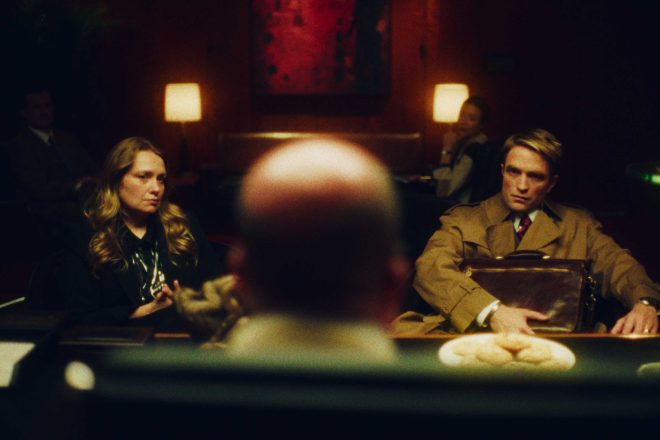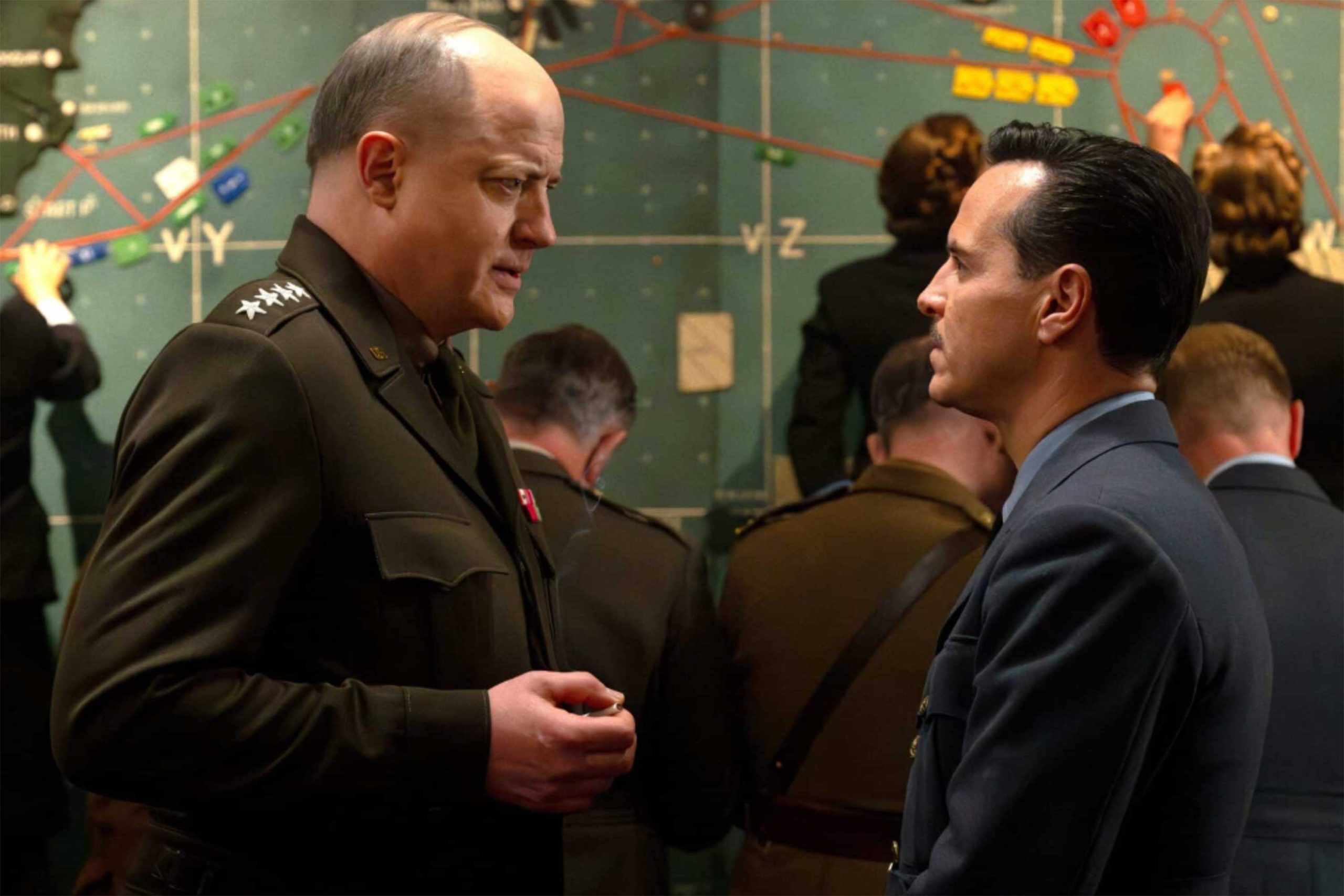
Although Brendan Fraser has a plum role as General Dwight D. Eisenhower, he’s not really the star of the new World War II drama Pressure. The leading man is Andrew Scott, playing Royal Air Force officer James Stagg, who was in charge of predicting the weather on D-Day, initially scheduled for Monday, June 5, 1944. The title has a double meaning; the pressure in question is atmospheric as well as military. The movie is the story of how a weatherman saved the world for democracy—porn for meteorologists.
Directed by Anthony Maras from a script he wrote with David Haig (based on Haig’s 2014 play), Pressure mostly unfolds at the headquarters for Operation Overlord in rural England, in the days leading up to the Allied invasion of France. Stagg is convinced that a severe storm will hit the Normandy coast on June 5, with winds and waves that will make the landings impossible. His hotshot American counterpart, Irving Krick (Chris Messina), basing his opinion on “analog” weather patterns from earlier years – and also on what he knew his superiors wanted to hear – predicts that nothing but blue skies will they see.
The arguments which ensue are, one might say, tempestuous. Stagg, a dour, dead-serious Scotsman, comes across poorly by comparison to the gladhanding Krick, and Ike and his cronies, especially Bernard “Monty” Montgomery (Damian Lewis, switching armies and earning a promotion since his breakout role in Band of Brothers), don’t want to hear that that their big event could be called on account of rain, especially when they can look out the window and see nothing but sunny and pleasant skies.
The tension that builds is considerable; I don’t think I’ve ever wanted bad weather to show up so much, even though I knew, as you probably do, what was coming. Though considerably streamlined and simplified, this is a true story, and it carries an emotional punch on several levels. First, it gets across how many individual acts of courage – not just battlefield courage, but courage of convictions – were necessary for the Allies to prevail. It’s also a tribute to expertise and competence, and leaders who listen to and respect it, even when they don’t want to.
Scott is sympathetic as Stagg, showing us both his off-putting manner toward his colleagues and the deep feelings residing behind his rough exterior. The audience with whom I saw the film seemed to take on almost a protective feeling toward him. This is reflected onscreen through the performance of Kerry Condon, terrific as always as Eisenhower’s long-suffering intimate aide Kay Summersby, who quickly registers Stagg’s decency.
Tall and imposingly fleshy, Fraser also manages to give us a human Eisenhower; his broad, wide-mouthed face registers all the pain and uncertainty under his blustering anger (Eisenhower had no direct combat experience). It was upsetting, though, to think that Fraser is of an age where he can plausibly play Eisenhower; it didn’t seem right that Encino Man or George of the Jungle could be Ike. It turns out, however, that Fraser is now indeed a couple of years older than Eisenhower was on D-Day. His boyishness endures, however.