One woman’s solo crossing of the Grand Canyon is more than meets the eye.
By Jessica Dunham | Illustrations by Nathalie Aall
“What the f*ck are you doing?”
Shawn Cheshire says this to herself in the pre-dawn hours of May 23, 2024. She’s perched at the North Rim of the Grand Canyon, about to depart on foot for the cross-canyon journey to the South Rim.
“Why the hell do you feel you need to do this?” she asks, continuing the interrogation.
It’s a valid line of questioning. The rim-to-rim hike is notoriously difficult, a perilous 23-mile trek of narrow switchbacks, uneven footing and sheer drop-offs. Departing from either rim, hikers descend 1 mile to the canyon floor before climbing back out. From start to finish, Rim-to-Rim typically takes a minimum of 12 hours to complete – or quite a bit if you camp. Of the 5 million annual visitors to the Grand Canyon, less than 50,000 – or 1 percent – attempt it. So, why the f*ck is Shawn Cheshire about to embark on this grueling expedition?
Because among that elite group numbering 50,000 or so, none in the world have accomplished the feat as a solo blind hiker.
Shawn Cheshire is blind. And she’s very much alone.
Cheshire wasn’t born blind. She lost her sight on December 29, 2009, on the eve of a new decade. The 34-year-old U.S. Army veteran was a single mother of two who had recently fled an abusive marriage and was clocking shifts as an EMT-paramedic in Syracuse, New York, to pay the bills.
That snowy day, while transporting a combative patient in an ambulance, Cheshire was knocked off her feet, striking the back of her head and sustaining a traumatic brain injury from blunt force trauma.
Doctors said the accident – of which Cheshire has no memory – caused what’s known as cortical blindness. It’s the total or partial loss of vision from damage to the occipital cortex, which resides – somewhat ironically – in the back of the brain. Cheshire’s sight deteriorated slowly and inexorably, and by June 2012, she was completely blind.
Because medical science hasn’t discovered how to regenerate damaged brain tissue, doctors told Cheshire she’d never see again. Not only that, but another hit to her head could risk the loss of speech or mobility, or worse – death.
Struggling with severe depression, Cheshire found an outlet in adaptive sports. She competed as a tandem cyclist for the U.S. National Paralympic Cycling Team, representing the United States at the 2016 Paralympic Games in Rio de Janeiro. She moved from New York to Massachusetts to Florida. But when a concussion sidelined her from tandem racing, it spurred yet another identity shift. She had lost her sight, then found her place as a para-athlete. Without that, who was she now?
In 2018, Cheshire attended a women’s retreat in the Grand Canyon to find out.
What she found was hiking. Or rather, hiking as a blind person. And even more specifically: hiking the Grand Canyon as a blind person. It was a revelation. Four months later, on October 8, Cheshire became the first blind woman to complete a double crossing of the Grand Canyon, accompanied by three sighted guides. Moved deeply by the experience, she moved to Flagstaff a short time later. Arizona became her home.
The question was no longer: “Who am I?” The question was: “What else can I do?”
Having spent a sleepless night in the parking lot of the North Rim, Cheshire readies her gear.
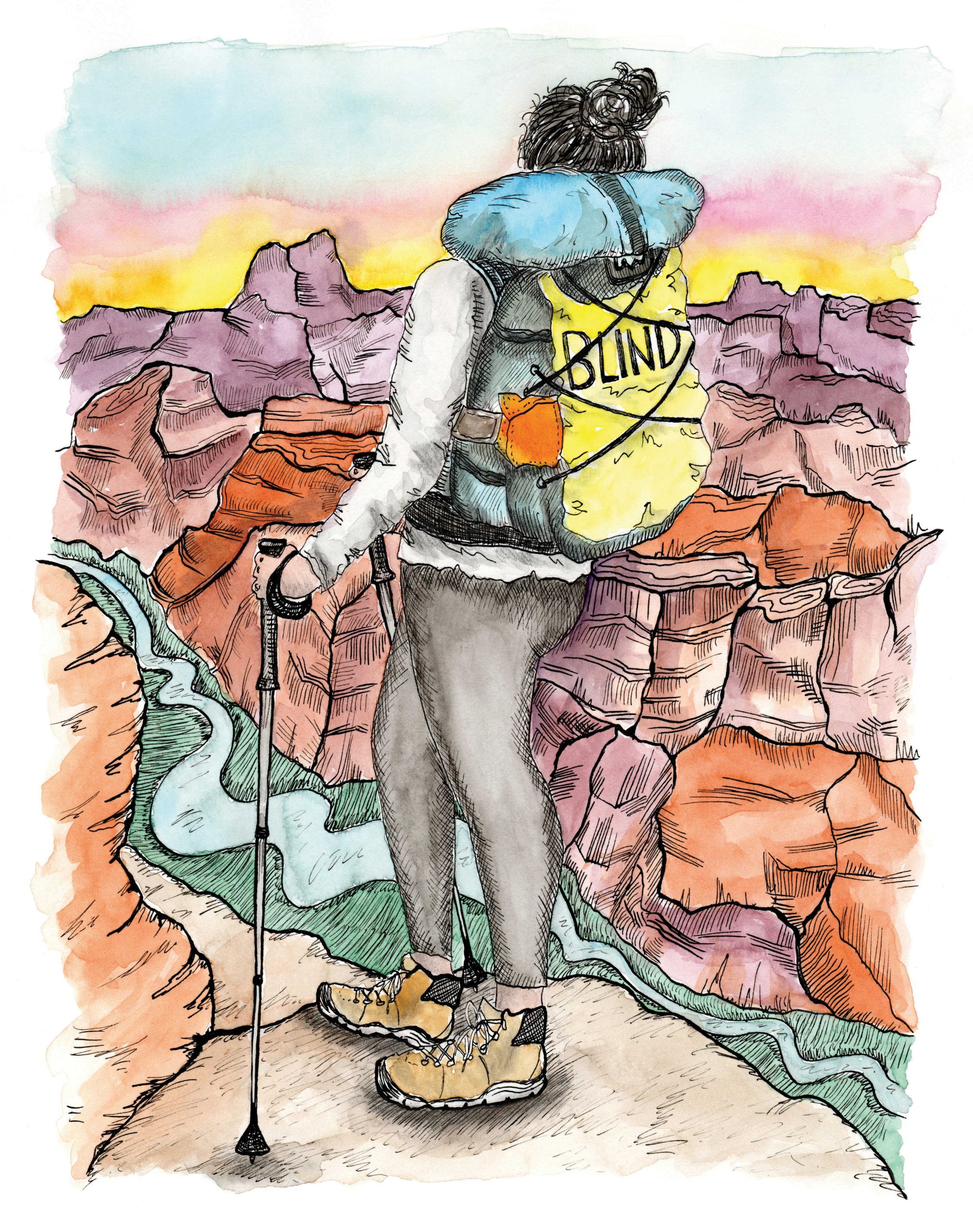
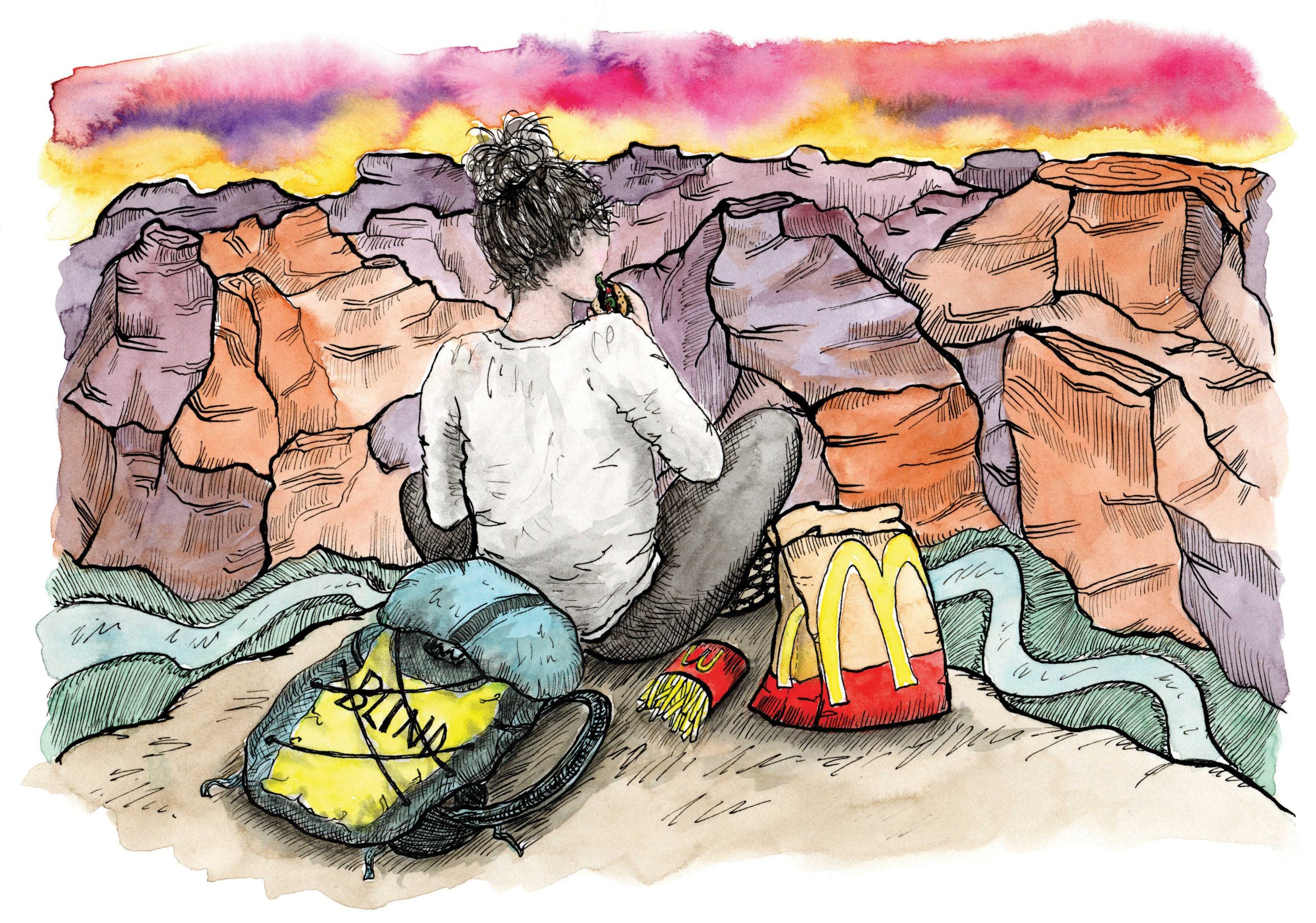
In a fanny pack: lip balm, salt stick, Band-Aids, migraine medication, peanut M&Ms and her phone. In a backpack: Garmin GPS device, 3-liter hydration bladder, spare battery, extra socks, a flask of espresso and two bottles of Coca-Cola. Affixed to the backpack’s exterior: a sign emblazoned with the word BLIND. Cheshire brings her white mobility cane, but she’ll rely on hiking poles to feel her way along the trail.
It’s a misnomer to say that she’s alone in these wee hours of May 23, 2024. Two friends, Jesse Crandall and Liz Drum, have also spent the night, the three of them hunkering down in a 31-foot RV.
Cheshire is attempting to become the first blind person to complete a solo rim-to-rim hike, and the group has a safety plan in place. Crandall and Drum will follow her to Phantom Ranch on the canyon floor, about midway through the journey, where another friend, Scott Drum, will join the entourage. The three will maintain a distance of a quarter mile behind Cheshire and will not talk to her, help her or otherwise interact with her unless she quite literally is about to fall to her death.
It’s 4 a.m. Cheshire high-fives Crandall and Drum, flicks on her headlamp – which she wears so others can see her – and stands at the trail’s edge. The canyon bleeds darkness. Cheshire can’t see that. But she can sense it. She’s shaking with terror, imagining wrong turns and missteps and dagger-edged cliffs.
She remembers back to those first weeks after she lost her sight completely. She would spend hours standing still, so still, on her front porch, absorbing the sounds of the neighborhood – the hum of traffic on a nearby road, a dog barking – and frightened to set foot into the world. Wondering how she was going to get to the post office, or the grocery store. It soon became clear, though, that there was no such thing as alleviating the fear. No matter how long she stood on that porch, the fear persisted. You have a choice, she realized. You can either stay put, or you can step out.
Cheshire takes a deep breath. And steps out onto the trail.
Going down is harder than going up. The footing is less firm, there’s more loose rock. The chance of slipping is pretty darn good. Cheshire knows the descent from the North Rim, less groomed even than the scabrous South Rim trail, will be the most challenging of the day.
Adrenaline pumps at an all-time high, weakening her legs. It’s imperative that she focus. She turns and steps down the trail sideways until her heart rate slows.
Cheshire possesses a skill that her friend Scott calls “mind-mapping.” Put her in a new environment and Cheshire can sense where furniture or people or animals are by picking up the sound vibrations they give off in order to commit the scene to memory, creating a map in her head.
Though it’s reasonable to assume she adopted this practice since becoming blind, Cheshire knows it’s something she cultivated long before.
Growing up in Texas, her childhood was one of emotional neglect and physical and sexual abuse. From a young age, Cheshire learned to read a room instantly to know if she was safe or not.
Here, in the canyon, she deploys that superpower to mind-map the contours of the switchbacks and the textures of the trail. There’s a rock wall to one side and a gaping maw on the other. Using the sound of Bright Angel Creek as an audio anchor and her hiking poles to feel the wall, Cheshire maneuvers down.
She listens to her shoes crunching. If there are trees, the sound is absorbed. If there’s nothing but open canyon, the sound carries. And in areas where the ground doesn’t offer much crunch, and therefore no sound to reverberate, Cheshire flips on a tiny JBL speaker dangling from her backpack, the tinny sound of coffeehouse tunes clueing her in to the proximity of rocks, walls, ledges.
She also feels the tilt of the path as it approaches a bend in the switchbacks. She senses a slight decline in her left foot as the trail angles left. For right turns, a dip under her right shoe. Cheshire finds the rhythm of high-low, left-right, high-low, left-right to anticipate each curve, quickening her pace as she settles into the cadence.
Two miles in, Cheshire comes across something unexpected. There’s an impasse in the trail. She nudges with her hiking pole, tracing the height and length of it.
A rockfall. But how big? Can she get around it?
Cheshire stops and listens. She hears hikers in front of her, their voices retreating, which means they came from the same direction she did and somehow found a way around the obstacle. She clips her hiking poles to her pack and uses her hands to feel the pile of rocks. It’s large, but not so large that she can’t climb it. Tucking in as close to the side of the canyon wall as possible, she scrabbles up and over, finding solid footing and an obstruction-free route on the other side.
She soon arrives at Cottonwood Campground at the bottom of the rim, refills her water, then pushes on. She’s about an hour from Phantom Ranch. She has a feeling she’s on pace for a fast finish, not just for a blind hiker, but for any hiker attempting Rim-to-Rim.
She remembers a doctor telling her after her sight deteriorated: “Everybody thinks that once you lose one sense, the others instantly become more heightened. That’s not the case. If you want your senses to step in and overtake what you’ve lost with your vision, you’re going to have to practice.”
And that’s what she did, walking hallways lined with doors, listening for echoes to determine which ones were closed or open; solving math problems and spelling tests while doing strength exercises with her trainer; deciphering the scents of different people. Basically, chiseling her remaining senses to so fine a point that her mind and body vibrate with an alert energy.
It’s this energy that now suddenly prickles with alarm. Cheshire hears a sound on the trail.
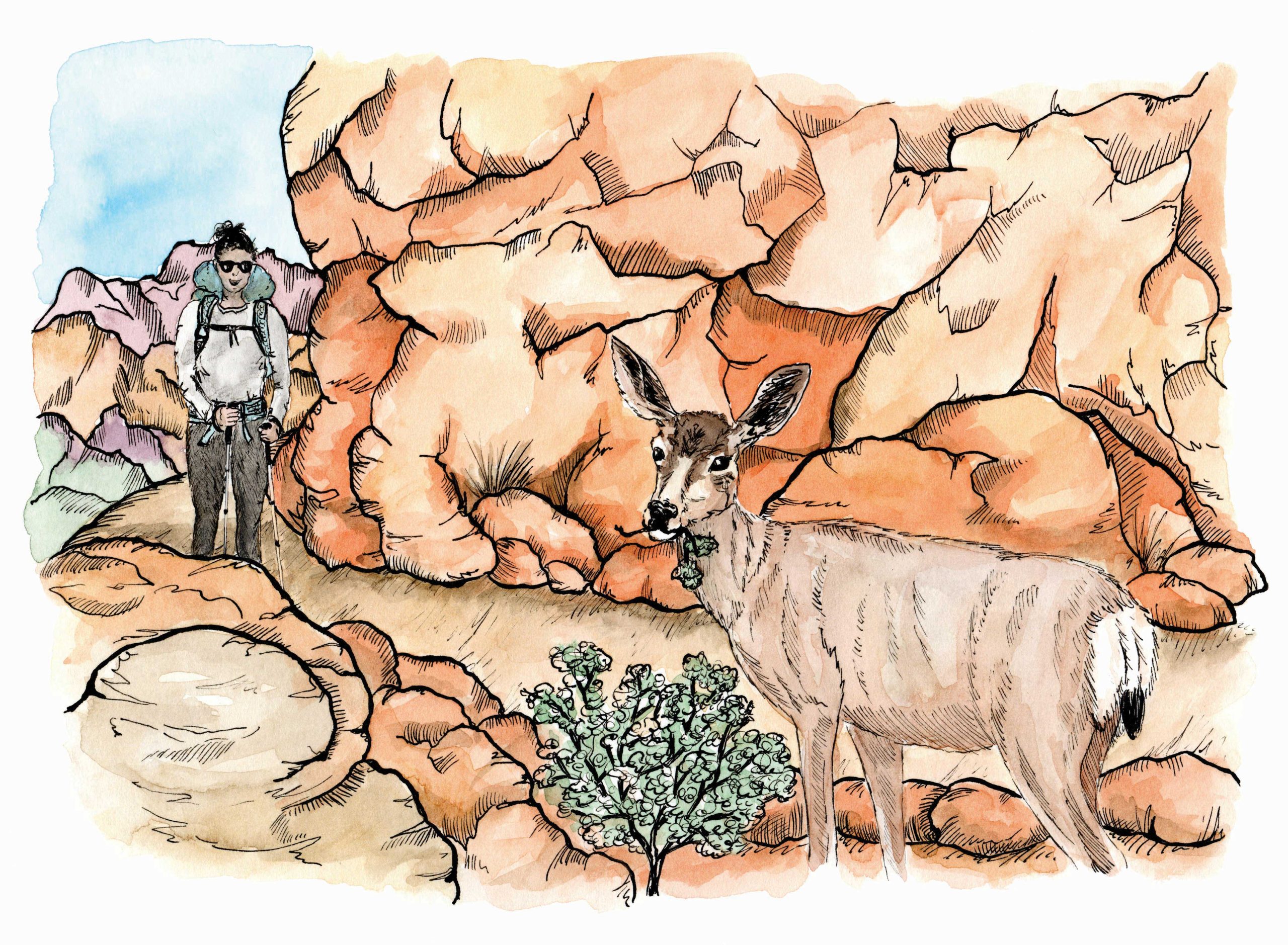
Rustling. Leaves brushing against leaves. A body – something enormous, much larger than a human – moving very, very close.
Liz had warned Cheshire about mountain lions. Is that the noise? A mountain lion behind a bush?
Cheshire freezes. She hears the animal freeze, too. It shifts its weight in her direction. Before she can think or act, Cheshire picks up the familiar sound of hikers clomping down the trail. She shouts.
“Wait, stop! There’s something in a bush! It might be a mountain lion!”
The hikers approach and see that it’s only deer nibbling on leaves. When they tell Cheshire, she heaves a sigh of relief. The hikers express amazement that Cheshire was able to hear the deer at all, and also shock at how close the animals are to her. They’ve never seen anything like it. And in a small irony, neither has Cheshire.
Being blind is noisy. But not in the way sighted people think.
For the visually impaired, the brain thrums with concentration to interpret a near-constant flood of information about the external environment. Without vision, the world comes into sharp relief, often in exhausting ways. Sighted folks can find respite in zoning out when life gets difficult. That’s not always true for a blind person. That isn’t true for Cheshire, and it wasn’t true even before she became blind.
From an abusive upbringing to struggling with PTSD in the military to a marriage fraught with fear and hurt, Cheshire’s had to overcome hard things. She’s grappled with abandonment, fought for her safety and that of her children, heard parents and partners tell her she wasn’t good enough. For 40-some years, she’s lived in a constant state of adrenaline-fueled hyper-awareness just to survive.
It took losing her sight to finally see just how much pain she’d been carrying. Every mile Cheshire bicycled as a para-athlete, every step she took during the double-crossing of the Grand Canyon, every hour that ticks down to completing today’s solo rim-to-rim hike, for her, has simply been one leg after another of a passage to healing.
The sun arcs overhead. As the day warms, it blooms into a marvel of bluebird skies set against the striated reds and purples of the canyon. Cheshire arrives at Phantom Ranch.
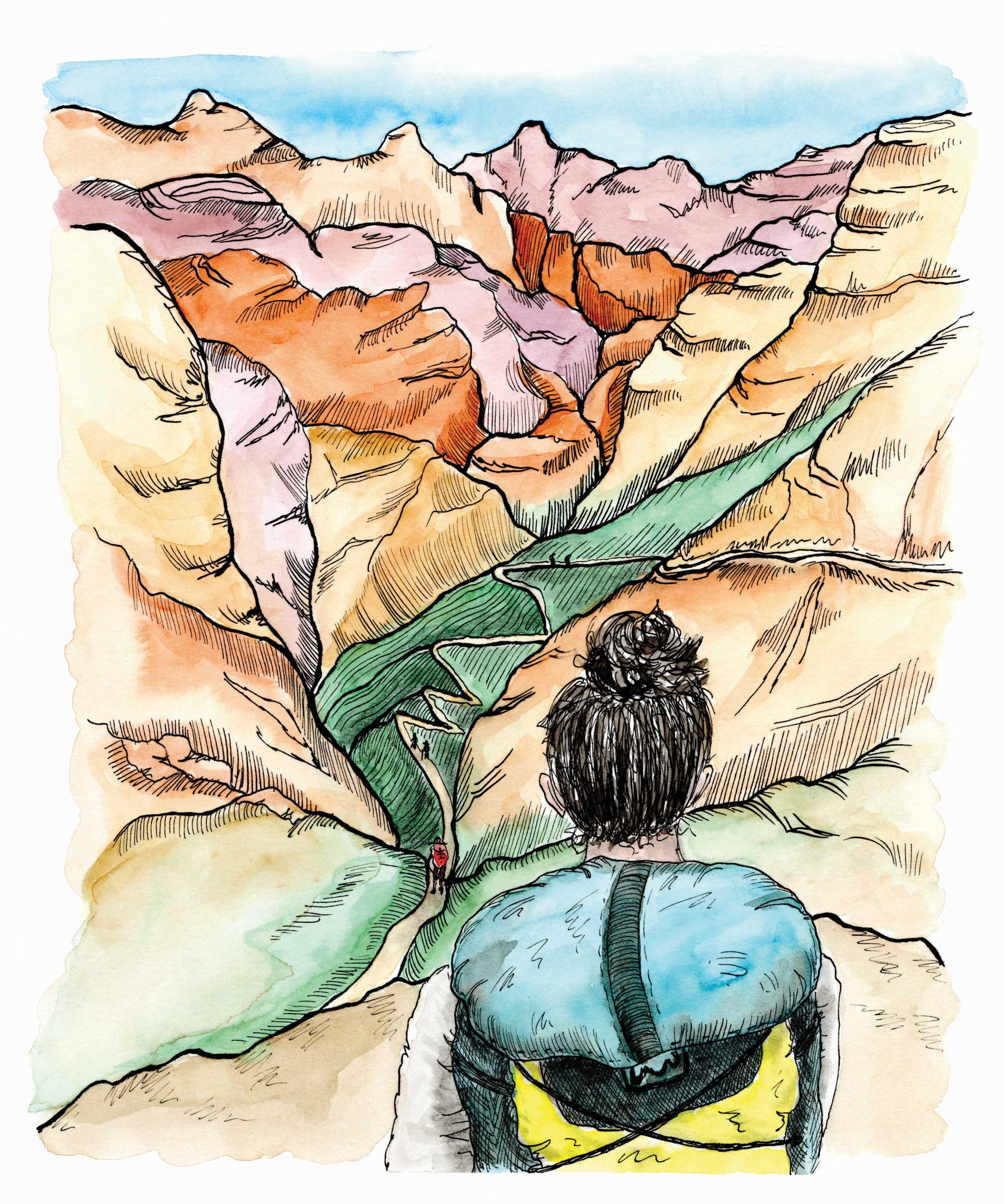
Hikers mill about. They dip sore feet in icy water, heave packs off tired backs, devour granola bars like they’re porterhouse steaks.
At Phantom Ranch, Cheshire sits for the first time today, maybe five hours into her journey, maybe six. She isn’t keeping time. Whatever the clock says, she can’t believe she’s made it this far. She feels her emotions swell. But she knows she can’t succumb to them. Not now. Not yet.
She slides off her shoes to find an old business card wedged in one. She’d been so nervous this morning she hadn’t realized it was there – nor, apparently, noticed it rubbing a whale of a blister on her heel. She stuffs the card in her pocket.
Cheshire eats a snack, uses the bathroom, then asks some hikers where the water is so she can refill her supply.
“Over there,” they say.
“Can you be more specific?” Cheshire replies. “I’m blind.”
“What?! You’re blind?”
There’s a pause.
“Is it… is it OK if we ask you a question?” the hikers inquire. Cheshire loves this. She loves meeting people, and she especially likes when they are curious about her blindness. This is preferable to pretending she doesn’t exist, that her blindness isn’t real.
“You can ask me anything.”
“How are you doing this? We can see where we’re going and we’re struggling! We’re tripping, banging our toes, twisting our ankles. How do you do it?”
Cheshire thinks for a minute, then laughs.
“Same as you. One step at a time.”
She straps on her backpack. It’s time for the ascent.
The sun is high. The day is hot. Climbing up South Kaibab to the South Rim, there is no shade, no breeze. Just rocky switchback after rocky switchback overlooking one of the planet’s broadest chasms. Cheshire feels her heartbeat throb in her ears. She doesn’t have the privilege to mentally check out. She must pay attention to every footfall.
She decides to count steps to distract herself from the staggering heat. The added benefit? Counting will keep her brain engaged in the task at hand – hiking out of this canyon safely.
Cheshire counts 50 steps, then rests for 30 seconds with her back to the sun. She counts another 50. Rests for 30 seconds. Again. And again.
Someone shouts. It echoes through the canyon, breaking her count. They yell again, screaming Cheshire’s name. She recognizes the voices of her friends, Jesse and Liz and Scott, calling from their sightline to Cheshire a quarter mile away.
“Shawn! You’re five minutes to 11 hours! Five minutes to the top! YOU’RE UNDER 11 HOURS!”
Cheshire knows she’s moving quickly, but had no idea it was that quick. She’s going to make it. She can’t believe it, but she’s going to make it, and in record time.
To nobody but herself – and the canyon, which hears everything but gives away nothing – Cheshire whispers: “Let’s go, bitch.”
Cheshire hauls up the switchbacks.
She counts steps.
She breathes in.
She breathes out.
She remembers the crisp smell of the air that morning, the earthy redolence of dirt. She recalls the balmy scent of humidity as she neared the river. And there was the acidic odor of urine from where hikers peed off the side of the trail. All the smells of the day signaling where she was on her journey.
Now, here: The fragrance of shampooed hair and deodorized armpits and perfumed wrists – none of the ripe tang of sweaty, weary thru-hikers – tells Cheshire she’s close to the visitor-crowded South Rim. Tourists always smell like Chanel.
Her muscles push, her hiking poles strike out in front to ensure a clear path forward. She takes the last few steps. Then Cheshire emerges from the Grand Canyon to a chorus of cheers from friends at the top, including her guide dog, Nick, and the friends below still making their way out of the canyon.
Emotion overcomes Cheshire and she cries for the first time today, a gasping sob that folds her in half, hands to knees, breath catching in her throat.
She just hiked from the North Rim to the South Rim of the Grand Canyon, totally blind, completely unguided, and fast. Her time: 10 hours and 58 minutes.
Both as a blind person, and a person forged from the fire of trauma and pain, Cheshire lives in the contradiction of nothing is possible and anything is possible. Becoming the first blind hiker to complete a solo crossing of the Grand Canyon is a perfect example of this, and one that will earn her a degree of celebrity – this hike, and another rim-to-rim she will undertake the following October, will be recounted in print, TV and web stories around the world.
But today wasn’t about breaking records or making national news.
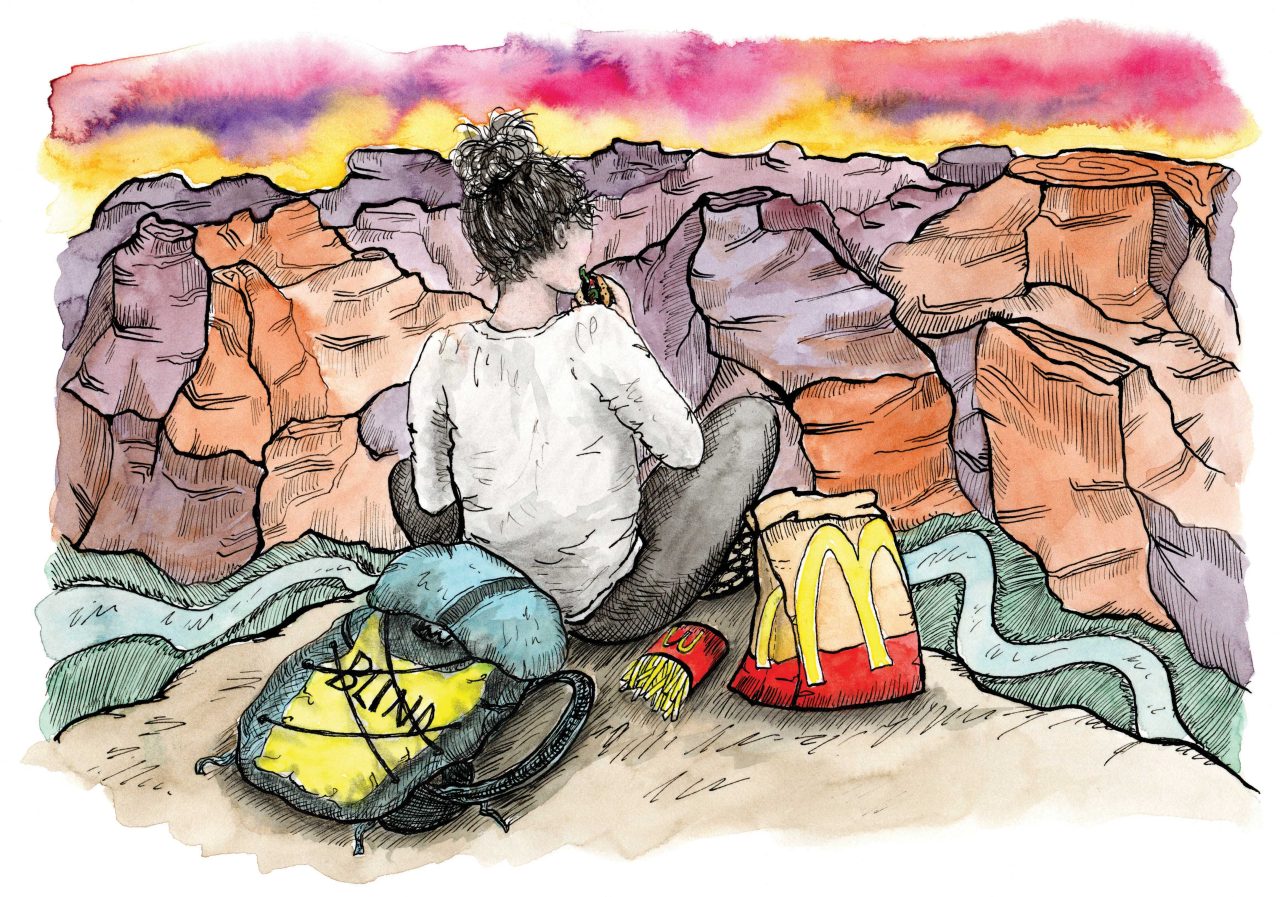
Cheshire bites into a post-hike Quarter Pounder from McDonald’s at the Grand Canyon Village and thinks back to this morning at the North Rim when she demanded answers from herself. A chance to exist outside the contradiction of possibilities, if only for 10 hours and 58 minutes?
“That’s why the f*ck I needed to do this.”
She takes another bite of the burger. It’s the best thing she’s ever tasted.
Shawn on Film
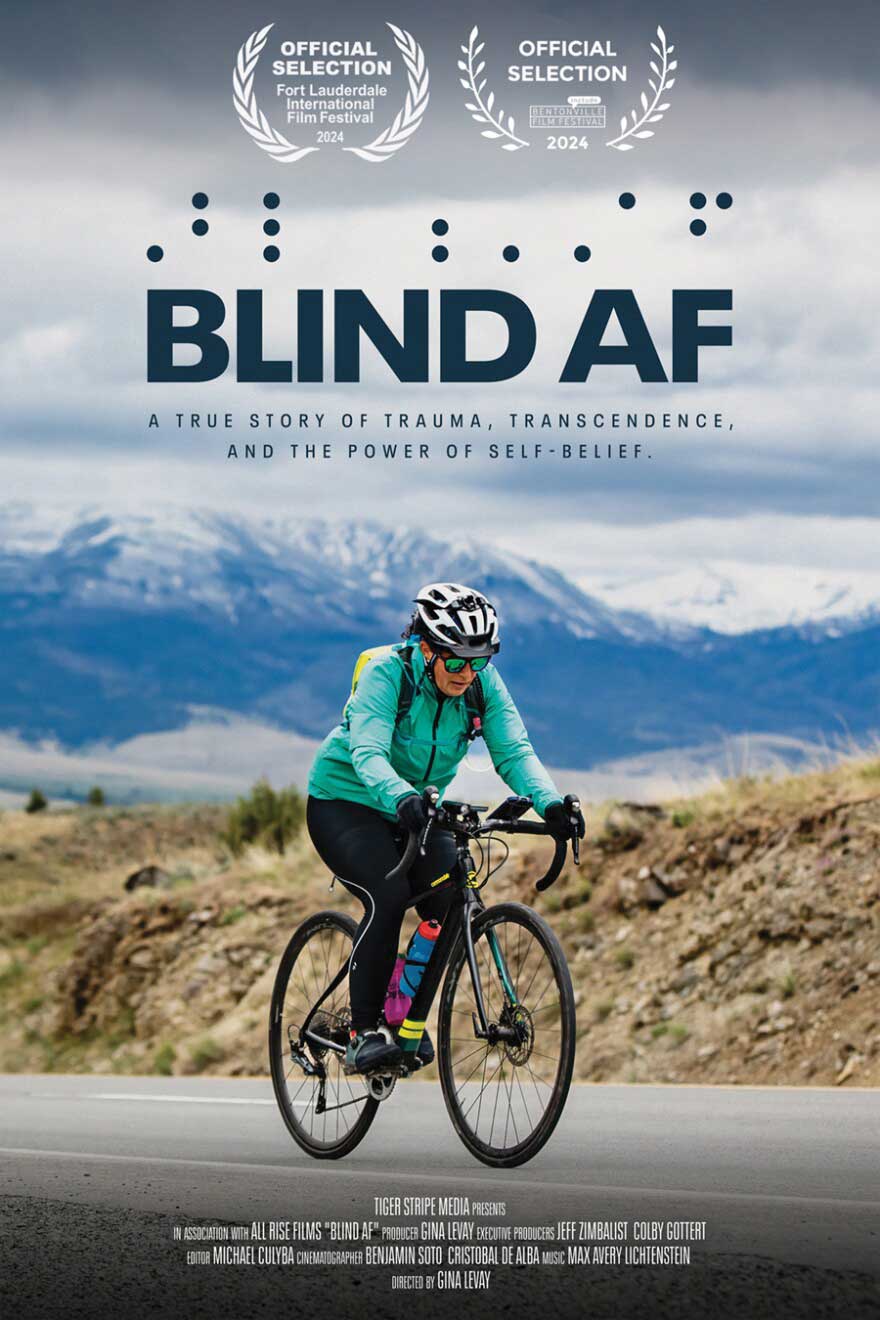
Shawn Cheshire’s solo crossing of the Grand Canyon is one of several exploits in her athletic trophy case, including the completion of Tour Divide, a 2,700-mile mountain-bike race from Banff, Canada, to the U.S.-Mexico border, and a Mount Everest summit attempt. In 2021, she finished a 3,700-mile transatlantic road-bicycle trip, becoming the first blind person to cross the country alone on a bike. A film crew captured the 60-day odyssey for Blind AF, a documentary debuting this year at film festivals, including the Sedona International Film Festival (sedonafilmfestival.com). “It’s a story of healing in motion,” Cheshire says. Directed by Gina LeVay, Blind AF chronicles the harrowing bicycle ride and offers an intimate portrait of Cheshire herself. And yes. The “AF” in the title stands for exactly what you think it does.