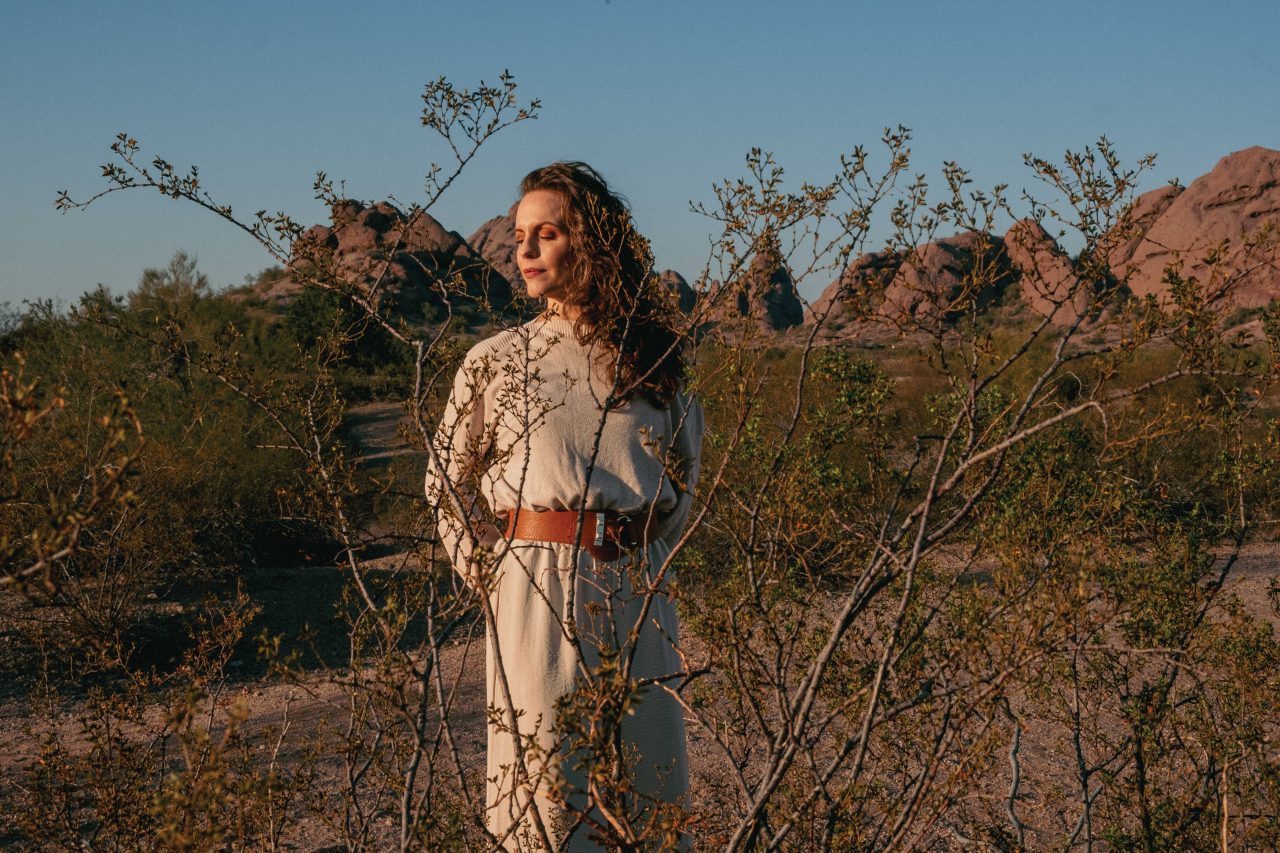
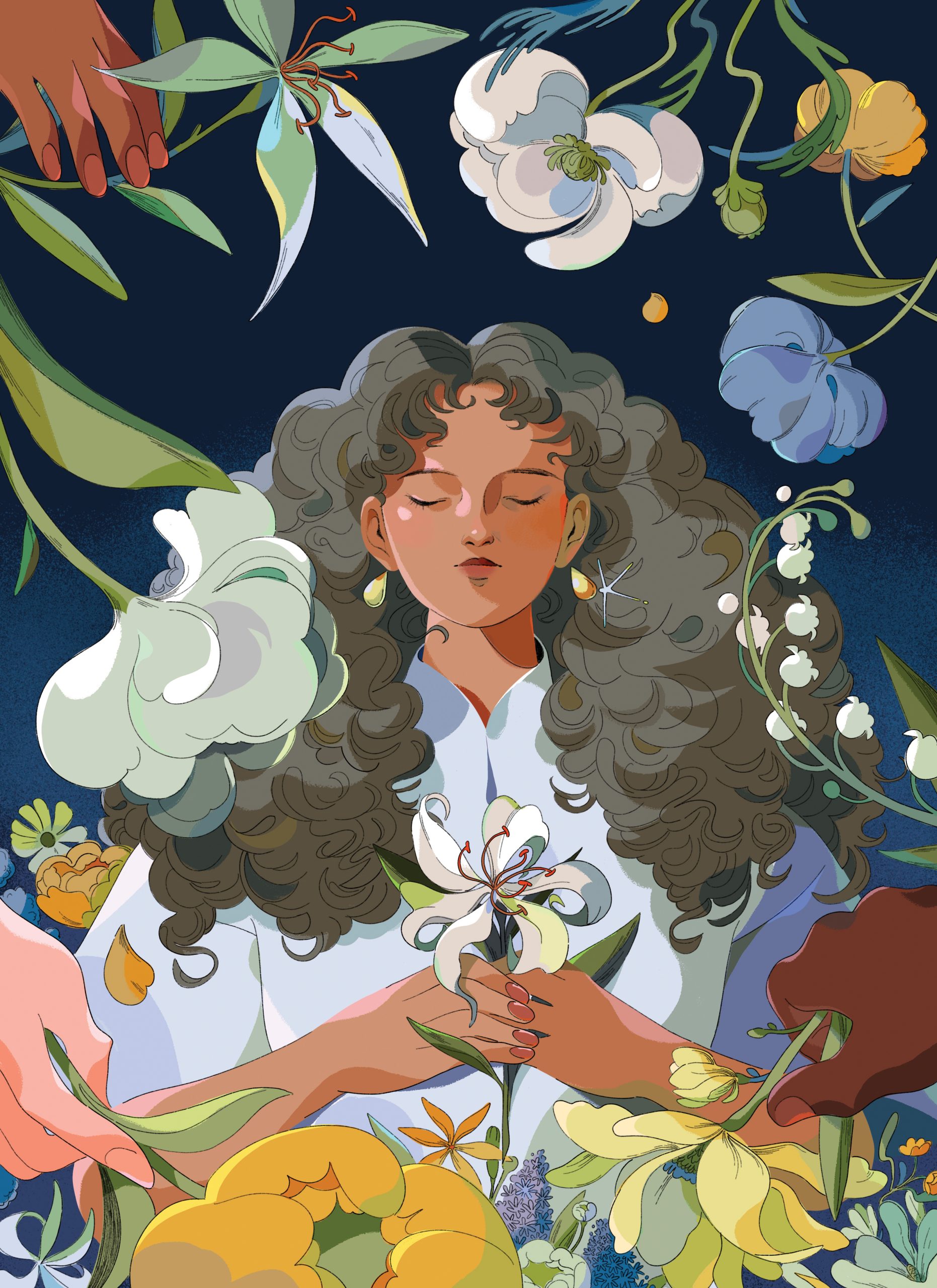
Like their birth-work counterparts, death doulas aid clients in transition. But where birth midwives bring life into the world, end-of-life midwives help people leave it.
By Leah LeMoine | Illustration by Kim Salt
When Jennifer O’Connell helps families plan home funerals, they’re usually for older folks. But last summer, her “client” was a 12-year-old girl.
“She had cancer, and it had come back,” she says. “I got to meet her and really talk to her about what things she would like. We picked out this beautiful wicker casket, and she had these fuzzy little pink flannel sheets, and [decided] what she wanted to wear.” Her siblings each picked a stuffed animal to lay in the casket with her.
Helping the girl and her family through the dying process “was the most moving [experience] to me in all that I’ve done,” O’Connell says. “Being a mom, you know, it really hit close… Guiding the family in it, it’s this closure. It’s this amazing healing closure.”
O’Connell is a death midwife, a person who supports the dying and the bereaved throughout the death process. Also known as death doulas, end-of-life doulas/midwives and death workers, they are consultants and educators who provide support on a variety of levels.
Sometimes, they assist in purely practical matters, like estate planning and advance directives – “the death file,” as O’Connell calls it.
Others address the more emotional and spiritual aspects of dying – creating rituals and ceremonies, leading meditations, facilitating conversations with family and even serving as deathbed confessors. At the most basic level, they simply sit with people, listening to them as they work through their fears and grief and bearing witness to “the transition,” O’Connell says.
“We’re not replacing funeral people or doctors or hospice,” she says. “We’re so complementary to everyone. We need all those folks.”
Paradise Valley death midwife Kim Stravers agrees. “One of my teachers, Angie Buchanan… likens the work of death doulas to being the water that flows between the rocks of the funeral industry and the hospice industry,” she says. “We come in and we really do interface with both of those boulders, but we are going over, around, underneath and just filling in.”

The existence of these practitioners has made its way to mainstream consciousness only in the last few years. Independent film projects Death and Her Compass (2021) and A Good Death (2023) shone lights on death doulas, as did an episode of the Netflix docuseries The Future Of (2022). In 2023, People magazine profiled death doula Martha Heymann. In 2024, death doula Alua Arthur’s book Briefly Perfectly Human: Making an Authentic Life By Getting Real About the End made The New York Times bestseller list (Arthur also gave a TED Talk about her work that year). In February, KJZZ dedicated a Voices of Arizona segment to Prescott death doula Susan Wielechowski.
“It’s something we’ve been doing for one another since the beginning of humankind. Someone, I would imagine, would always have been next to someone who is dying,” Stravers says. “It’s only really been in the last maybe 10 years or so that it’s come forward as something that folks can do outside of their families and outside of their immediate communities, in a wider range of helping folks that they’ve never met.”
Historically, human cultures have tended to take care of their dead at home – or at least within their close communities. In the United States, a tectonic shift in death care happened during the Civil War.
“Embalming was introduced because we had so many decedents on the battlefields who were far from home, and the aim was to preserve the bodies as best as possible so that they could be returned to their families for the traditional funeral rites that were still conducted in a home,” says Stravers, who has also worked as a funeral attendant and celebrant. “As embalming became more popular, more of an available option for the everyday person, it engendered the specialty of someone who could undertake the funeral arrangements.”
The professionalization of funeral services largely removed death from the family sphere and, consequently, induced physical and emotional distance from the dying process. “People have gotten less intimate with death and more afraid of it,” Stravers says. “And that is inseparable from the outsourcing of death and dying into industry.”
The seeds of the modern “death-positive” movement (chronicled in 2018 by The New York Times) were sewn in the 1970s and 1980s, alongside the establishment of the first hospice facility in the U.S. in 1974, the passage of the Natural Death Act in 1976, the Chicano Movement that brought Día de los Muertos to the public, the introduction of palliative care and the “die-in” protests of the AIDS crisis. Its central tenet is a more authentic, nuanced and thoughtful view of death and dying, and a more empowering one.
“When you ask somebody, ‘What are your plans for dying?’ They almost always just tell you what happens after they die,” says Emrys Staton, a chaplain at Suncrest, a home health and hospice company in Phoenix. “Like, ‘Well, I’ve got my affairs in order. I’ve got my will set up.’ … Very, very few people will have a plan or an idea of what dying could look like, or how they would want it to go for them.”
It’s something most people don’t think about until they reach an advanced age, or until they’re diagnosed with a terminal illness. In his 2024 book, Finally Fearless: Exposing and Resolving Our Greatest Fears Around Death and Dying, Phoenix clinical social worker and health-care consultant Cameron Svendsen advocates for articulating and communicating one’s vision for one’s death much sooner.
“I really want more people to be proactive,” he says. “If we can remove the clinical side and move death into more of just a personal, social reality, we’ll remove the taboo and the stigma, and… make it less fearful, less apprehensive and actually more fun, because it’s about life and not about death. That’s what planning for out-of-life should be.” Svendsen, who co-founded Palliative Care Alliance in Phoenix, says death doulas could be part of changing that discourse.
“I think they’re massively misunderstood and undervalued, and because of that, they’re under-utilized,” he says. “We celebrate the birth of a child. What we don’t celebrate is the loss of somebody – we mourn it. And so, this end-of-life doula concept is often shunned because, ‘Ah, I don’t want to bring that up. We’ll talk about that later.’ Just like everything else that surrounds death. But for people that do want that and do want the expertise in that area, they are so valuable.”
The breadth, depth and shape of that expertise varies from practitioner to practitioner. There is no central governing body that licenses death doulas in the United States. Rather, individuals, collectives and organizations have developed their own training programs, certifications and proficiency metrics.
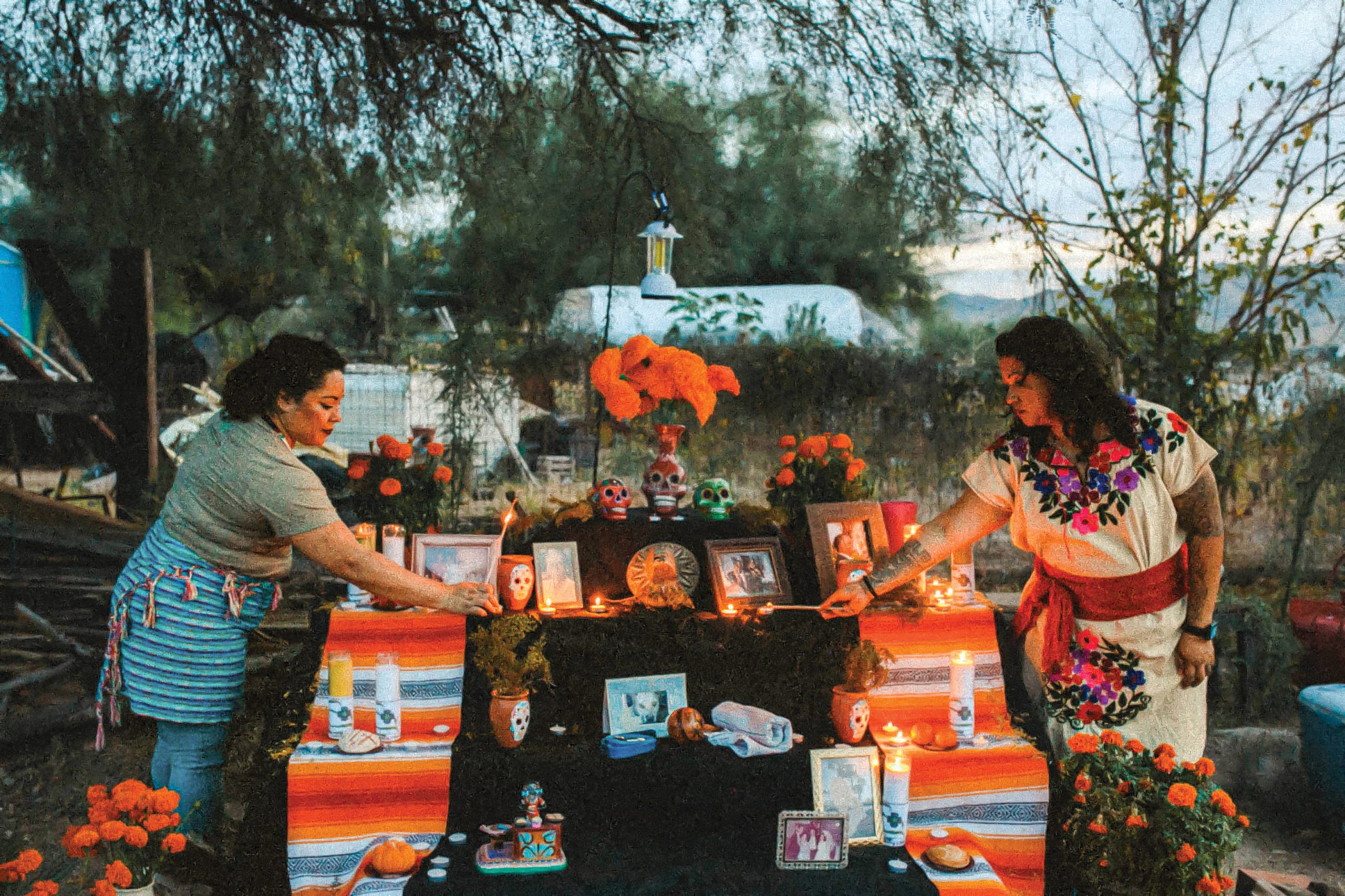
Some death midwives may train under multiple “schools,” if you will, while others eschew formal training and work from their lived experiences sitting with the dying and grieving. This is particularly true in Indigenous, Latin and African cultures, where death is viewed non-linearly and there are strong traditions and ceremonies marking each stage of the life cycle.
The International End-of-Life Doula Association (INELDA) is one of the preeminent educational and advocacy organizations in the death-worker space. Headquartered in New Jersey, INELDA offers a 40-hour death doula training that emphasizes “actually sitting with the dying individuals,” executive director Douglas Simpson says. It has trained nearly 8,000 death doulas, including 169 in Arizona, 31 of which are in Phoenix. “Which is a significant amount,” he continues. “But if we’re not creating spaces for them to be in, we’re not creating partnerships with hospices or getting hospices to understand the value or benefit, then it’s kind of for nothing… As much as we’re advocating for spaces for doulas to come in, we’re also advocating for reimbursement.”
Money is an even stickier wicket than credentialing. Since death doulas are not formally recognized by the highly regulated hospice industry, they are not eligible for reimbursement from Medicaid. They’re also not covered by traditional insurance. “That makes it challenging to integrate,” says Staton, the hospice chaplain who started Suncrest’s doula program during his time as its volunteer coordinator and trained as a doula himself. (As with many care professions, death doulas trend female, but this is not exclusively the case, as Staton and Simpson show.)
If a hospice wants to utilize doulas, it or its clients must pay out of pocket, à la the concierge model, or “employ” them solely as volunteers. Many death doulas volunteer at hospice companies that do not formally acknowledge them as such. A representative for Hospice of the Valley, for example, said that the organization does not work with death doulas. But at least one of the end-of-life workers interviewed for this piece has volunteered there.
Many death midwives operate private practices and charge for their services – ranging from a flat fee to an hourly rate to a sliding scale. Stravers posts her pricing on her website and sees no issue with charging for the services she provides (her specialty: “bedside,” or sitting with people in person), but she also does a great deal of pro bono work and acknowledges that death midwifery isn’t her sole profession – she makes her living as a writer.
By day, O’Connell is the director of a Down syndrome nonprofit. “I always tell people they can give me what they would like to give me,” she says. “Kind of an honorarium.” But she often provides gratis help in planning home funerals, which has become her niche.
Many others do not accept payment, viewing their work as a gift, an energetic exchange or even a ministry of sorts. Enjolie Lafaurie and Maria Del Carmen Parra Cano do not charge for the support they provide as death comadres (co-mothers) in Phoenix’s Cihuapactli Collective. They co-founded the group in 2015 and have grown it into a nonprofit that provides food distribution, Indigenous healing and a community mental-health program, among myriad other endeavors. “We say we support urban Indigenous families from womb to tomb,” Lafaurie says. “Many of us have training in the birth and the end-of-life care side.”
While the collective has its own death comadre curriculum – developed by Lafaurie – to train others, Lafaurie (a psychologist and hypnotherapist) and Parra Cano (a chef) don’t advertise their personal services as comadres. Requests for help come through word of mouth. “It’s been mainly people close to us, in similar circles, or our extended family,” Parra Cano says. “It’s just, ‘How do we show up?’ With our Crock-Pots and all.”
Like many death midwives, they draw from their own experiences with loss. Lafaurie’s father and husband died within one day of each other. Parra Cano lost her infant son.
“We had to prepare unexpectedly for that and learn how to navigate that from not only our family, but from a community perspective,” Parra Cano says. “How do we heal? How do we grieve? How do we do all this from a healthy community lens?”
They do so through ceremonies and spiritual work, like cleansings, blessings and songs. And through more practical avenues: Parra Cano has mastered the “death binder” of documents and administrative tasks, and Lafaurie’s skill in having “the one-on-one hard conversation” means she’s often called upon by people who are “choosing whether or not they’re going to die.” Should they keep fighting or accept – perhaps even welcome – death?
“Sometimes people do go more peacefully,” Stravers says. “Sometimes, it doesn’t look like that.” While she works with clients who enlist her services, she is also often called for “11th hour” vigils with people she has never met. These dying people may not have friends or family to sit with them, or perhaps their loved ones live elsewhere and can’t get to the deathbed in time. On one such visit, a woman in an assisted living facility had been moaning and wailing for hours. She was noncommunicative and inconsolable, even after exhausting pain-management measures.
“It just hit me that this person’s distress was not necessarily physical pain. It was possibly just an emotional or spiritual reckoning,” Stravers says. “I was in this extraordinary position to just be witness to someone in this moment of suffering, and remain calm in it. Not try to fix it, not try to get her to quiet down, not try to get her to do anything… The whole purpose of me being called there was just to witness her and her dying process, and this is what it happened to look like.”
That support doesn’t end at the moment of passing. Death midwives often aid survivors in the wake of the loss. O’Connell helps families create funeral rituals that are meaningful for them. For a grandpa who was a musician, O’Connell led the grandkids in filling his cremation box with sheet music. For people whose loved ones died suddenly and unexpectedly, she has led meditations/visualizations of their ancestors welcoming the deceased to the afterlife so that their souls can rest. She has de-petaled bunches of roses for family and friends to lay, petal by petal, in their dearly departed’s casket.
Her most popular ritual, one that works across belief systems, is the body blessing. “I’ll take some frankincense and myrrh, which are common anointing essential oils, and put them in water in a little bowl and pass it around,” O’Connell says. “And we literally, from head to toe, thank them – that head for all their creativity and what they brought to the world, the words on their lips, the feet that carried them, the places they walked… It’s just so tender.
“You have all these little letting-gos,” she says. “Everything is ceremony.”