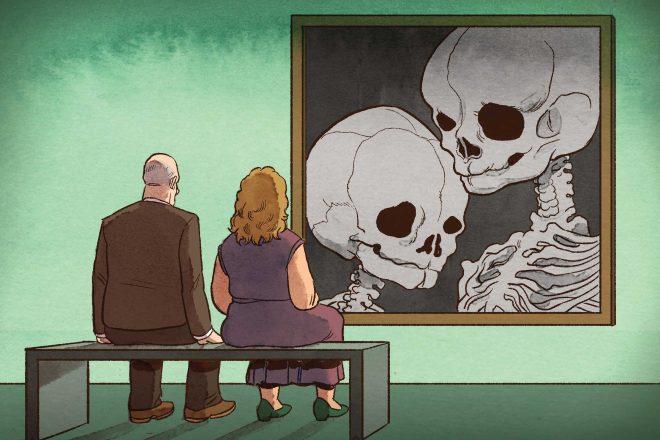
A Holocaust museum coming to Phoenix invites our Jewish columnist to consider the true meaning of
never forgetting.
by Amy Silverman | illustration by Jess Suttner
When I was a fifth grader at Hopi Elementary School in East Phoenix, a classmate kicked my metal Snoopy lunchbox across the breezeway and announced, “You killed Jesus Christ.”
As I recall, there wasn’t a particular reason for this. It certainly wasn’t the first time I’d been bullied, but it was the first time anyone had mentioned religion. I’m not even sure how he knew I was Jewish. I remember being more confused than upset. Wasn’t Jesus Christ Jewish, like me? That’s what I’d always been told. No hard feelings.
I doubt I said anything to my attacker – more likely, I picked up the lunchbox and slunk back to class, head down. It was the ’70s. No one talked about feelings.
Arcadia was lily white, not like today, and being a Jew was about as exotic as it got.
It wasn’t that there was no Jewish community in Metro Phoenix, there was. It was small but robust enough to support several congregations, including Temple Solel, a groovy little group that rented space at the Unitarian Church on Lincoln Drive.
I didn’t fit in there, either. This was long before I learned to joke that I put the “ish” in Jewish. All I knew was that my family didn’t really believe much. Later, I’d be told that my mother’s family came from Odessa, where they watched pogroms in the early 20th century literally burn their homes and villages to the ground while their neighbors begged God to save them, à la Fiddler on the Roof.
Disgusted, my mother’s family found their way to the States and became socialists. Nothing much was ever said about what shaped my father’s family. They went to temple but were far from pious, and it was my grandmother on that side who taught me Christmas is more fun than Hanukkah, and that it’s OK to eat pork as long as you don’t cook it in your own kitchen.
My sister and I were raised to be good people, and I like to think that we are. She married a guy she’d first met at Jewish camp in high school and found a synagogue and community in Denver. I married a guy I thought was Jewish. Turns out he’s not – he was just raised in Queens, New York, and happens to have curly hair.
But he’s the one who told me one night over Red Devil pizza that he wanted our children to know they were Jewish before someone else told them. I was five months pregnant with our first daughter. We hadn’t planned ahead. But I liked what he said. So, we celebrate Jewish holidays alongside his family’s traditions, even though we don’t go to synagogue or church.
We have a wonderful life, and as far as I’m concerned, our daughters have learned the most important parts of what it means to be Jewish, even if more conservative folks would be horrified by our themed Passover seders (“Seder-day Night Fever” was a favorite) and a bat mitzvah where we sang “Seasons of Love” from Rent instead of the traditional prayer to honor the dead. Our celebrations include as many non-Jews as Jews, and this has allowed us to build community in fundamental and meaningful ways.
I know there’s anti-Semitism here in Phoenix, and not just because of the dent in my beloved Snoopy lunch box. High-profile country clubs were closed to Jews till way too recently. Places like the Camelback Inn didn’t allow us past the lobby back in the day. High-profile local Jewish families “passed” as Christian to avoid hate, or maybe just to fit in. I hear what certain politicians and activists say and imply, even today. Particularly today.
I didn’t pay much attention in school. Instead, I raised myself on the books I wanted to read. As a tween I never tried drugs, but I read and re-read young adult books like Go Ask Alice and The Outsiders so many times the pages literally fell out.
Another favorite was The Diary of Anne Frank. I related primarily as a young girl, less because I was Jewish. The Holocaust seemed very far away. No one talked about it in school, and I wasn’t paying attention on the rare occasion I attended synagogue.
Later in college I studied the Holocaust as an American studies major, visited the Holocaust Museum in Washington, D.C., and even ate dinner with Elie Wiesel, the survivor who wrote so eloquently about this experience in books like Night.
All that said, still, I am struggling, a little, to figure out where a $40 million Holocaust education center fits into the Phoenix landscape. Not literally – I know it’s slated to be built in Downtown Phoenix near the central library, that it will feature state-of-the-art technology, including AI.
It’s not that I don’t think people need to learn about the Holocaust, or that I don’t think the Holocaust is unique, or impossible to compare to any other example of genocide in terms of how Hitler conjured and weaponized hatred. And at this point, Phoenix is one of the larger cities in the country that doesn’t have a Holocaust museum. Houston has one. So does Albuquerque.
“Never again.” That’s always been the counter message, right? And frankly, given today’s political landscape both locally and nationally, it’s one we need to hear. Without being histrionic, let me say that it’s not hard to imagine a few of our current leaders adopting pages from Mein Kampf. Some already have.
But how do we teach about the Holocaust in a meaningful, respectful way, as the last remaining survivors, those who bore witness, perish? How do we teach about the Holocaust in Phoenix, Arizona?
Tom Horne, the state’s superintendent of public instruction, believes strongly in mandating Holocaust education for public school students in middle and high school, and it feels as though he envisions this center as a magic portal – one afternoon, a single field trip and your Holocaust education is complete!
To me, that is impossibly naive. It simply checks a box. I very much doubt a field trip would have changed the mind of the kid who kicked my lunchbox or impacted the disaffected young people who latch onto white supremacy as a safe space. The history of the Holocaust is too big to be contained in a building. Instead, we need a complete overhaul in how each of us considers humanity.
We have to start somewhere, you’re saying, and I get that.
But I worry this education center will feel inauthentic, with a focus on what’s come to be called trauma porn. I am concerned that organizers are planning to include references to mistreatment of Indigenous communities here in the Southwest simply to placate those who feel the effort to remember a Jewish Holocaust is outsized and misplaced here. I don’t like the thought of leaving those groups out, either.
Mostly, I wonder if we’re building a giant target for hate. Part of why the museum will be so expensive is the fancy consultants – designers of the Musical Instrument Museum here and The National World War II Museum in New Orleans, among others. But it’s also because of security needs.
Not long ago, I attended Phoenix Theatre Company’s production of Cabaret, a love story set against the backdrop of 1931 Berlin and the rise of the Nazi Party. Sitting in a packed house, shoulder to shoulder with fellow Phoenicians, I felt the vibes of understanding and empathy.
Of course, the actors were preaching to the choir. And that’s my biggest concern about a Phoenix Holocaust education center – that it will be built for the community leaders and funders who don’t need to be convinced otherwise. That it won’t ever reach the people who really need to hear the message. That nothing will, not in a place as hard as Phoenix.