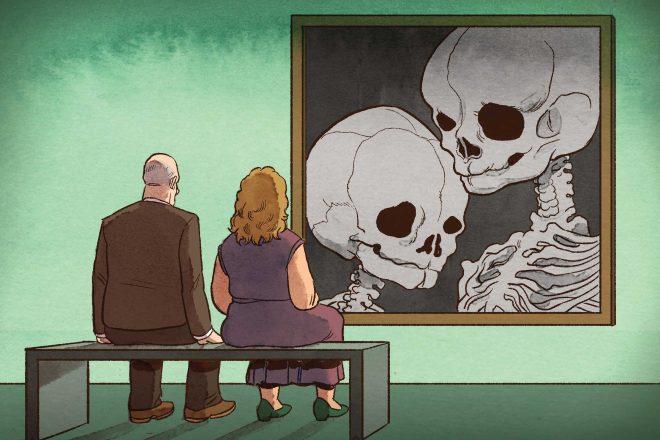
Despite its fiery, improvident and sometimes pitiless reputation, Phoenix deserves credit for its better angels.
by Amy Silverman | Illustration by Laura Spalding Best
Not long ago, I was asked to make a cake that represented my hometown. I considered my options.
We live in a place with extreme heat – and extreme politics. I decided I’d have to set something on fire. That felt exhausting, and not just because I wasn’t sure I’d be able to put my hands on a blow torch, let alone figure out how to use it.
I’m tired of seeing this city, this Valley, this state through the eyes of outsiders and their clichés. People who don’t bother to look past the headlines, the deadly hot sidewalks and nasty politics. Who’ve made Phoenix the poster child for the damages of climate change and hate.
So, instead of torching a Baked Arizona or crafting angry members of the state legislature out of fondant, I thought I’d try celebrating my home.
I made a Bundt cake flavored with the juice and zest of Meyer lemons from a tree in my yard. Topped with lemon icing, decorated with papery magenta flowers from my bougainvillea, it felt symbolic.
A survivor. A different way of considering this place.
After last summer’s heat literally seared the side of that Meyer lemon tree, I figured the thing was a goner. I grew up in the Valley, so I knew all about covering citrus trees with sheets to protect them from a winter freeze, but I didn’t know a lemon tree could actually get a sunburn.
By that September, quite a few of the lemons were hard and parched-looking. Even so, December brought a bumper crop of sweet, beautiful fruit. We’d only recently planted the bougainvillea, but the heat gave it superpowers, a burst of purple and green against the rest of my crispy brown garden.
A burst of nuance.
Last summer was terrifying, I don’t mean to imply that it wasn’t. The heat toppled saguaros. And human beings. I will never forget meeting a man who passed out in the direct sun on blacktop outside a Phoenix convenience store and woke up in the burn unit at Valleywise Hospital. Months later, he pulled up his T-shirt to show me burns that were still healing and the scars that obliterated the intricate, gorgeous black and white tattoos that once graced his entire back.
It was only 95 degrees the day he sustained his injuries, which kind of messes with the narrative, right? This could happen across America, as temperatures creep upward just about everywhere.
Just as Los Angeles is not only about earthquakes and celebrity political endorsements, Phoenix is not only about heat and election deniers.
That’s the thing. Live anywhere long enough, look hard enough, and you can find breaks in the narrative.
A cool breeze on an early morning walk, even in August. Reasonable lawmakers from both sides of the aisle. So many lemons I mailed them to friends and family across the country. That’s my hometown – at least, that’s part of it.
Instead, many people – both here and out of state – think of Arizona and only picture that shaman in horns, fur and face paint, storming the U.S. Capitol. (If we’re lucky, they might think of the Grand Canyon, too.) I get it. These days, you can find hate in just about every corner of this country, but in a lot of ways its roots are in our hard, thirsty soil.
We’re not just mean, we’re O.G. mean. This is the place where Maricopa County Sheriff Joe Arpaio inspired Donald Trump by making a brand out of jailing people in tents and pink underwear, stoking the fires of hate by making undocumented immigrants the enemy. Even the late U.S. Senator John McCain, who remade himself as progressive in later years, chose Sarah Palin as his running mate in 2008 and unleashed a new kind of political wrath. You can thank one of Arizona’s own for the Tea Party.
And to be fair, we’re O.G. hot, too. More than a decade ago, a professor from New York University named Andrew Ross came to town, talked to some folks and published a book called Bird on Fire: Lessons from the World’s Least Sustainable City.
People here – including me – took umbrage. I mean, dude. Calm down. Thanks to some smart politics in the last century, Arizona has more water than neighboring states. Even the biggest naysayers concede we won’t shrivel up and die any time soon.
I know I sound defensive, but consider the facts. In 2022, Governor Katie Hobbs beat Kari Lake. Secretary of State Adrian Fontes took out Mark Finchem; Attorney General Kris Mayes squeaked past Abe Hamadeh. And look at the average temperatures for May and June 2023 – it was actually pleasant in the middle of the day.
Pretending there’s never an in-between isn’t going to convince anyone to get off the grid or change their political affiliation. At least, it hasn’t so far.
These days, both the hate and the heat have spread across the country, but Phoenix still gets top billing as the harbinger of doom. Earlier this year, The Atlantic published a 25,000-word cover story by George Packer headlined “What Will Become of American Civilization?: Conspiracism and hyper-partisanship in the nation’s fastest-growing city.”
The magazine called its own story “a sweeping and kaleidoscopic look” at Phoenix. I wouldn’t go that far, though Packer is an excellent journalist who spent months here. He found the usual suspects, like former state lawmaker Rusty Bowers, whom Packer used to explain the state’s complicated relationship with water.
Bowers is a conservative former lawmaker who disagrees with Trump and says he’s concerned about preserving natural resources. He’s a fascinating outlier.
But still, I wish out-of-town observers like George Packer could meet Jacob Newman. In his 20s, Newman is relatively new in town, from the Midwest by way of Denver. I found him on Instagram and fell for his take on his adopted hometown.
I’ve never seen Newman talk about the heat or the politics. He’s more interested in the people. (Amen.) And in a relatively short period of time, he’s gotten to know this place better than just about any journalist I know.
His interest takes the form of illustrations of local businesses in Phoenix and other parts of the state. A spot catches his eye and he draws it, then presents the business owner with a copy.
I can imagine the confusion, because instead of illustrating hip places like Crescent Ballroom or Pizzeria Bianco, which are accustomed to being fetishized, for the most part Newman chooses places you pass every day but likely never notice.
Like Don José, a tiny Mexican restaurant on Thomas Road in Phoenix, Western Dry Cleaners in Avondale, Stephani’s Pooch Parlor in Casa Grande and Earl’s Hometown Candy in Cave Creek. He signs each piece. On the Don José illustration, he wrote, “Mazel tov on 40 years, Jacob.”
He recently published an anthology of these illustrations called Phoenix: Or, Drawings of this Amazing Place.
On an opening page, Newman writes, “This book is dedicated to the memory of my grandpa, Joel Newman. He instilled a love of art and storytelling in me from a young age on tours of the metropolitan museum and beyond. His encyclopedic knowledge of New York City’s street system, and the history of its storefronts, guide me as I tell the stories of what’s around me today in Phoenix.”
So many people have looked so long and hard at New York that even though an outsider might never truly understand the city, most of us have a deep knowledge of the different facets of the place. I love that Newman is trying to do the same here, that he sees past the clichés to the culture. The nuance. The context. Us.
The lemons on my tree are looking pretty good this summer. When they’re ripe, I think I’ll make him a cake.