Our columnist asks voters to consider the human stories beyond the rationales.
by Amy Silverman | Illustration by Jess Suttner
You probably have all kinds of fancy summer travel plans. But if you get a spare day, or two, I suggest a trip to the border. Specifically, to the border wall.
I’ve been to the border plenty of times – in the ’90s I crossed back and forth to Nogales so often I’m pretty sure Border Patrol knew me. What can I say? I had a friend who was addicted to Xanax. And I was always up for trinket shopping and lunch at Elvira’s.
It was a different time.
But until this spring, I hadn’t been to the border wall. Before you vote in November’s election, please go.
The car ride to Douglas is easy. You pass through towns like Benson and Tombstone en route to the southeastern corner of the state. You can stay at The Gadsden Hotel in downtown Douglas, but I suggest you book a room in Bisbee for its charming breweries and winding streets.
Douglas is not a fun town – I don’t need to go back. Not much happened on this particular weekend, which was fine with me after a security guard assured us there are near-daily high-speed chases through town.
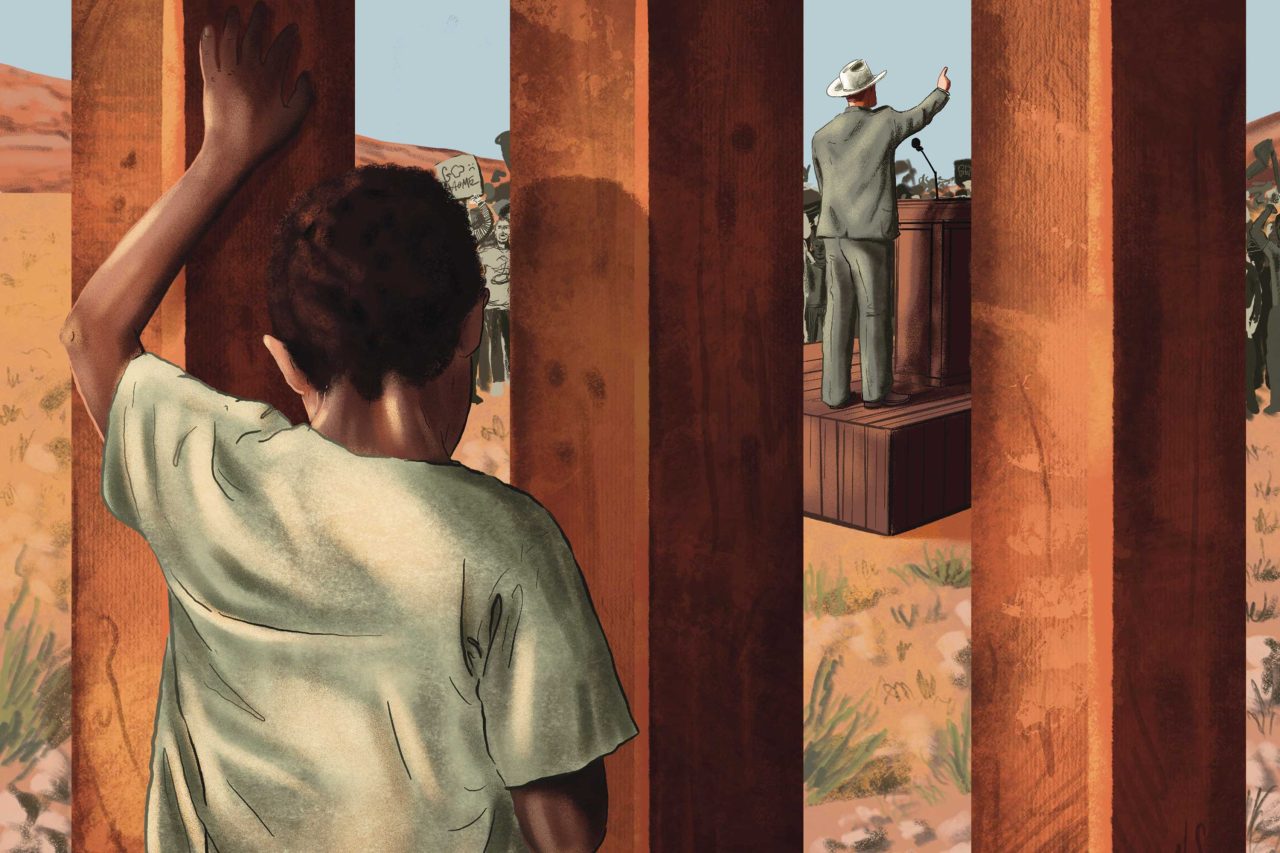
But I won’t forget this trip. We walked past weekend shoppers with Walmart bags crossing back to Mexico, traversed an empty field, and stood before the wall, under the watch of at least one Border Patrol agent and then… we just stood there, staring through the gaps in the metal.
I took pictures of the razor wire, captured the way the wall seems to stretch on forever. I could see drips of light blue paint making their way from the other side of the rust-hued metal, a public art project where the wall was painted to blend into the sky.
I did not blend in, a more-than-middle-aged lady with tangled blonde hair dressed in black. I don’t speak Spanish, so I couldn’t call out to the couple of young men hanging out on the other side. If I could have, I’m not sure what I would have said, anyway.
I was there to bear witness. It was a reset, a reminder that this is real, not just something to fill space on the 24/7 news cycle. Real, and at the same time – so arbitrary, the border, a division between Us and Them.
As the sun began to set, we turned and walked back to town. The night was quiet. The next morning, we hiked nearby, the desert empty and endless – dead-ending at the wall, a row of toothpicks far in the distance.
I’ve been thinking about that trip as the debate roils over the Secure the Border Act, a measure Arizona voters will consider this November. Among other things, it would give local and state law enforcement permission to stop undocumented people from crossing the border.
Not to be one-upped by Texas, whose own anti-immigration law is tied up in court, Arizona Republican lawmakers circumvented Governor Katie Hobbs to put this before voters.
Almost immediately, Hobbs sent out a press release blasting the measure with the headline, “Governor Katie Hobbs Releases Statement on House Passing Job-Killing HCR 2060.”
Just before the vote, one of the most progressive political players in the state posted on social media:
Heartbreaking session in the Az House, where Republicans appear poised to pass HCR2060. Despite the costs it will impose, despite the fact that it is likely unconstitutional, in part because it doesn’t fund those costs. In the face of Az’s massive deficit- totally nonsensical.
All of that is true. But it didn’t sit well with me. I didn’t see anyone lead with “this could hurt innocent people in danger” or “human rights on the line” or a lot of things that could have been said.
I get it. It took several tries for Democrats to defeat then-Sheriff Joe Arpaio. For years, activists led with the human-rights angle, critical of his treatment of migrants, but ultimately voters supported Arpaio, in no small part because he opened an animal shelter. Also, I’m guessing, because they shared his xenophobia.
Ultimately it was about money. Voters finally defeated Arpaio when his opponent made it clear that he had cost Maricopa County taxpayers millions of dollars in court settlements after county jail inmates sued for poor treatment and terrible health care.
So, I understand why Democrats are leading with the financial costs, the harm to the state’s reputation. It’s the best chance to defeat the current measure. But I don’t have to like it.
It makes me think of the work of my dear friend and occasional colleague, Valeria Fernandez. Fernandez, who is from Uruguay, has lived in Phoenix for many years, working as a journalist. Her work is essential – she’s broken more stories than I can count, and now works as managing editor for palabra, a publication of the National Association of Hispanic Journalists, which is doing incredibly important work.
But it’s the individual tales Fernandez has told over the years, the people she’s introduced to readers, that really stick with me. Like the story of Sara (full disclosure – I edited that one), a teen who escaped abuse in El Salvador and arrived in the U.S. in desperate need of mental-health care. Or Frankie, a young gay man who took his life after being sent back to Mexico, where he was terrified.
I get that thousands of people have poured over the border. It’s hard to personalize the experience, to get voters to stop and consider these migrants as individuals. But I hate that it feels like even the opponents of the Secure the Border Act have given up.
Secure the border from whom? Every voter should consider it.
I called Fernandez to talk about it. Not surprisingly, she got fired up – but not just about telling individual stories. That’s not enough, she says. I’ll be thinking about our conversation for a long time.
“I have realized that it’s not enough to humanize people. I have been doing this for years and years and years, trying to show the real face of who’s coming. And then it goes into this empty void,” Fernandez tells me.
I’m inspired by Fernandez. And she is inspired by another journalist, Michelle Garcia, and describes her philosophy.
“We’ve got to go beyond just simply humanizing people to make them acceptable and presentable. We need to move beyond that and to start normalizing migration. Normalizing people who have to move, and understanding that the United States does not exist in a vacuum… We have to start confronting the forces that dehumanize. We have to start asking, ‘Why don’t you see the human that is in front of us?’”
Instead, she says, we justify putting shackles on women giving birth “as if it is their fault, they have brought it upon them.” Individual stories are still important, she adds. They just aren’t enough.
“I talk to some people who are on the fence about this issue for sure. It helps them to connect with the humanity… But it’s not enough if we’ve reached this stage where we are OK with separating children from parents at the border. We’ve hit that point already. How do we talk to people who think that that is OK?”
And that, of course, is always the question. It’s not enough to preach to the choir. If only we could build a wall that would keep out the hate.

Born and raised in Phoenix, Amy Silverman is a multiple winner of the Virg Hill Arizona Journalist of the Year award. She also penned the memoir My Heart Can’t Even Believe It.