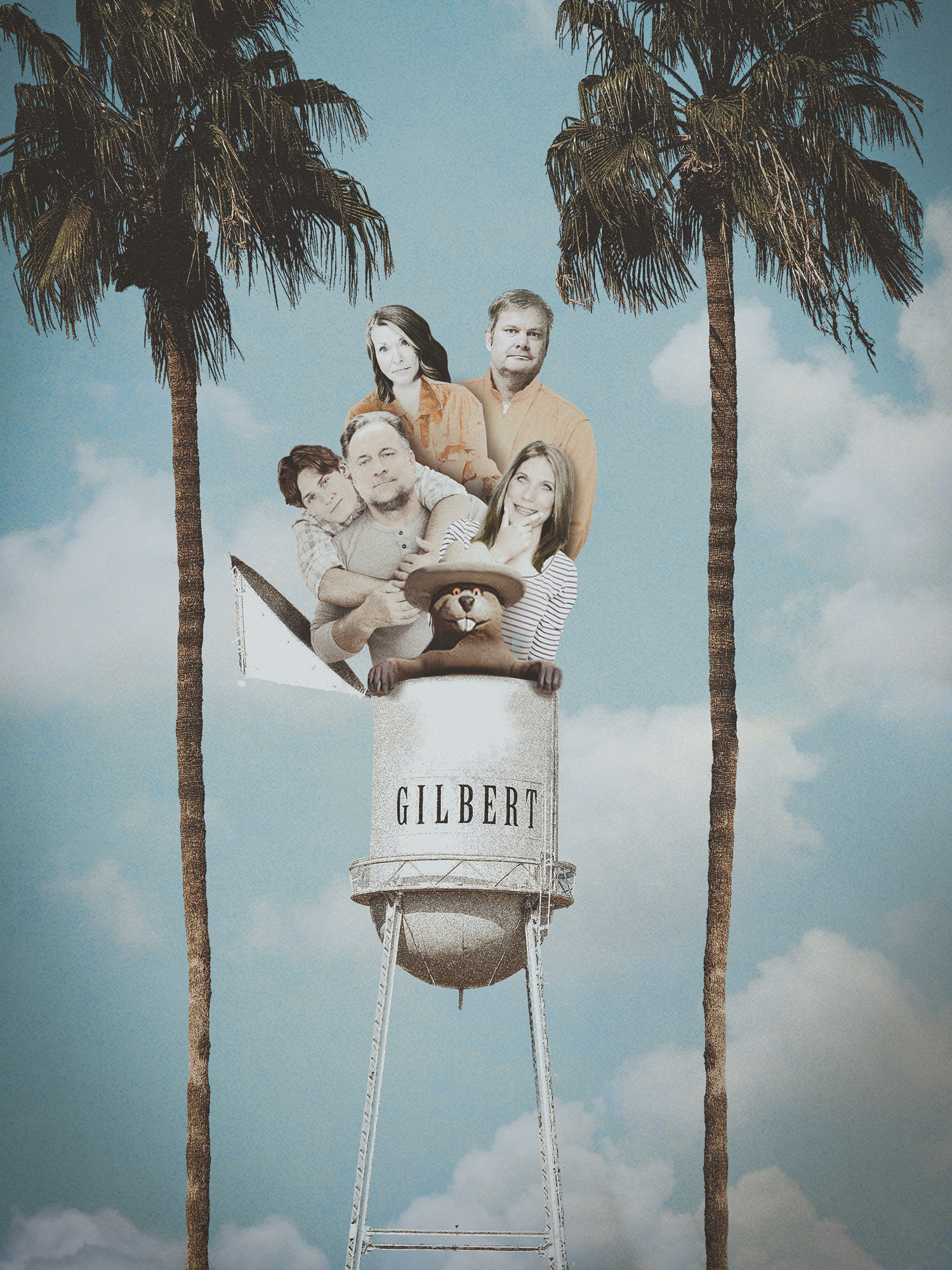
Renowned for its stability, affluence and fetching restaurants, the Southeast Valley now garners headlines for teen violence and apocalyptic ideation. When will Gilbert be boring again?
In a 911 recording released by the Queen Creek Police Department, the wavering voice of an unnamed teenage boy describes a chaotic situation to a police operator.
He recounts that he and about 100 other high-school-age teens were at an October 28 Halloween party at a house near South 194th Street and East Via Del Rancho Road in Queen Creek when violence erupted. “There’s a bunch of people out here with guns and shit, and they just jumped my friend and he’s knocked down on the ground,” he says, panicked.
Another of his companions had a broken wrist. The attack was unprovoked, he claims. “We don’t have any beef with them,” he says of the attackers.
The 911 operator asks about the boy on the ground. The caller tells her that the boy on the ground is “bleeding from the knee” and had his chin cracked open. He had been unconscious for about two minutes.
“He’s super, super pale,” the caller says, telling her that teens trained as lifeguards were performing CPR on him.
Others at the party told him not to call 911, but he decided to do so anyway. “I’m scared,” he says. “I don’t know what to do.”
He was doing the right thing, the operator assures him. The police were close, she says. The boy replies that he can hear the sirens.
Talking to another male, the caller says nervously, “He’s not waking up.”
“No, we got him,” the other boy says. “He’s got a pulse.”
That moment of hope would be short-lived. The unconscious boy, later identified as 16-year-old Preston Lord, died from his injuries two days later.
The 911 recording accompanied a 1,000-plus-page investigative report released by the Queen Creek police in March, which lists Lord’s cause of death as “multiple blunt force injuries.”
In the report, witnesses described the assault on Lord as happening after he intervened when a friend was attacked over a $10 necklace. Teens at the party had been drinking and smoking pot, said witnesses, some of whom linked the attack to a gang of local teens who referred to themselves on Snapchat as the Gilbert Goons.
First identified in a December investigative piece by The Arizona Republic, the Gilbert Goons, or the “Goonies” as they’re sometimes called, have been connected by law enforcement agencies to a rash of teen violence in the Southeast Valley towns of Gilbert, Chandler and Queen Creek, shattering the suburban community’s sense of well-being and undermining the picture painted by the area’s boosters as a family-friendly paradise.
The Goons have dominated local media for months, drawing national and international attention. Outraged residents have demonstrated and demanded change, accusing local authorities of looking the other way at the misdeeds of privileged teenagers.
But there’s more to what’s troubling Gilbert than the Goonies. Political and religious extremism afflict the area’s image as well.
The region is represented by such far-right, conspiracy-minded politicians as U.S. Congressman Andy Biggs, who has been accused of helping to organize the January 6, 2021, rally that led to the assault on the U.S. Capitol, and State Senator Jake Hoffman, known for running a “troll farm” that spread conspiracy theories and disinformation in the run-up to the 2020 election.
In August, former Chandler resident and convicted child-killer Lori Vallow Daybell, aka the “Doomsday Cult Mom,” is scheduled to be tried in Maricopa County Superior Court for a murder and an attempted murder allegedly inspired by apocalyptic beliefs shared by others in the area.
No wonder so many of the more than 600,000 people who live in the Southeast Valley are concerned. Certainly, teen violence affects many other cities and neighborhoods in the Valley besides Gilbert – some much more so. And conspiracy-fueled extremism is a national problem, not just a local one.
But it’s also true that – despite its upper middle-class environs, explosive growth and booming economy – something specific is eating at Gilbert and its neighboring towns, where some residents are working to make sure weird is not the new normal.
It is an axiom in criminology that most violent crime is committed by young adult males.
According to FBI crime statistics, in 2022, nearly 76 percent of all violent crime in the U.S. was committed by males, with those in the 20 to 29 age bracket committing more crime than any other single age group. Youths 10 to 19 committed about 15 percent of all violent crimes.
Charles Katz, professor and director of Arizona State University’s Center for Violence Prevention and Community Safety, described this fact as timeless, like something out of William Golding’s Lord of the Flies.
“I don’t care if it’s young males in school, out of school, in a workplace, police officers, professors, I don’t care what the situation is – you put young males together, you are significantly more likely to find misbehavior taking place,” he says. “And the more of ’em that are together in a particular location, the higher the probability is that you’re going to find that they’re trouble.”
He says he has not followed the Gilbert Goons phenomenon closely, but his take on it is that it has “quite a bit of shock value to it because of those that are involved in it and where it’s at.”
Daily, egregious acts of violence are done by and to teenagers and young adults in Phoenix, but often these crimes receive scant attention from the authorities and the media. As for gangs, Phoenix has no dearth of them. The Maricopa County Attorney’s Office’s online data dashboard tracks recognized gangs in the county, listing the 29 it deems most prolific, i.e. receiving the most law enforcement referrals. The Gilbert Goons have not been designated a criminal street gang – to qualify under state law, a group must meet two of seven criteria, such as proclaiming oneself to be a gang member, wearing gang colors or having a gang tattoo – but even if they were, it’s unlikely they’d make the Top 29.
When it comes to violent crime, on paper, Gilbert and its neighboring communities are incredibly free of it. According to statistics obtained from the Arizona Department of Public Safety, Maricopa County law enforcement agencies reported 259 murders and non-negligent homicides in 2023, most of them in Phoenix.
Gilbert reported a total of four homicides in 2023. Chandler, seven. Queen Creek reported none. Lord’s homicide was still an ongoing investigation at the time its crime report was made.
On Gilbert’s website, the town touts itself as “the second-safest city in America among the 100 largest in the nation,” according to its analysis of FBI crime statistics for 2022. Using broader metrics, the personal finance website WalletHub.com ranked Gilbert “No. 10 for home and community safety.”
In addition to its relative safety, Gilbert, a former farming community once known as the “Alfalfa Hay Capital of the World,” is also incredibly prosperous.
The town was incorporated in 1920 as a railroad stop with 500 residents. The U.S. Census Bureau now pegs its population at more than 275,000 people, with a median income of more than $115,000 – higher than any Arizona municipality besides Paradise Valley – and a poverty rate of 5.5 percent. It’s also largely Anglo, with whites making up 67 percent of the population – compared to about 57 percent statewide.


Gilbert’s town manager, Patrick Banger, tells PHOENIX that the average age of Gilbert’s residents is 34.5, and nearly 50 percent of Gilbert’s residents have a bachelor’s degree or higher – one of the state’s top rates. “It’s that highly educated, skilled workforce that really has been a big driver when it comes to our ability to attract some of the nation’s top employers,” he says.
Though not exactly a monoculture, Gilbert arguably comes as close as any large municipality – it chose the designation “town” despite having a larger population than Salt Lake City – in the Valley. Gilbert is technically only 22 miles from Phoenix, but geographically and culturally, it seems farther.
It is, in a word, insular – which is part of its charm, and also drives to the root of its troubles.
Gilbert stubbornly clings to an idyllic vision of itself as a “small town” where certain things do not occur. But there is a growing fissure between Gilbert as it wants to be and Gilbert as it is.
The brutal beating death of Lord, a popular, handsome basketball player for Combs High School in San Tan Valley – and the spate of muggings and beatings linked to the Gilbert Goons – upended Gilbert’s reputation as a cynosure of tranquility and contentment. The crimes also angered residents who didn’t believe this kind of violence was possible – or, at least, permissible – in its well-tended backyard.
The Republic documented a number of Goon assaults in 2023 at local In-N-Out Burger restaurants, parking garages and elsewhere, linking Lord’s homicide to “a string of vicious, blitz-style attacks” by “‘a gang’ of 20 or more, mostly white, upper-middle-class teenagers from multiple East Valley high schools.”
Since Lord’s murder, dozens of teens and adults have been arrested in the attacks, which sometimes involved brass knuckles and were often filmed and posted to various social media accounts like Snapchat. Contrary to initial perception, several of those arrested were people of color.
In early March, Queen Creek police arrested four adults and three minors, charging each with kidnapping and first-degree murder in Lord’s death. All seven – Talyn Vigil, 17, Talan Renner, 17, Treston Billey, 18, William Hines, 18, Jacob Meisner, 17, Taylor Sherman, 19, and Dominic Turner, 20 – pled not guilty and were held on $1 million bonds.
Only Vigil has made bail at press time. According to the Queen Creek police report, following the attack on Lord, Vigil allegedly posted an admission to Snapchat, stating: “I hit a kid and this kid feel (sic) hit his head and then they kicked his head in the ground then i got word he died so idk.”
Accusations of a cover-up and preferential treatment have dogged Renner since the attack, particularly on online forums such as the subreddit r/GilbertAccountability.
The police report recounts an interview with a former girlfriend of Renner’s father, Travis. The ex-girlfriend claimed that Travis, 50, transported his son from the luxury, gated Gilbert community of Whitewing, where they lived, to a cabin in Show Low, so Renner’s wounds, allegedly incurred during the attack on Lord, could heal.
Renner was a star football player at the American Leadership Academy, a Gilbert charter school. In April, The Mesa Tribune reported that ALA administrators were aware Renner was a suspect in the Lord slaying but allowed the running back to play in football games on November 10 and 17.

A month before, two Maricopa County Sheriff’s Office deputies were reassigned from their posts at the county juvenile court after giving Renner’s parents an escort through secure passages in the building with one deputy playing valet for the Renners and retrieving their Tesla for them. The Renners were in court for their son’s initial appearance before a judge on kidnapping and murder charges.
Justifiably or no, such incidents have helped fuel the wrath of Gilbert’s citizenry, with many calling for the resignations of various town officials, including manager Banger, Mayor Brigette Peterson and police chief Michael Soelberg.
Banger and Soelberg are standing fast. But in January, Peterson announced that she was ending her re-election campaign. Despite widespread speculation to the contrary, she did not attribute her decision to anger over Lord’s death and the Goons.
“I always knew that I would know, in my heart, when it would be the right time to step away, and for many reasons I’m choosing now for this next step,” she wrote in a letter issued by her office.
At a March 26 meeting of the Gilbert Town Council’s Subcommittee on Teen Violence, held at a local library, Soelberg played defense, telling attendees that his department was still investigating whether the Gilbert Goons can be classified under Arizona law as a gang.
“We’ve made significant progress,” Soelberg said, announcing that his department recently made two more arrests related to teen assaults in Gilbert. “That brings our total arrests to 29 since January of last year,” he added.
But when the mic was opened up to comments from the public, some speakers confronted the chief over news that in the wake of Lord’s killing, Gilbert PD reopened several assault cases from previous years that had been shelved.
Gilbert resident Mindy Brocker addressed the chief and the three Gilbert city councilmembers leading the meeting, telling them, “I keep hearing excuses, but what I’m not really hearing is about changes.” She asked if data on arrests was being collected correctly and if it was the right kind of data.
“Are reports not being completed fully?” she asked. “Do you plan to do an audit or a retrospective of procedures or processes?”
Soelberg did not address Brocker’s questions, but after the meeting, the chief told PHOENIX that his department was not sweeping anything under the rug in order to keep crime stats low. “We have actively worked every investigation involving teen violence,” Soelberg says. “We may not be able to establish probable cause to make an arrest, but we still do an investigation.”
Also at the meeting was community activist Angela Rogers who, along with fellow Gilbert resident and mom Kristine Brennan, used a Facebook page established under the pseudonym “Lily Waterfield” to share information about the Lord case and the Gilbert Goons.
Rogers told PHOENIX that she believes the Gilbert police pooh-poohed teen violence before Lord’s slaying, thinking it was just kids being kids. “Yeah, well, it’s snowballed now,” she says. “And you gotta answer for it.”
That cuts to the most damning aspect of the case, respective to a “cover-up” and police culpability. Even if the Lord murder investigation was expeditious and by-the-book, which several disinterested sources interviewed for this story say it was, it seems clear that the Gilbert PD and other agencies under-prosecuted the many teen muggings and beatings that preceded it. What if they had made a few more arrests in the months leading up to Lord’s murder? Would that have broken the Goons’ back? Would Lord still be alive?
It’s a reasonable train of thought.
PHOENIX also spoke with Gilbert dad Richard Kuehner at the meeting. In August 2023, at a local In-N-Out Burger, a pack of alleged Gilbert Goons surrounded and attacked his son, then a junior at Perry High School in Gilbert.
The attack left his son with a concussion. Because of continued harassment from the group, including death threats, Kuehner relocated him to another country.
Six males have since been arrested for the attack, with one allegedly self-identifying as a Goon. Kuehner is now suing several alleged Goons and their parents for damages.
Kuehner, a manager for a large real estate investment trust, says that one reason he moved to Gilbert eight years ago was for its reputed safety. He says he was shocked by the random violence directed at his son. “We didn’t know any of these kids,” he says. “Preston Lord was the same thing. They didn’t know Preston and had no reason to attack him. I don’t know if it’s some initiation they have or they just think it’s cool.”
Perhaps the most interesting part of the subcommittee meeting occurred when local high school students in attendance to observe the proceedings were asked if they wished to comment.
One teen named Julia took the mic and said she and her fellow students were practically forbidden by their teachers to talk about the Lord killing or the Gilbert Goons in school. The situation “amplified” the “air of mystique” around teen violence. “It almost feels like a sense of negligence when we don’t directly address what has already happened,” she told the group.
Another teen, who did not give her name, addressed suggestions by adults in the meeting that the town’s nightly curfew for unaccompanied minors – 10 p.m. for those 15 and younger, midnight for 16- and 17-year-olds – be strictly enforced.
“While I think it is really important to be protective of our children and teenagers and stuff like that, after a certain point, it becomes not beneficial to the teenager and their ability to be independent,” she said.
A third teen told the adults that it was important for students to be taught accountability, otherwise small misdeeds could lead to bigger problems later in life.
Two days later, near sunset, more than 100 demonstrators of all ages honored Lord by walking from the Gilbert Civic Center, north on Gilbert Road about 2 miles to Elliot Road, within sight of Gilbert’s iconic water tower. The group then doubled back to the civic center, ending in front of Gilbert Town Hall.
It was the fifth monthly “Light the Night” walk since Lord’s October 28 killing. Many wore bright orange shirts reading “Justice for Preston” and carried orange, battery-powered candles. Reportedly, orange was Lord’s favorite color.
In front of Town Hall, Lord’s friends and family gathered before members of the news media, some holding signs that said, “Be an upstander, not a bystander.” Lord’s stepmother, Melissa Ciconte, read a sorrowful letter from his biological mother, Autumn.
“‘Miss’ doesn’t encompass the hole in our hearts that will never close and the gut-wrenching pits in our stomachs,” Ciconte read. “The world isn’t viewed in color anymore without you in it. It is dull, sometimes senseless and motionless.”
Ciconte thanked the walkers, telling them the next step in obtaining justice for her stepson would be the prosecution of his alleged killers.
PHOENIX asked Ciconte if the marches would continue.
“At this point we are, every month,” she says. “We don’t know what will transpire come summer.”
Driving through Gilbert and its environs, there is a sameness to the sprawl and the seemingly endless housing developments, some of them with white picket fences that go on and on. It does conjure a certain vision of classic Americana – sometimes with the cloistered, lockstep political attitudes to match.
Much of the area falls within Arizona’s Fifth Congressional District, represented by Biggs, former chairman of the ultra-conservative House Freedom Caucus. Biggs has supported disproved, conspiratorial claims of voter fraud in the 2020 election.
Biggs was one of 126 House Republicans who signed an amicus brief supporting an effort to have the U.S. Supreme Court overturn the 2020 election. He has been accused of helping to organize the January 6 rally that led to the siege of the U.S. Capitol, accusations he has denied. And he was one of six members of Congress who allegedly asked the Trump White House for pardons for their efforts to deny the vote.
Biggs, who famously financed his first state legislative campaign with part of a $10 million American Family Publishers sweepstakes jackpot he won in 1993, is seeking a fifth Congressional term this November and is expected to win easily.
One of the area’s most prominent state legislators is Hoffman, the founding chairman of the far-right Arizona Freedom Caucus. Hoffman is one of 11 Republicans being investigated by Arizona Attorney General Kris Mayes for falsely declaring themselves to be members of the Electoral College from Arizona and casting their “votes” for Donald Trump, despite Trump having lost Arizona by more than 10,000 votes.
Among Hoffman’s other achievements: getting banned from Facebook for running a conspiracy-mongering internet troll farm and sponsoring an unsuccessful bill to ban images of Satan from public property.
Moderate Republican activist and political consultant Tyler Montague remembers when his hometown of Mesa was synonymous with extremism. He thinks Mesa has passed the torch.
“The center of gravity of crazy has definitely moved east and south,” Montague says. “They like to ‘cray’ over there more than anywhere else.”
Why has Mesa, in his opinion, moderated politically relative to places like Gilbert?
“I think just some of the folks over here aged out and died,” he said.
He added that “there’s still plenty of crazy far-right people here,” but Mesa is also known for a more traditional brand of conservatism often associated with former U.S. Senator Jeff Flake, now U.S. Ambassador to Turkey.
Notable examples of this brand include former Mesa Mayor Scott Smith, Mesa’s current Mayor John Giles and former Arizona House Speaker Rusty Bowers, who famously resisted direct pressure from Trump and his minions to overturn the results of the presidential election in Arizona.
The addition of light rail linking Mesa to Phoenix and Mesa’s partnerships with Arizona State University, including ASU’s new Media and Immersive eXperience Center, gives Mesa a more metropolitan feel relative to Gilbert, where most buildings look like they were erected yesterday.
But Gilbert won’t be a young “town” forever, or as monocultural as Mesa once was. The myriad recent controversies might be seismic evidence of that – a growing pain as forces intersect within it.
Several recent, unusual examples of religious extremism have also illuminated the fault lines.
In late October, just days before the attack on Lord, a Gilbert woman, Spring Thibaudeau, allegedly took her son Blaze, 16, out of Gilbert High School and out of state, without his father’s permission.
Thibaudeau and her brother, Brook Hale of Fairbanks, Alaska, were later arrested at the Alaska-Canadian border trying to spirit the boy out of the country. According to court documents, Hale and Thibaudeau believed that end times were nigh, and that Blaze needed to be hidden away in the Canadian mountains because he was the harbinger of the second coming of Christ.
Hale and Thibaudeau were arrested and extradited to Maricopa County to face felony counts of custodial interference. Blaze has since been safely returned to his home in Gilbert.
In an October 24 motion in Maricopa County Superior Court seeking sole custody of his son, Benjamin Thibaudeau described how his wife had come to believe she is the “chosen prophetess” of end times. “Several years ago, Mother started forming beliefs in end-of-the-world scenarios, eerily similar to the well-publicized Lori Vallow [Daybell] and Chad Daybell saga,” the motion reads.
The Daybells – both former local residents – have been accused of using their unorthodox beliefs in paranormal phenomena like zombies, possession by dark spirits, reincarnation and an impending apocalypse to justify a string of alleged murders.
Before marrying Chad, an author of fiction and non-fiction books about end-time prophecy and near-death experiences, Lori lived in Gilbert and Chandler. In May 2023, she was convicted in Idaho of murdering her two children, Joshua “JJ” Vallow, 7, and Tylee Ryan, 16.
As this article went to press, Chad is on trial in Idaho for his alleged role in murdering Joshua, Tylee, and his first wife, Tammy Daybell.
Currently, Lori is in the custody of the Maricopa County Sheriff’s Office, awaiting trial on charges of conspiring to kill her former husband Charles Vallow in Chandler. She is also accused of conspiracy in the attempted murder of her niece’s ex-husband in Gilbert.
Chandler residents Matt and Tawni Browning, investigators and reality show producers who have appeared in true-life series such as Escaping Polygamy and Secrets of Polygamy, knew Lori and Chad Vallow and attended Sunday services with them at meeting houses of the Church of Jesus Christ of Latter-day Saints.
Lori was a Mormon, as is Chad and Spring Thibaudeau, but their bizarre beliefs are not part of the LDS church’s teachings. The Brownings, who are lifelong LDS members, say these fringe ideas are completely foreign to them.
“We are not reincarnated,” Tawni states firmly. She says Lori tried to be “besties” with her in church, but she wasn’t interested in a friendship with her, though she can’t say why.
“It’s embarrassing,” she says. “I used to be able to say, ‘Come and let me show you who I go to church with.’ And then it’s like, ‘Oh, Lori Vallow is in my ward. Great. The craziest of crazy.’”
Matt, a former Mesa Police Department detective, is well known for investigating and arresting white supremacists. Author of the 2023 memoir The Hate Next Door, Browning observed that religious beliefs of all stripes are often used to rationalize illegal behavior.
“Religion itself, if allowed to be, can be a motivator for violence. Whether we’re talking about Catholics, Calvinists or Muslims,” he says.
Gilbert has an LDS temple, which opened in 2014. Outsiders might think of Gilbert as being “Mormon country,” but LDS members only make up 6.4 percent of residents in Gilbert who consider themselves religious, according to one estimate.
The Brownings have lived in Queen Creek for more than 20 years, moving from Mesa when land in the Southeast Valley was inexpensive. At the time, it was quiet, a backwater. Now it has an unfortunate reputation, they say. “My brother lives in Spokane,” Tawni says. “They love it out here, but they would not move out here now because they think it’s cuckoo. They’re like, what is going on out there?”
Still, despite the recent unflattering headlines, many residents and businesspeople remain bullish on Gilbert and the Southeast Valley.
One of them is Jonathan Buford, co-owner of Arizona Wilderness Brewing Co., which opened its first brewpub in Gilbert in 2013. Buford and his business partner, Patrick Ware, now have two more locations, a “fermentorium” in Gilbert and a beer garden on Phoenix’s Roosevelt Row, with a fourth location soon to open on East McDowell Road in Phoenix.
Buford told PHOENIX that he chose Gilbert to begin his suds empire for two reasons: the chance to be the first brewpub in Gilbert’s history and cheap land.
“This was $3 a square foot,” he says, sitting at a table mid-day in his northwest Gilbert restaurant. “This was a steal, and that’s different now. But that was what made Gilbert so attractive to so many folks.”
Recent news about Gilbert’s woes hasn’t dampened what the tall, bearded proprietor called his “Gilbert pride.” He says his business in Gilbert has not taken a hit, and whenever they’ve needed help from law enforcement, Gilbert police have been quick to respond.
A photographer for Arizona Highways and a conservation enthusiast, Buford’s vision for Gilbert’s future is decidedly diverse and progressive. He points out that despite the area’s conservative political leadership, his Gilbert location proudly flies the LGBTQ+ rainbow flag outside its door.
He admits there have been some negative comments about the flag, but “more good comments,” with many patrons making a point to express their gratitude.
Buford believes Gilbert is becoming more moderate as more millennials move to the town to raise their families. He agrees that the death of Lord has been tragic and the tales of teen violence, troubling. But from his perspective, the community is rising to the occasion, demanding more from itself and its leaders.
“It hurts to think of that,” he says of Lord’s death. “When you have pain like that in a city, I think that city has to adapt to it. The pain has to be processed.”
Buford says he applauds people for standing up and saying the situation with Lord is unacceptable – taking control of their town and moving it forward.
“That’s what I appreciate about this scene,” he says. “My take on it is that Gilbert is taking that feedback and saying, ‘Let’s get better there. Let’s get a lot better there.’”