A rash of self-defense killings casts light on Arizona’s stand-your-ground law. Are we primed for a Florida-size controversy?
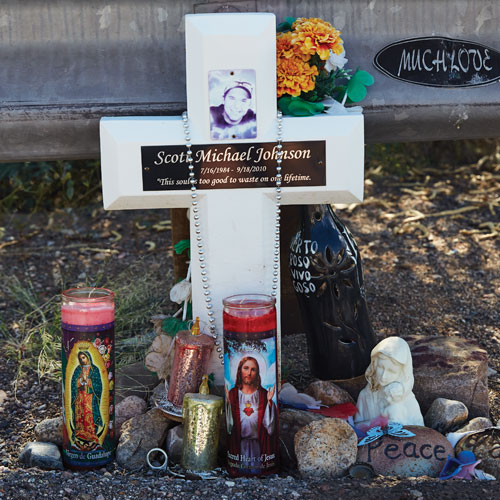
At first they thought the scratching at the door was a javelina. No such luck. Robert Verdugo, 23, his girlfriend Jessica Luna, 21, and Jessica’s sister Deanna, 24, soon realized the noise at 601 N. Fourth Street in Globe was caused by Scott Johnson, 25, a former high-school classmate. It was a hot, late night in September 2010.
Nobody knew it at the time, but Johnson had about five hours to live.
Before they graduated from high school in 2004, Johnson and Deanna had been friends. But Deanna hadn’t seen him for about a year, and only a glancing “hi” at a bar at that. Here he was now, uninvited on her driveway. Because he seemed drunk and belligerent, and because it was late, she didn’t want to see him.
But Johnson insisted. Verdugo went out to the driveway and asked him to leave. Johnson did walk away, and Verdugo returned inside the house. But through the window, Deanna saw Johnson come back. Verdugo asked the sisters to call 911.
When Verdugo returned to the driveway, he had a five-inch hunting knife – fixed-blade, decorated bone-type handle – tucked into the waistband of his net shorts. Shoving and shouting broke out. Words were exchanged: “Pussy!” “This is my hood!” “[Expletive] you… if I want to get in that house I will!”
“They’re fighting,” Deanna Luna told the 911 dispatcher. Verdugo told police Johnson hit him on the side of the head, knocking him to the ground. When Verdugo drew the knife, he reported, Johnson said, “Oh, I see you have to use a knife, you pussy!” Johnson was unarmed, though he did outweigh Verdugo by about 70 pounds.
As Verdugo tells it, Johnson yelled “I’m going to [expletive] kill you!” and came at him. Verdugo stabbed Johnson in the abdomen. Johnson walked about 50 feet, into the street. Then he collapsed. Globe police arrived at about 12:20 to find Verdugo using his T-shirt to try to stop Johnson’s bleeding. Johnson was lying in a pool of blood, moaning, unable to speak. By ambulance and then helicopter, emergency medical technicians rushed Johnson to Maricopa Regional Medical Center. He died of stab wounds at about 5 a.m.
Globe police advised county attorney Daisy Flores to charge Verdugo with manslaughter, according to police chief Tim Truett, who joined the force last year. But Flores believed Verdugo acted, as he claimed, in self-defense. In a letter to Johnson’s parents, she also stated that Arizona law gives the benefit of every doubt to a person who claims self-defense, even if it results in death, following important legislative changes in 2006 and 2010. Flores said she did not believe she could win a conviction against Verdugo, citing the new legal standard: “When a defendant raises the claim of self-defense and there is any evidence to support it, the State is then tasked with the heavy burden of refuting such a claim…”
Robert Verdugo has been a free man ever since. Flores lost re-election in 2012 to Bradley Beauchamp, who based his campaign largely on the death of Johnson. Two years since taking office, Beauchamp hasn’t said publicly if he will pursue a case against Verdugo. He says only this: “I’m not bound by the previous administration’s decision.”
Like 21 other states, Arizona says a person has no “duty to retreat” when confronted by a threat outside the home, even when a safe way out is available. Stand-your-ground supporters contend that such laws preserve a person’s right to dignity and self-defense. Opponents counter that they propagate acts of deadly violence in lieu of non-lethal resolutions. Either way, Arizona – with its mix of concealed-carry laws and robust gun rights advocacy – is primed as a flash-point for America’s smoldering SYG controversy.

Warning Shots
Since the 2012 shooting death of Floridian Trayvon Martin, and the 2013 acquittal of his admitted shooter George Zimmerman, stand-your-ground laws and their effects have been polarizing national news.
Some, like the Jodi Arias story and her debunked claims of self-defense, make the national radar. Others hover under it. Cases often include sudden violence, often between strangers, often young people. Sometimes the person who claims justifiable homicide goes free. But not always.
Arizona’s role in the modern stand-your-ground debate begins with two men ill-met on a Payson hiking trail in 2004. Retired high-school Spanish teacher Harold Fish, then 57, crossed paths with Grant Kuenzli, 43, a volunteer at the Payson animal shelter. Kuenzli was walking with his yellow Labrador retriever, Maggie, and two dogs from the shelter, a chow and a German shepherd mix. The dogs were not leashed.
Fish, the only surviving witness, gave this account to NBC’s Dateline in 2006: He was resting from a day-long solo hike along the Pine Rock Canyon Trail. He planned to exit the trail and go back to his car, when he met Kuenzli. Fish raised his hand in greeting and the dogs ran at him, fangs bared. Fish pulled out the 10mm Kimber semiautomatic pistol he carried when hiking and fired a warning shot at the ground. The dogs scattered, but Kuenzli rushed toward Fish.
“I yell at him, ‘I didn’t shoot your dogs’ or ‘I didn’t hurt your dogs,’”Fish said. “And he’s yelling back at me as he’s coming, he says, in a kind of strange voice, ‘I’m going to hurt you. I’m going to kill you,’ and he’s swinging, kind of punching at me. I’m yelling at him. ‘I didn’t shoot your dogs. No. Don’t. Get back. Leave me alone. No!’”
Fish said he thought Kuenzli meant what he’d said about killing him. The three shots he fired hit Kuenzli in the chest and felled the man immediately. Fish made a pillow of his backpack for Kuenzli, covered him in a blanket, and tried to call 911 on his cell phone, but couldn’t get a call out. He ran to the nearest highway and flagged down a motorist, who used OnStar to call for help. Paramedics found Kuenzli dead.
Kuenzli had a screwdriver in his pocket – sharpened, according to some reports – which Fish’s lawyers argued could have been used as a weapon. The argument didn’t help Fish, who didn’t know about the screwdriver when he pulled the trigger. The Coconino County Superior Court sentenced him to 10 years for second-degree murder in 2006. That spurred the Arizona Legislature to rewrite the state’s self-defense law, to require prosecutors to prove that a person is not justified in using a weapon for self-protection – in essence, asking prosecutors to prove a negative.
The 2006 bill also stipulates that a person acts “reasonably” when he or she uses physical or deadly force – its chief hedge against defense attorneys abusing the law. Governor Janet Napolitano signed the bill into law, which some legislators and media nicknamed “Make My Day.” Fish spent about three years in prison until the Arizona Appeals Court overturned his conviction in 2009. He died in 2012.
In 2010 – two years before the death of Trayvon Martin – the Arizona legislature passed another law, which Governor Jan Brewer signed. It says “a person has no duty to retreat before threatening or using deadly physical force” if he or she isn’t doing anything illegal. The bill also reaffirms that homicide is justified “when and to the degree a reasonable person would believe that deadly physical force is immediately necessary…” to protect oneself.
“It is pretty difficult to second-guess somebody” who claims feeling threatened, comments Eugene Volokh, Gary T. Schwartz Professor of Law at the UCLA School of Law. He sees pros and cons to stand-your-ground laws. The right to not retreat from menace is a matter of human dignity, he says. On the other hand, the law should promote amicable interaction between citizens. “I think it’s a hard call,” he says.
This past April, a jury had to make that call, in a controversial case that, like many to date, pivoted on when or if deadly force is reasonable. Even if the case itself defies reason.
In February 2013, Marine Reserve David Arnoldo Mota, 22, killed Joshua Stephen Switalski, 21, on Oracle Road in Tucson. Both the shooter and victim were in moving vehicles: Mota, driving a silver-colored Chevy Silverado pickup; Switalski, a red Pontiac Grand Am. They were headed north. Mota cut off Switalski in traffic. Switalski sped up to exchange angry words with Mota, “[Expletive] you” and “Beaner!” among them. Mota’s friend and passenger, Daniel Fehr, may have given Switalski the finger. He doesn’t remember, having told police he was “pretty [messed]-up” after multiple beers at Hooters and Toby Keith’s I Love This Bar & Grill that night. Police smelled alcohol on the breath of both men.
By his own admission, Mota panicked. He and Fehr carried three guns between them that night, including Fehr’s .38 and Mota’s .45 caliber handgun. Mota fired what he later told police were two “warning shots.” One of those “warning” bullets went through Switalski’s lung and heart. He managed to pull to the side of the road while his passenger, girlfriend April Taylor, then 21, called 911. Quick response by police and paramedics got Switalski to a local hospital, but he died during surgery. Switalski and Taylor had been on their way to an Olive Garden to celebrate Taylor’s acceptance to beauty school.
Following Taylor’s description of the vehicle, police found Mota parked at a Burger King on Oracle Road. By the time they questioned him, they knew Switalski was dead. But Mota didn’t. Video of Mota breaking down in shock and remorse helped sway the jury at his trial for first-degree murder, aggravated assault, and drive-by shooting, says his defense attorney, Natasha Wrae. The jurors ultimately sympathized with Mota, finding no premeditation in the crime, despite incontrovertible evidence that Mota escalated the dispute with deadly force. They found Mota not guilty.
Wrae understands this outcome makes some people angry. “My knee-jerk reaction to those folks is that they’re the people who flip people off when they get cut off by accident… But I always bring it back to the fact that we had a panel of 12 jurors [and] these 12 breathing individuals all decided that David was not guilty of homicide. You look at that and I sleep very well at night knowing I did a good thing and that this young man is reunited with his family.”
The opposing side ruefully accepted the jury’s decision. “It is the jurors who decide these cases, that are intended to be the litmus test of the community on what reasonable conduct is,” says Kellie Johnson, chief criminal deputy of the Pima County Attorney’s Office. “It’s somewhat shocking and alarming that 12 members of the community said, ‘Well, this is OK, we understand that this is reasonable behavior.’ But they spoke.”
Mota could not be reached for an interview. Shortly after his acquittal in April, he told TV station KVOA: “It’s really not over for me and having to live with the fact that I took someone’s life away.” And Mota is a free man today.
Shots by Both Sides
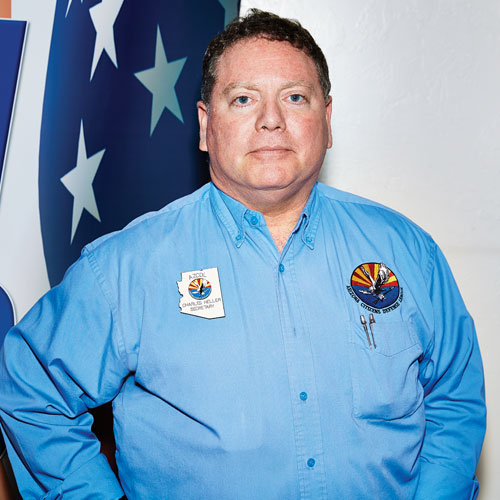
As a social issue bound tightly to the national controversy over gun rights versus gun control, stand-your-ground is a hot-button issue, to say the least. People even fight over the term itself. Advocates like Charles Heller, who nine years ago co-founded the Arizona Citizens Defense League (AzCDL) over coffee at the 5 and Diner on Ray Road in Chandler, prefers to call it “self-defense.” Charles Long, public affairs director for Arizona’s National Rifle Association affiliate, the century-old Arizona Rifle & Pistol Association, calls it “no obligation to retreat.” He adds, “It has nothing to do with ‘I’m looking for a confrontation. Make my day.’”
Gun-control advocates like John Roman, a fellow with the Justice Policy Center at the Urban Institute, a D.C.-based think tank, say stand-your-ground is an accurate label.
The main controversy over stand-your-ground, distilled into a three-word sentence: Is it necessary? Arizona has never demanded that its citizens retreat from danger. So why pass new laws? “Why does the First Amendment need to be reaffirmed?” counters Heller. “Why are there cases on the First Amendment like Citizens United [vs. Federal Election Commision]? Every single right that you have needs to be reaffirmed. Otherwise it gets eroded. That which you do not reaffirm, you do not get to keep.”
Long says Florida, Arizona and other stand-your-ground states enact the laws because citizens who defended themselves, like Fish, were prosecuted for failing to retreat. “You take a little bubble of personal space with you and if someone threatens that space you should not have the obligation to retreat. [We need the laws because of] overzealous prosecutors and D.A.s who really don’t like guns or gun rights and look for any little chink in the armor they can use to push gun rights backwards.”
 He adds: “My heart goes out to the family members of those killed. However, if every case of lawful self-defense was litigated because of the lamentations of grieving family members, we would create a situation where those legitimately acting to preserve life and limb could become dangerously hesitant for fear of prosecution in the aftermath.”
Roman, the gun-control advocate, suggests that’s the least of his worries: “If somebody could show that Arizona citizens were acting in self-defense and still being criminally convicted of homicide, then absolutely, stand-your-ground makes total sense. Nobody’s ever made that case in any state, so it seems to me to be completely political, people scoring political points.”
He goes further: “If the express purpose of these laws is to allow more people to kill and not be prosecuted, which I think is [their express] purpose… then it is clearly working.”
He says the laws require police to make snap decisions on self-defense at the crime scene. “It’s a really chaotic environment and the police have to decide on the scene if this person acted in self-defense or not, rather than doing that in a courtroom… I don’t see anything to be gained from doing murder investigations more quickly.”
Brian Malte, policy head of the D.C.-based Brady Campaign to Prevent Gun Violence, a leading gun-control advocacy group, contends that no-retreat laws are driven by “the corporate gun lobby… [which] wants to sell more guns by creating a fear out there.”
He cites studies that suggest stand-your-ground states see more homicides. For example, a Texas A&M analysis (2000-2010) found that stand-your-ground laws don’t deter burglary, robbery or aggravated assault – but states with the laws did see an 8 percent rise in reported murders or non-negligent manslaughter. He also cites a 2012 Tampa Bay Times investigation of 200 cases, which found that nearly 70 percent of those who invoke self-defense go free. It also found that a stand-your-ground defense is far more likely to prevail if the victim is black.
Citing the Times report, Malte says, “People often go free under ‘stand your ground’ in cases that seem to make a mockery of what lawmakers intended. One man killed two unarmed people and walked out of jail. Another shot a man as he lay on the ground. Others went free after shooting their victims in the back. In nearly a third of the cases the Times analyzed, defendants initiated the fight, shot an unarmed person or pursued their victim – and still went free.”
Doing Time?
Invoking a no-retreat law is by no means a self-defense slam-dunk, Jerry Cobb, spokesman for Maricopa County Attorney Bill Montgomery, is quick to point out.
“The mere assertion of a claim of self-defense by a defendant does not in and of itself present a challenge to a prosecution,” he says. “The decision of whether to charge a case ultimately comes down to whether or not we believe we have sufficient evidence to prove a criminal offense beyond a reasonable doubt. If we do, we charge the case. If we don’t, we don’t. There are numerous cases we have successfully prosecuted in which the defendant claimed self-defense: Cordell Jude, John Chester Stuart, Marissa Devault, Jodi Arias, to name just a few recent high-profile examples. All were convicted.”
Stuart was found guilty in 2013 of a road-rage shooting death. Stuart, who shot a man named Thomas Beasley at a red light in north Scottsdale in 2008, “attempted to justify his actions by claiming self-defense, [but the] jury was able to apply the important distinction Arizona law makes between the legitimate and illegitimate use of deadly force,” Montgomery said last year.
Devault was sentenced to life in August for the first-degree murder of her sleeping husband, Dale Harrell, by hammer, in 2009. She’d called police and told them that Harrell tried to strangle her in her sleep but that her boyfriend, Stanley Cook Jr., rescued her by taking a hammer to Harrell. Cook pleaded memory loss from traumatic brain injury, Devault admitted to wielding the hammer, and forensic evidence showed Harrell, who died weeks later, was alone in bed at the time Devault attacked him.
Then there’s Cordell Jude, 23, now serving eight years for manslaughter in a case CNN labeled “the reverse Trayvon Martin.” Jude, who is African-American, killed Daniel Adkins Jr., 29, who was Hispanic, in April 2012 at the Taco Bell near 51st Avenue and Baseline Road.
Jude was moving his car through the drive-through lane, with his pregnant girlfriend sitting in the passenger seat. On Jude’s lap rested a .40 caliber pistol.
It was about 7:45 p.m. when Adkins walked his yellow Labrador, Lady, through the parking lot. For some reason he stepped in front of Jude’s moving car. Jude slammed on the brakes. Adkins yelled at Jude, and Jude says Adkins hit the car with a metal pipe or baseball bat. Jude says he thought the next swing was for him. So he shot Adkins.
Jude’s girlfriend called 911, but Adkins died on the asphalt. Police never found a pipe, bat, or anything like it. Even so, they didn’t immediately arrest Jude, who was indicted on second-degree murder by a grand jury four months later.
In a letter to the court from his lawyer, Jude expresses remorse. Among other things, Jude didn’t know that Adkins was “mentally challenged” and “never lived away from [his parents’] home due to his special needs,” according to court documents. Adkins’ mother told media her son had the mind of a 13-year-old.
A defense statement says: “The victim was in a rage and leaning inside of [Jude’s] car when he was shot. The only way this could have been prevented was if the victim just kept walking and they never made contact. [Jude] was just trying to protect his family when he shot and killed Mr. Adkins… He has remorse because a man lost his life but feels he had no other option in the situation.” Jude, the father of two toddlers, also told the court he does not believe he got a fair trial, and said he may appeal. Convicted in February, he is inmate #288916 in the Arizona corrections system.
Still, at least one prosecutor suggests that self-defense cases are now harder to prosecute in the wake of Arizona’s 2010 law. In her letter to Scott Johnson’s family, Daisy Flores argues that the bar for invoking self-defense is low, and the burden of proof on a prosecutor has grown correspondingly heavier.
She cites the Fish case and other recent Arizona cases where defendants won acquittal on the grounds of self-defense. One was a man who kicked a homeless person to death in 2010 for throwing a water bottle at him. In another 2010 Gila County case, an off-duty paramedic stabbed a man to death in a bar parking lot and fled the scene, but a jury found him not guilty. “Through discussion with the jury,” Flores wrote, “we learned [prosecutors] had not overcome the claim of self-defense.” A man who shot a victim in the back of the head in 2011 in Gila County was acquitted too, Flores wrote.
Analyzing FBI 2005-2010 numbers, Roman last year reported that Arizona saw 80 homicides ruled as justifiable, a rate of 5.52 percent. Only Oregon, at 5.95 percent, exceeded that acquittal rate. Roman says Florida doesn’t cooperate with the FBI on supplying those stats.
To Be Continued
Several slayings, and the self-defense justifications offered, are still open cases in Arizona. For example, defense lawyer Wrae represents Daniel Renteria, who killed two men in 2010. Renteria claims he acted in self-defense when confronting a neighbor who allegedly molested Renteria’s then 3-year-old son. After four jury trials, Renteria was convicted of negligent homicide and sentenced to four years in prison. He continues to appeal his case.
A more recent death still under investigation happened in February, at the Walmart on Warner Road in Chandler. Two shoppers, strangers to each other – Kyle Wayne Quadlin, 25, and Kriston Charles Belinte Chee, 36 – got into an argument at the check-cashing counter. Store employees told police the verbal sparring began when Belinte Chee complained that Quadlin cut him off in line, and also violated his wife’s personal space. While Belinte Chee’s wife collected her cash, Belinte Chee and Quadlin agreed to take their disagreement outside.
A customer said he saw the two men “scruffling” near an ice machine. Belinte Chee pushed Quadlin against the wall and put him in a headlock. At some point, Quadlin realized he was losing the fight. He cursed and pulled a silver .45 semiautomatic from his pants.
“Pow,” said the witness. A store employee working cash register number 17 saw the trail of blood and ran to get some paper towels. Quadlin bolted, but his wife, Tanika York, called police from their home on Alma School Road. A doctor at the Scottsdale Osborn Hospital pronounced Belinte Chee dead at 4:46 p.m.
Quadlin told police it was self-defense. Maricopa County did not file charges, spokesman Cobb says. Chandler police still consider the case open, with Quadlin still free pending investigation, says Sergeant Joe Favazzo, the department’s public information officer. Leonard Gorman, executive director of the Navajo Nation Human Rights Commission, said shortly after the killing: “Claims of self defense are very subjective. Based on the recent Florida cases (Zimmerman and Dunn), it is clear that no duty to retreat is confusing and requires substantial investigation.” He added: “It’s disappointing to learn that Mr. Chee’s family is left with the notion that his death is okay, no crime committed.”
In Globe, Scott Johnson’s mother feels the same way. Roberta Johnson, elected to the Globe City Council last year, says she won’t agitate for her son’s killer to be prosecuted. But she does want the grand jury investigation that she thinks should have occurred in 2010: “We want the truth,” she says, adding: “We’re the victims. We shouldn’t have to fight so hard.”
In a 2011 letter to Flores, Johnson family lawyers argue that enough questions remain surrounding Johnson’s death to justify an indictment for second-degree murder or manslaughter. Among other things, witnesses differ on whether Johnson kicked at the door, or just scratched at it. Robert Verdugo said once that Johnson knocked, and another time that Johnson tried to break the door down.
Chief Truett defends the Globe police department’s investigation of the killing. He bristles at criticism that Verdugo wasn’t screened for drugs, saying the police had no probable cause, and that Flores told police screening wasn’t necessary. Verdugo told police that night he’d taken Ambien, methadone, Xanax and Paxil. He said he was being treated for depression, and also admitted to some illegal drug use in the past.
In the letter, attorney Jamiel Allen – then with the Tucson firm Heurlin Sherlock Panahi, now a federal public defender – says there’s doubt as to whether the stabbing took place in the Luna home’s driveway or on the street. Allen also says that Deanna Luna hinted on Facebook that she knows more than she’s told, and suggests that Verdugo got off easy because he may have been a police informant. “Since there is no evidence to dispute that Scott Johnson was the initial aggressor, the true question becomes whether or not the amount of force used by Verdugo to defend himself was appropriate to the amount of force Johnson was using against him,” Allen says.
That’s the question in almost every stand-your-ground case. The Verdugo case even raises questions about a Second Amendment right to use a knife, an idea which has supporters every bit as passionate as gun owners.
And the questions don’t end there. Gun-rights supporters like Heller and Long cite anecdotes about people who successfully and nonfatally used guns to protect themselves or stop crimes. Critics like Roman counter with stories about gun use gone horribly wrong, like the recent accidental shooting death of a gun instructor in White Hills by a 9-year-old with an Uzi. Roman says there’s a shortage of information on guns and crime in America, largely because Congress cut off funding for research. “Anecdotes are not data,” Roman says. “You can always find a story that supports your opinion. So I don’t believe anybody’s stories from either side.”
For now, stories are all we have. That, and the fact stated by Pima attorney Kellie Johnson: “The law is the law… the legislature has spoken, and I live with the law as they give it to me.