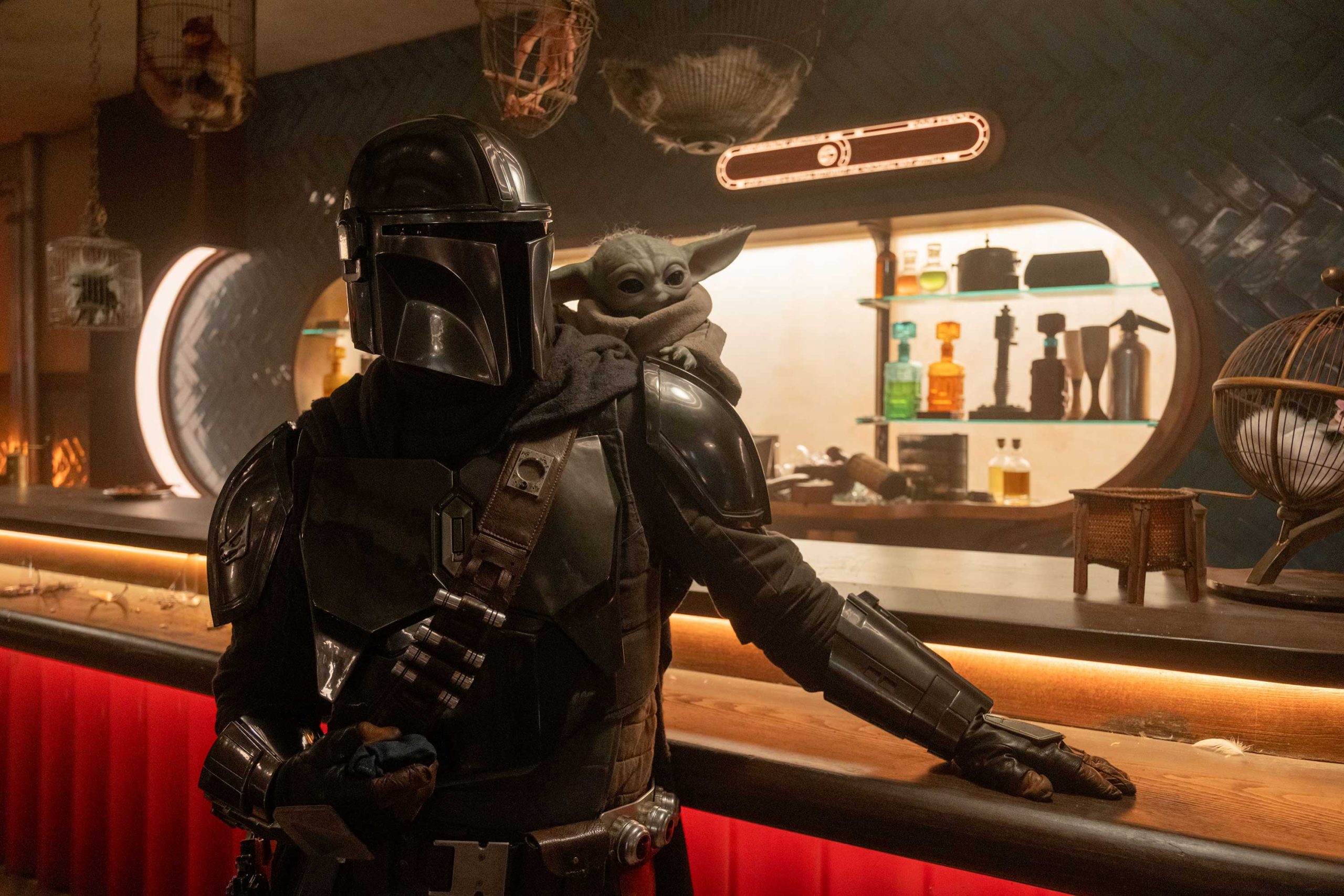
The Mandalorian is a member of an order of helmeted and armored space bounty hunters with a warrior’s code. Played by Pedro Pascal when the helmet’s off and various stuntmen including Lateef Crowder when it’s on, he’s part of the Star Wars universe – he wears essentially the same armor as Boba Fett from the original trilogy, though I’m told Boba Fett’s status as a true Mandalorian is questionable.
There’s a good chance you already know all this if you’re bothering to read this review. I, on the other hand, just learned it in the last few days, as I’m one of the handful of people who have managed to see not so much as one episode of The Mandalorian, Jon Favreau’s hugely popular TV series that ran on Disney+ from 2019-2023, wherefrom the character originated.
The other title character of the new feature Star Wars: The Mandalorian and Grogu, opening this weekend, is commonly known as “Baby Yoda.” Grogu is a toddler from Yoda’s gnome-like, green-skinned species who already commands prodigal access to The Force. The Mandalorian is Grogu’s devoted surrogate parent.
The movie, directed by Iron Man kingpin Favreau from a script he wrote with a couple of other hands, takes place after the defeat of the hated Galactic Empire. “Mando” works for the New Republic (the government; not the magazine), tracking down the scattered Imperialist creeps that are still getting up to fascistic mischief on the downlow in remote reaches of the galaxy.
His boss (Sigourney Weaver) sends him on a mission to rescue a Hutt, one of the big sluglike gangster aliens of which the late Jabba is the best known. The Hutt in question is Jabba’s son Rotta (nicely voiced by Jeremy Allen White), who has been imprisoned on a gritty urban planet and forced into gladiatorial combat.
When Mando and Grogu, who’s usually riding in an over-the-shoulder pouch, catch up with Rotta, they find he doesn’t particularly mind his captivity; he’s treated like a star. The organized crime scion has also gotten into good physical shape; you might call him Jabba the Cut. Most strikingly of all, he’s not a bad sort. It’s a testament to the spirit of the franchise, and of Favreau, that the Hutts aren’t automatically bad guys.
The adventures which follow are heavy on action, light on dialogue. Fights, chases, monsters and sinister rivals abound; the shadowy, spindly-limbed agent with face concealed under a conical hat has a particular air of menace. There are lengthy passages of the movie, like Grogu’s methodical treatment of a wounded, unconscious, down-and-out Mando, that verge on pantomime; they have the feel, almost, of silent movie technique. Influences from Blade Runner to King Kong to The Wizard of Oz to the kaiju movies, not to mention the earlier Star Wars flicks, are easy enough to spot, but they also combine, blended by Ludwig Göransson’s excellent music, to create an atmosphere distinctive to this movie.
I was curious, going in, if my unfamiliarity with the material would leave me baffled by The Mandalorian and Grogu. It didn’t. This film has some of the almost Jungian fairy-tale simplicity of the original 1977 Star Wars. Back then it was as simple as: Here are the good guys, they have to rescue a princess and blow up the Death Star. Here, it’s as simple as: This is the good guy and his cute sidekick, and this is the mission they’ve been given.
After the eye-crossing political backstory of the much-lamented Star Wars prequel and sequel trilogies, it was refreshing.