Following a humiliating 2024 election – and the even more-humiliating ouster of their new chairman this summer – Arizona Democrats look for a way to clean up the mess.
By Tom Zoellner | Photo Composite by Mirelle Inglefield
The Arizona Democratic Party was riding high in 2021. President Joe Biden had snatched a narrow statewide victory from Donald Trump in the previous November’s election, confirming “baby swing state” status on what had recently been a well-guarded Republican stronghold.
Meanwhile, a military man without a prior electoral record, Mark Kelly, won his race for the U.S. Senate, joining senior Senator Kyrsten Sinema, meaning the state would be represented in the upper house by two Democrats for the first time since 1952. Strong candidates were preparing to make successful runs at Arizona’s three most powerful constitutional offices: governor, secretary of state and attorney general. Control of both houses of the legislature seemed within reach.
After years of crawling through their own political Sonoran Desert, it seemed for weary Arizona Democrats like the unofficial party anthem, “Happy Days Are Here Again,” might at least be worth humming, if not belting.

“Jubilation is an understatement,” says Valley political consultant Matt Grodsky, who helped put Secretary of State Adrian Fontes into office in 2022. “A lot of us felt like we had laid the groundwork for an infrastructure at the state party to keep winning into the next decade.”
So much for that fantasy. Following a drubbing in the 2024 election, in which they failed to flip either state legislative chamber and similarly came up short in Arizona’s two competitive congressional districts, state Democrats have once again descended into the kind of rock-throwing and identity politicking for which the party is famous. The dysfunction reached a spectacular crescendo this summer after the ouster of the Arizona Democratic Party’s top official, chairman Robert Branscomb II.
Stability appears nowhere in sight, and some in the party are wondering if state Democrats have the mojo to make a strong showing in the 2026 midterms.
Elected by state committee members to lead the party in a January election, Branscomb – a Goodyear-based insurance broker who ran as an outsider – served just six months of an expected two-year term before the same voters deposed him in a hastily planned Zoom meeting this past July.
The reason for the firing: in-fighting, alleged financial mismanagement and a healthy dose of racial finger-pointing. Back in January, Branscomb had promised to calm tensions after the presidential blowout of 2024 and the loss of three legislative seats. He ran against – and decisively defeated – incumbent Yolanda Bejarano, who managed the 2024 cycle and was later criticized for propping up several candidates who proved unelectable. The party’s presence outside Phoenix and Tucson had also withered to a husk. In his new role as the state party’s lead fundraiser and candidate-vetter, Branscomb said he wanted “bold and transformative change.” He was also the first Black chair of the party.
But things soured fast for Branscomb. After removing executive director Morgan Dick amid a massive staff exodus, he launched a national search for Dick’s replacement – subsequently rejecting the two candidates presented to him and instead hiring his own choice, Michael Ruff, who previously managed African American outreach for ADP. The move raised transparency concerns among Democratic insiders and smacked to some of patronage politics.
Fundraising was also not going well: The numbers in early 2025 were less than 12 percent of what they had been in comparable quarters, and the annual dinner to garner donations had to be canceled for lack of interest.
Some committee members began to regret their choice. “[Branscomb] talked good, he looked good, but didn’t have the leadership capabilities,” says Patty Cervantez, chairperson of the Graham County Democratic Party. “No budget was drawn up.
He was not returning our calls. We wanted more transparency. We didn’t see him out here, though he was in travel status most of the time.”
Then came a bad Saturday morning on April 19 when Branscomb hit send on an email to every state party member complaining that elected officials had sandbagged his transition. He then accused a Kelly staffer of making a barbed racist comment about him, specifically, that his election meant “Black folks coming after Latinos,” touching on historical rivalries in Phoenix city politics. He demanded an apology.
What he got instead was a coup d’etat. “We’ve spent the last several months meeting regularly with the chair and working to support the party through the transition,” read a joint statement signed by Kelly and fellow U.S. Senator Ruben Gallego, along with Governor Katie Hobbs, Secretary of State Adrian Fontes and Attorney General Kris Mayes. “Unfortunately, his statement today includes many false claims and is the kind of bad-faith response we’ve come to expect from the new leadership over the last several weeks.”
After that knockdown missive, nobody in state politics expected Branscomb to hold his job through the summer, but he fought it to the point of a vote, which came during a four-hour call-in committee meeting on July 16 ridden with technical glitches, embarrassing mispronunciations of tribal names and general disorganization, according to several in attendance. “Such a stupid, stupid, stupid episode,” laments Democratic consultant Stacy Pearson.
Branscomb was removed by a vote of 476-56. In an interview with PHOENIX after his ouster, he struck a conciliatory tone, acknowledging that he was too quick to make staffing changes without consulting the elected leaders. He says he sent the irate email because he felt bullied. But he also believes that party stalwarts were too quick to “take their ball and go home” without giving him enough time to reconcile divergent interests. “People don’t see the value of the state party, but we try to get people under this big tent,” he says.
For many constituents, however, the Arizona Democratic Party looks like a dumpster fire – not unlike the real-life blaze that destroyed its hovel-like office at Thomas Road and Central Avenue in July 2020, when an aggrieved volunteer threw an incendiary device through a window and immediately confessed to the crime on social media in what might be called an “extreme influencer move.” Today, the incident appears eerily prophetic.
Many are now wondering if the Arizona Democratic Party will be able to get its act together to stage an offensive in the 2026 midterms and stay vibrant enough to field a volunteer army for the 2028 presidential election. Some are asking if a state party organization is even relevant any longer. Posed this question in a brief telephone interview, interim state party chair Kim Khoury hesitates. “Let me think about that and get back to you,” she says. The return call never comes.
Tellingly, before the Branscomb ouster, Hobbs and Mayes – who are both up for reelection in 2026 – took the radical step of steering their fundraising through the Navajo County Democratic Committee, a regional organization managed separately from the state party. Its chairperson, Missa Foy, formed an alternative group called Copper State Victory to handle the money.
It was the beginning of a state-wide trend and may provide a modicum of salvation for Democrats in Arizona, where more county chairs are detouring around the dumpster fire and taking control of fundraising and candidate recruitment. The frustrated faction of county leaders calls itself “The Secret Sauce” after one of Branscomb’s cryptic statements about fundraising and victory tactics.
“There were promises made to us, and when those promises fell through, we looked at each other and figured out how to do things without the support of the Arizona Democratic Party,” Pinal County Democrats chairperson Jennifer Hilsbos says. “Our intention was to build a strong network amongst ourselves so that if the state party couldn’t come back, we wouldn’t start losing races.”
In particular, county offices can do a much better job attracting volunteers who want to feel closer to their communities and not a distant circuit in a Phoenix-based motherboard, Hilsbos says. “Just telling us to do a thing is not always the best way to get things done. We’re Democrats, after all – we’re all here for different reasons. Bulldozing doesn’t work.”
At least on the Democratic side, the mechanics of state party politics were never well defined: It might be compared to a central bank that has no power to set interest rates or monetary policy, only to cheerlead from afar, make the national platform palatable to a skeptical audience and try to referee internal disputes.
It also serves as a fundraising machine and distributor of money from the Democratic National Committee to races it thinks it can win. “It’s kind of like the Death Star,” Grodsky says. “It can point a big laser, but the star destroyers” – i.e. the individual campaigns – “have to tell them where to point it.”
Exactly where these blasts of money get directed is a matter of intraparty contention, of course – so the state organization also enforces a coordinated campaign in which down-ballot candidates could ride the coattails of a popular governor or president.
Palace intrigue and disputes between the establishment wing of the Arizona Democratic Party and those further left grew more heated in 2022 when the executive board voted to censure U.S. Senator Kyrsten Sinema for her support of the filibuster.
According to multiple county chairs, some of the tone-deaf messaging from Phoenix and the confusion at the headquarters was alienating rural Arizona to the point where county organizations died on the vine and winnable legislative races went unchallenged.
As such, the later Branscomb meltdown did not come out of nowhere.
“This is the equivalent of teenager growing pains,” says Pearson, the director of Lumen Strategies, a consultancy that mainly represents Democrats. “The party leaders inherited a small tent. A decade ago, we were begging for $500 checks to get [Sheriff Joe] Arpaio out, and now we’re talking about $50 million statewide campaigns. The growth has been so fast and so furious that the party has been struggling to catch up.”
An extremely compact history of the Arizona Democratic Party would start in 1910, when it gave the state a labor-friendly constitution that checked the power of the copper companies. But it nevertheless had a touch of the Old South, with hostility to Latinos and Natives, and operated like a patronage machine. The ladder to high office ran through the counties – those who got ahead were sheriffs or judges who made the right friends and waited their turn. Once in federal office, their No. 1 job was to secure money for dams and military bases. That dominance crumbled after a wave of anti-tax Midwestern Republicans flooded in after World War II and elected rawboned Sun Belt cheerleaders like Barry Goldwater.
As suburban Republicans slowly chipped away the influence of conservative “pinto Democrats” from rural Arizona like Yuma’s Harold C. Giss, a wave of young Latino activists including Raúl Grijalva and Alfredo Gutierrez pressured the party to take bolder social justice stances. Arizona politics became increasingly “Maricopized” into the 1980s as the city spread to the horizons and the state grew redder.
For roughly two decades, Democrats seemed to win office only as temporary and fickle rebellions against GOP overreach or incompetence – for instance, Governor Rose Mofford’s three-year reign as the state’s top executive in the wake of the Evan Mecham scandal. Preppy attorneys with storied family names like Bruce Babbitt and Terry Goddard became the face of a shrinking party that – according to activists – took barrio and reservation votes for granted, building a foundation of mistrust.
“The Democratic Party has failed to include in its strategies a younger leadership developing in the Hispanic community,” investment adviser Gary Trujillo told The Arizona Republic in 1998.
In 2012, when Democrats took control of a majority of Arizona’s congressional districts, and shortly after, when they started to dominate U.S. senate elections, it seemed the party was taking the upper hand in Arizona with its mix of minority, liberal and moderate voters. But the shift proved illusory – and state party management may partly be to blame, insiders admit.
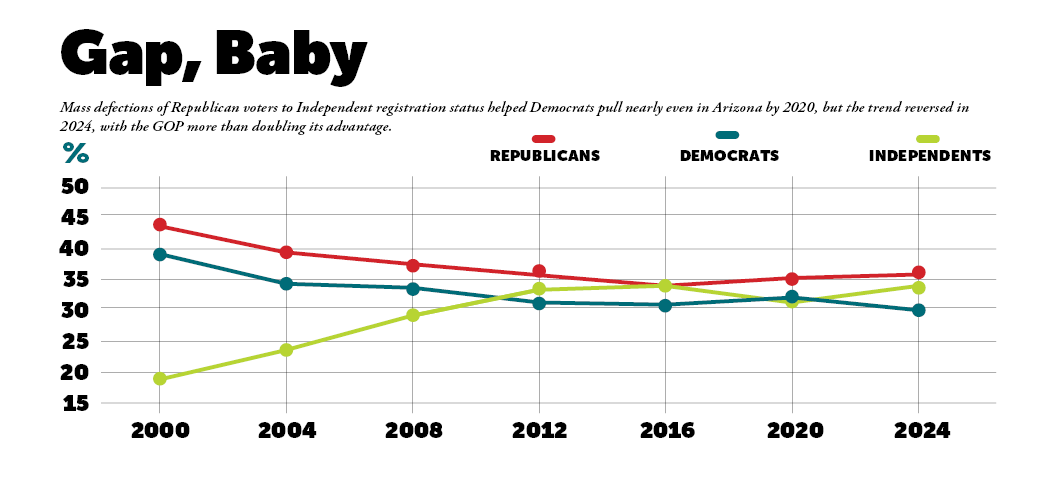
A recent contraction of Democratic voter registrations took them by surprise, as did the widespread defection of Latino voters to Trump and the Republicans. Registered Democrats came within three percentage points of the GOP in 2020, a gap that has since slipped to seven points (see graph).
“We drank our own Kool-Aid on what a Democrat looks like,” Pearson says. “We started talking about national niche issues and got away from public safety, housing and affordability.”
Pearson and others insist all is not lost for the perennially beat-up Arizona Democratic Party. Hobbs showed a strong second quarter of 2025 with $1.3 million raised. And state Democrats will meet again on September 13 – after this article goes to press – to choose a new permanent chair.
For his part, Branscomb remains a committed Democrat and wants to see the party succeed.
“For too many years, we’ve been too congenial with the Republicans,” he says. “We need to start pushing back and letting them know that the values we have as Americans are worth keeping.”