Are local museums – leery of funding cuts and conservative activism – censoring art and artists?
It’s 2055, and you’re visiting your favorite local museum. You’re there to see a new exhibition that depicts alternative sexuality in large-scale assemblages made from plywood and repurposed Dairy Queen spoons. But two of the sculptures you’ve read about and were expecting to see are missing. In their place are signs that read, “Management has deemed this artwork offensive and has removed it from the exhibition.”
In the gallery next door, you stop in at Bosoms: The Undraped Form in Paintings of the Eighteenth Century. You can’t help but notice that someone has pasted a tiny paper bikini on Francisco Goya’s “The Nude Maja” and that the bodies of the women in François Boucher’s “Diana Bathing” have been obscured with carefully placed bits of fabric.
You corner a docent and demand to know who’s defaced these famous Rococo paintings. She smiles and replies, “We’re not allowed to talk about that. But I’m happy to share with you the official release crafted by our marketing department about how we celebrate all arts and disapprove of censorship!”
On your way home, you phone your sister-in-law, who runs a local art gallery. “It’s the middle of the 21st century!” you holler. “What’s happening?”
“I’m sure I have no idea what you mean,” she replies. “No one has ever removed or obscured artwork that might offend someone and therefore threaten an art space’s funding.”
Then she whispers, “Look, I gotta go. There’s a bunch of LDS people here and I’m trying to sell them a lithograph!”
Don’t laugh. According to museum insiders, it may not take 30 years for such scenarios of suppression and rescission to become the norm. Censorship in the arts is hotter than ever these days – more popular than eco-friendly paint and hand-numbered giclée prints. Locally and nationally, arts organizations are squashing exhibitions and artwork portraying hot-button topics like race and gender and police brutality. Though censorship is nothing new, curators, artists and critics are pointing to our country’s newly conservative approach to arts funding as the reason more arts organizations are clamping down on what’s shown.
Just ask Tiffany Fairall. Until last year, Fairall was chief curator of Mesa Contemporary Arts Museum, a city-run space where she’d worked since 2006. Fairall was terminated in May of 2024 because, she alleged in a subsequent lawsuit, City of Mesa managers accused her of creating and overseeing exhibitions that were “too liberal” and might offend city employees or hinder federal funding. She says her employer demanded shows that were “more neutral.”
Or you could ask Christine Eyene, Jennifer McCabe, Daria Khan or Maura Reilly, who co-curated transfeminisms, an exhibition scheduled at Scottsdale Museum of Contemporary Art early this year. Months after it was announced, this traveling show, which dealt with feminist perspectives, disappeared from catalog copy and was replaced with an edited version of the exhibition with a less provocative title.
The arts CEOs and city employees I asked about these two cases of censorship rolled their eyes and dodged responsibility and agreed that censorship is bad and wrong. One of them tried to distract me with a story about how, only a few months ago, the Fort Worth Police Department had confiscated several artworks from that city’s modern art museum, and wasn’t that the worst case of unconstitutional censorship I’d ever heard of?
Not really, I wanted to reply. I thought it was way worse that artist Michelle Hartney’s Unplanned Parenthood – a mixed-media installation about reproductive rights – was pulled from a recent exhibition in Idaho. And when the Rhode Island School of Design shut down an exhibition on political resistance and Palestinian liberation a couple months ago, that was also pretty lousy. And don’t get me started, I felt like saying, about Donald Trump’s executive order titled “Restoring Truth and Sanity to American History,” which directs federally funded cultural programs to comply with nationalist narratives.
“It’s definitely not just happening in Arizona,” Fairall says of arts censorship. “And if censorship becomes the rule, it would mean we’re no longer the country we set out to be. And if that’s the case, I’ll be looking for another country to live in.”
Fairall has good reason to want to blow town. She went toe-to-toe with censorship, she says, and lost. She alleges she was shanghaied by a City Council that wanted to tell her what kind of art she could show.
Fairall admits she saw it coming. In December 2020, she’d proposed a gallery show to be crafted by curator Clottee Hammons.
That show, Human Contrasts, took its theme from Martin Luther King Jr.’s “I Have a Dream” speech and included images commenting on police brutality. Fairall says that then-city manager Chris Brady was unhappy with the exhibition, especially artwork that depicted law enforcement in a bad light.
In 2023, Fairall oversaw Just Cause: The Power of Contemporary Art, a group show that explored the power of arts imagery in social engagement. She was asked to remove several artworks from the exhibition.
“I had two pieces in that,” says South Carolina-based ceramic artist Russell Biles, “and I heard they wanted them out of the show. One of them was called ‘Terms of War’ and it’s a sculpture of Vladimir Putin standing on a nuclear explosion and urinating. It had to be the nudity they objected to, because the reasons people come up with for censorship are always ridiculous.”
“After the Just Cause show, [the City] wanted to review everything we were doing,” Fairall remembers. “They wanted me to flag artwork that was problematic. My supervisor was getting pressure about what we were showing, and that’s when they started saying I was ‘too liberal’ and our shows should be ‘more neutral.’”
In 2023, Fairall says Brady and former deputy city manager Natalie Lewis demanded she remove a piece of art from a traveling solo exhibition by street artist and activist Shepard Fairey, perhaps most famous for his iconic Barack Obama “Hope” poster.
The piece, titled “My Florist is a Dick,” commented on police brutality against Black people. Fairall says that when she declined to remove the print, Brady and Lewis postponed the show, then canceled it, saying the museum staff wasn’t ready with its new season.
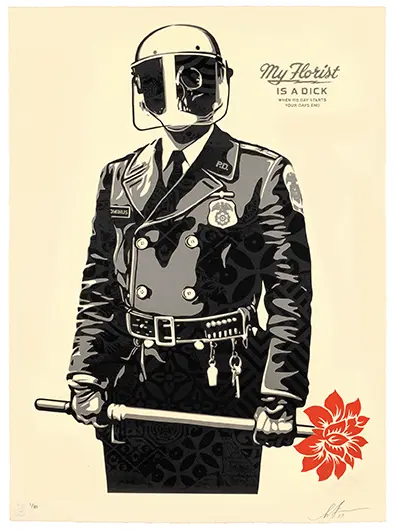
“They were lying to cover up their censorship,” Fairall says. “I was supposed to censor a piece of art because the City didn’t want to offend the police, who are city employees.”
Fairall contacted the National Coalition Against Censorship and the local chapter of the American Civil Liberties Union, which wrote a letter to the City demanding that the exhibition be reinstated. Fairall prevailed, and the show opened in October of 2023 and included “My Florist is a Dick.” But after that, Fairall says, the City put the clamps on.
“It was a victory, but it wasn’t,” she says. “Now they were telling me I couldn’t communicate directly with artists or speak to the media about our shows. Everything we did was being scrutinized, and they took away my autonomy because I called them out on censorship. They thought I was being disloyal.”
When Fairall continued to push back, she was told she should either resign, retire or accept another position with the City. She declined all these choices and was terminated in spring 2024, she says.
“They forced me out,” she says. “My professional reputation was harmed, not to mention my mental and physical health. I’m still recovering from all of it. I applied for a job recently and never heard back. I can see that’s how it’s going to go for me.”
Fairall brought a lawsuit against the City of Mesa, which offered her a deal: Take a $17,000 settlement and sign a non-disclosure agreement. She says she declined the deal and dropped her lawsuit, in part so she could publicly state her case. She wanted to talk about how she’d fought the law, and the law won.
“In my case, the law is the City,” she says, “and they were asking me to censor art and artists. And I wasn’t going to do that.”
The museum’s official response to these allegations is a masterclass of redirection, full of corporate lingo like “evolving best practices” and “broadening our community listening strategies,” courtesy of MAC executive director Mandy Tripoli, who responded in a statement forwarded by the Center’s director of marketing, Kristin McLeod.
Asked about Fairall’s complaints, McLeod says only, “Out of respect for privacy, we do not comment on individual human resources matters.”
Tripoli herself “wasn’t available” for an interview on the subject of censorship.
The museum’s signage is also expertly apologetic; during a recent exhibit, it posted signs reading, “To exhibit a work of art is not to endorse the work or the vision, ideas and opinions of the artist. No single point of view in any artistic work represents a position of the City of Mesa.”
In other words, “Don’t blame us if you’re offended.”
It’s easier to pull potentially “offensive” artwork from a show when you don’t have someone like Tiffany Fairall messing things up for you with all her anti-censorship stuff. Take transfeminisms, for example – a group show that was supposed to open at Scottsdale Museum of Contemporary Art a few months ago. The exhibition premiered at London’s Mimosa House gallery last year and, according to an article in the Arizona Digital Free Press, was going to feature artwork that addresses feminist solidarity, freedom of speech and reproductive rights, among other themes.
But when the show opened earlier this year, it had been significantly changed. Retitled There are other skies, the exhibition’s run was two months shorter, and its artist lineup had been trimmed. In London, transfeminisms was described as “bring[ing] to light a multiplicity of urgent, pressing and ongoing issues faced by women, queer and trans people across the globe.” Its renamed Scottsdale version claimed to be about “a multiplicity of urgent, pressing and ongoing topics faced by female-identifying people worldwide.”
The show fostered that message without the help of some of its more controversial pieces, which had been left out of the exhibition. Two of these were “Lalaga Toto Mai I Le Pō – Bloodlines Woven From The Night,” an installation by SaVĀge K’lub, a collective whose work explores racial and gender stereotypes. Also gone from the show was the sound installation “Penises also Cry” by Myriam Omar Awadi, which featured a sex toy planted inside a penis-shaped sculpture. Likewise, a proposed “forum” gallery space that would welcome women’s and LGBTQ+ groups to participate in film screenings and poetry readings had been excised from the show.
“The exhibition transfeminisms wasn’t canceled or postponed – but it was censored,” according to Maura Reilly, one of the show’s New Jersey-based curators. “It was exhibited, but in a compromised form that betrayed its original intent. The concept – a collective, transnational, feminist exhibition – received robust national funding and support. Ironically, that very support seemed irrelevant when the exhibition was deemed too provocative, too ahead of its time, or simply too uncomfortable for [SMOCA].”
Reilly’s co-curator, Daria Khan, put it more bluntly. “The exhibition was violently edited in Scottsdale,” Khan told journalist Lynn Trimble in the arts magazine Southwest Contemporary.
Not so, says Gerd Wuestemann, CEO and president of Scottsdale Arts, the nonprofit that manages SMOCA. The pieces removed from the show were dumped for logistical reasons, Wuestemann maintains.
“We included 29 of the original 33 works,” he says, “which is the vast majority of the show. Of the four not included, one artist chose to withdraw, two of the artists weren’t able to ship their work to the U.S., and the fourth was from a collective whose work we couldn’t import without significant customs issues. It’s not unusual for a touring show to be changed by the museum that’s hosting it.”
And what about that name change? Was it the prefix “trans” that was the problem?
“Our team evaluated the title of the show,” he says, “and looked at the concerns from some of the show’s London reviews that said the title was more controversial than it needed to be. We decided we wanted a title that was inviting, so we gave it a poetic title [instead].”
A recent change in SMOCA leadership may have had something to do with why transfeminisms was edited and renamed. Chief curator Jennifer McCabe resigned from SMOCA in October for a museum job in California, and Khan told Trimble that the show’s curators were sidelined after McCabe’s departure.
“We felt very unprotected as curators,” Khan told Trimble. “We were just told about the changes and we didn’t have any ownership of our own creation.”
Wuestemann agrees that removing controversial art from an exhibition is bad policy, especially lately, when the White House is issuing executive orders aimed at censoring cultural institutions, and when the Arizona legislature has introduced several anti-transgender bills and Scottsdale City Council has voted to cut funding for city-wide DEI initiatives.
“What’s more of a concern is that the funding mechanism is under threat,” he says. “We relied on two National Endowment of the Arts grants that are no longer in the system, which may lead to a hole in our budget.”
I ask Wuestemann if the solution was to present less controversial shows to ensure funding from newly conservative sources.
“All cultural institutions want to represent a broad spectrum of beliefs,” he answers. “But when funding mechanisms come apart, that’s harder to do. The current political climate has created greater peril for arts organizations.”
Reilly agrees. “We are watching this happen across the arts sector,” she says in a prepared email statement. “National buffers are gone. The NEH has canceled grants and gutted staff. The NEA is redirecting resources toward safe, patriotic programming tied to the Declaration of Independence. DEI commitments are quietly vanishing from institutional and government platforms.
This is the new censorship: not a loud rejection, but a quiet dilution. And it’s just as effective.”
Censorship in the arts is older than a cave painting. In the 16th century, Michelangelo’s Sistine Chapel portraits were painted over after the Roman Catholics freaked out about all the nudity. “Degenerate art” was banned in Nazi Germany, where Soviet artists were made to conform to Socialist Realism.
But censorship is easier to recognize these days because it tends to follow trends, according to Elizabeth Larison, director of the Arts and Culture Advocacy Program at the National Coalition Against Censorship.
“Two years ago, works that commented on police brutality were being questioned and censored and restricted,” she tells me.
“Last year, there was more censorship of art that commented on the conflict in Israel and Gaza. In 2025, it’s all about fear of government censorship, and about self-censoring to meet ideological criterion from the federal government.”
She’s referring, of course, to the White House’s recent slew of executive orders that tromp all over diversity and inclusion and anything to do with any kind of equity – the first such executive action since George W. Bush cut funding for arts education that focused on diversity, more than 20 years ago.
Larison reminds me that no government is required to give money to the arts. “But when they do, it can’t be in an effort to control ideology,” she says. “That’s a First Amendment violation. This new fear of losing federal arts funding is trickling down to federal grant recipients, and it’s a fear based on controlling ideology.”
She says she’s seeing more private institutions, fearful of losing federal funds, preemptively changing their freedom-of-expression policies.
“It’s an attempt to control what art people see, and what art gets produced,” Larison repeats. “If artists can’t make work because their grant is gone, or if there’s no venue to give them an audience, that’s concerning.”
Larison thinks there’s a critical key to fighting censorship in these difficult, hyper-restrictive times. “There needs to be ongoing displays of resistance,” she says. “The arts community needs to show its strength and its noncompliance. Complying in advance is like giving the bully your lunch money. It doesn’t guarantee safety.”
While we wait for signs of resistance, the City of Mesa has moved on. In April, it unveiled a new Shepard Fairey mural called “Interdependent Nature,” which depicts quiet themes of peace, justice and interconnectedness. Fairall has also moved on: She’s teaching art, writing art catalogs and studying to become an appraiser. In her spare time, she’s been posting on social media about the evils of censorship and about what happened to her when she stood up to those evils.
“If art has no power, why does the government spend so much time and resources trying to control it?” she recently asked on her Facebook page. “It’s all about controlling the narrative. Whose story gets told? Or in actuality, whose story is allowed to be told?”