
During his many visits to Arizona, Lolita author Vladimir Nabokov found inspiration and solitude – and untold butterflies.
By Chandler Fritz | Photography by David Blakeman
It’s late and I’m desperate, but for one reason or another, none of the roadside inns squeezed between the remote towns of Springerville and Alpine is quite measuring up.
Sportsman’s Lodge: no vacancy. Mountain Hi Lodge: no clerk. Meadows Edge Cabins: no phone.
Knocking on the door of yet another motel office, I begin feeling like the two main characters in Lolita, which the Russian-American novelist Vladimir Nabokov partially wrote in Arizona, touring remote high-country highways like this one. In the notorious 1955 best-seller, Humbert Humbert and his eponymous preteen paramour drive through hundreds of towns like Alpine and Springerville, stopping only for a night at a cheap motel with a sappy name: “We came to know… all those Sunset Motels, U-Beam Cottages, Hillcrest Courts, Pine View Courts, Mountain View Courts, Skyline Courts, Park Plaza Courts, Green Acres, Mac’s Courts…”
A constellation of highway flops and rural one-nighters, stretching into American infinity.
Recalling a 70-year-old novel while looking for a budget-friendly crash might seem like a stretch, but in the context of my trip, it’s pretty on the nose. Nabokov, you see, was well-acquainted with Arizona’s backroads. Over the course of two decades, he and his wife, Véra, visited the Grand Canyon State three times, staying in motels for a single night or idyllic small towns for months.
Fortunately, each trip was well-documented, both by Nabokov and his biographer, Brian Boyd, making a Nabokovian pilgrimage across the state a possibility for travel enthusiasts and lit geeks alike.
This is precisely why I’m driving through the White Mountains in the middle of a summer night, struggling to find a place to sleep. Finally, I find a room at the Howard Johnson in Eagar, where I spend the night in the company of a phlegmatic air conditioner.
But it looks like I’m on the right trail. In the morning, a cleaner slides a gratuity slip under the door with a note Nabokov himself might’ve written: “Thank you for staying with us! Your housekeeper: Lola.”
Nabokov published Lolita in the fall of 1955. The tale of Humbert, a conniving European academic with a compulsive fixation on pubescent girls, and his captive lover, Dolores “Lolita” Haze, scandalized the literary world, drawing equal measures of condemnation and praise, and came to be regarded as one of the greatest novels of the 20th century.
The subject of the book would have made for unbearable reading were it not for Nabokov’s extraordinary prose. The novel, which traces Humbert’s manic journey with Lolita across the United States, is arguably the finest road trip story ever told, and in it we are given over to a landscape of midcentury America described with such florid detail and grace that the reader becomes tempted to feel, as Humbert once confesses feeling himself, “lost in an artist’s dream.”
You might catch yourself lingering over small details, such as “tall trucks studded with colored lights, like dreadful giant Christmas trees,” or a description of how “a thinly populated sky, losing its blue to the heat, would melt overhead.” Tell me if you’ve ever heard a better description of the sky above Phoenix on a scorching summer day.
To broaden his sense of America, and also simply to feed his wanderlust, Nabokov and Véra took similar road trips across the country, with Véra at the wheel and Vladimir scribbling on notecards in the passenger seat. These trips served Nabokov in several ways: The motels and diners and roadside curios gave him material for his fiction, while the many parks and preserves they had occasion to visit gave him the opportunity to explore his second obsession, butterflies. These seemingly contrasting goals – to soak up both American consumerism and conservation – came together in the American West, where a person might conceivably catch a rare blue fluttering in the glow of a soda fountain’s neon light.
It was with these goals in mind that the couple bundled into their beloved Oldsmobile in the spring of 1953 and left their home in Ithaca, New York, to drive to a state that they had fallen in love with more than a decade before: Arizona.
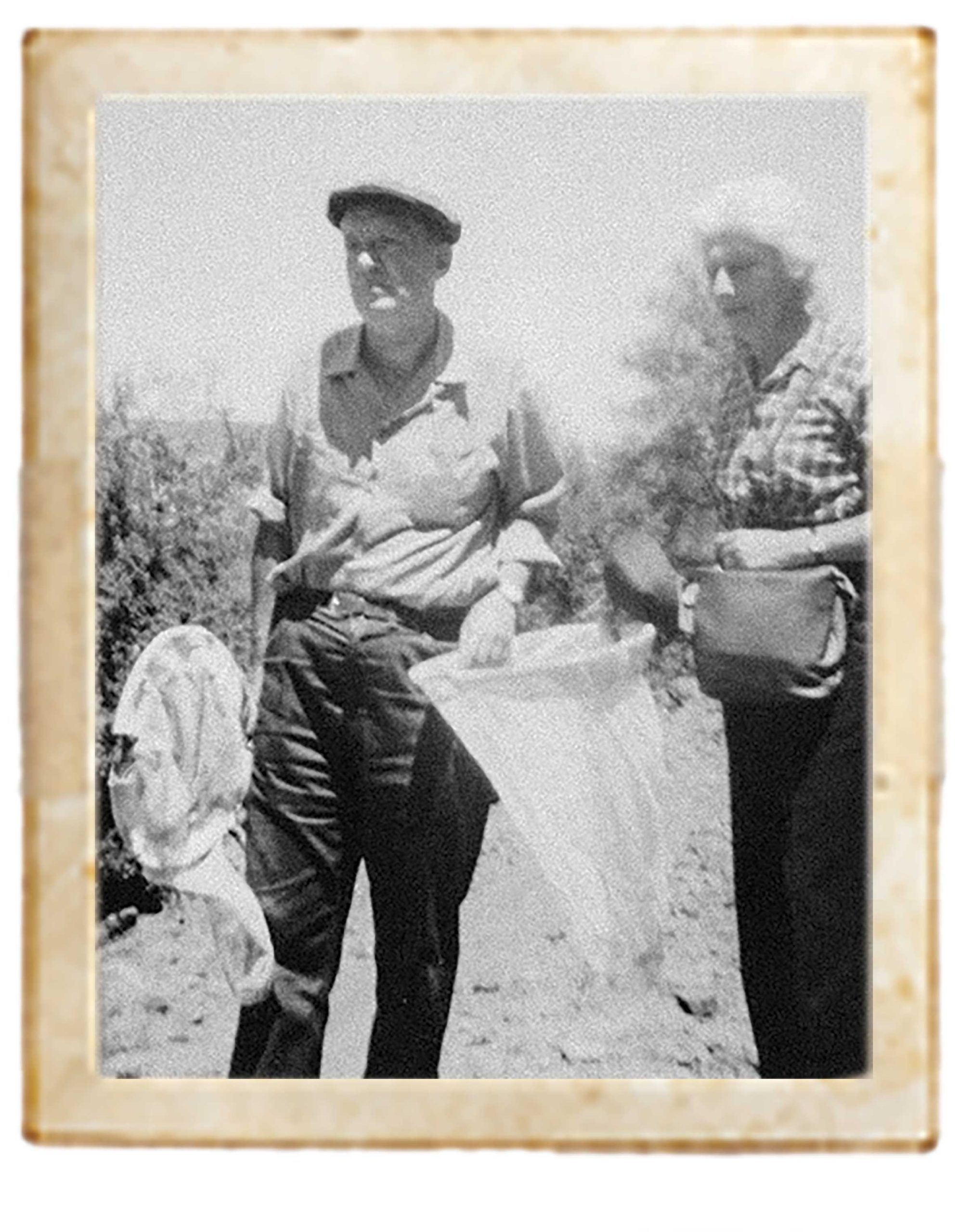
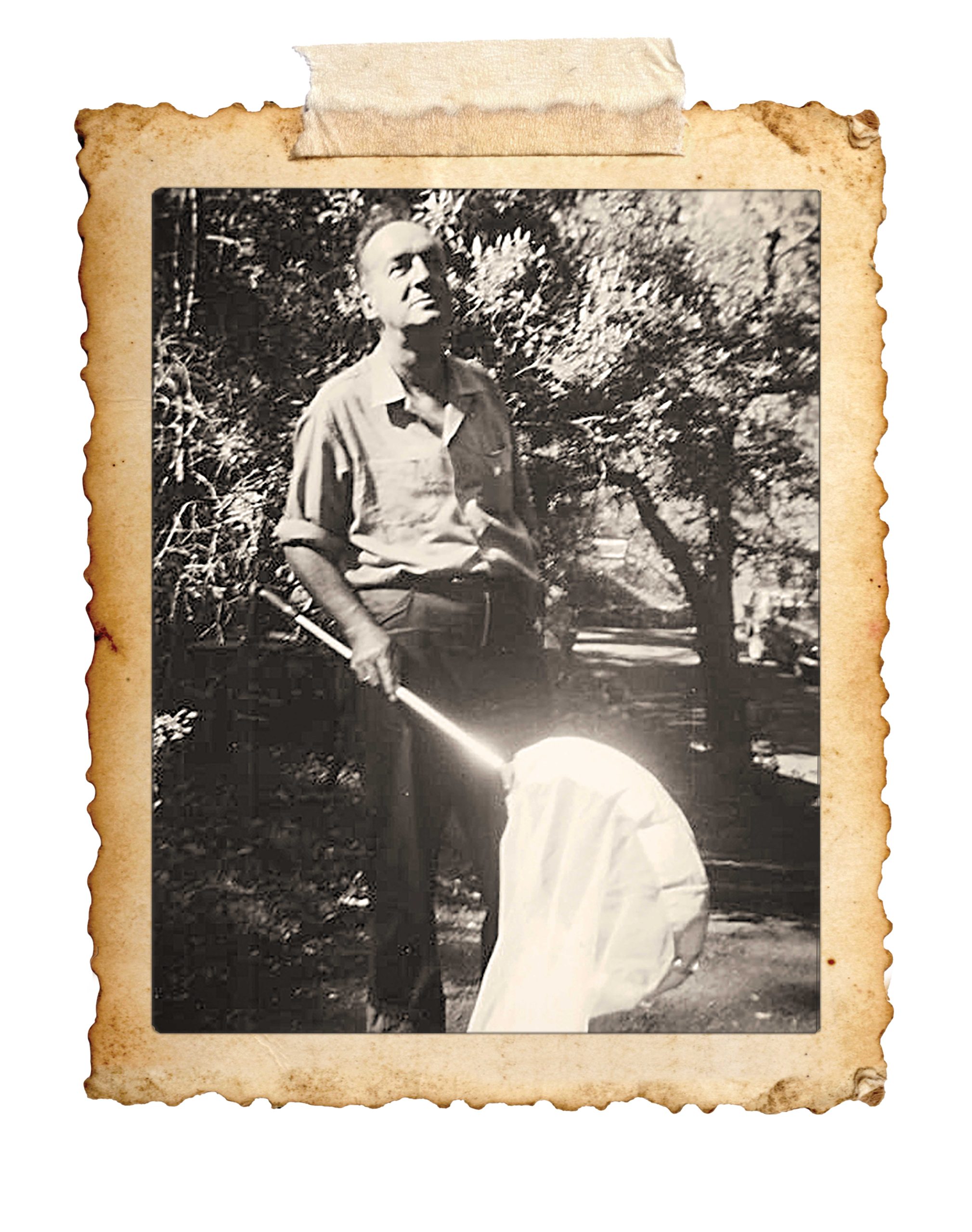
In his afterword to Lolita, Nabokov presciently gives modern readers a rare clue for ascertaining where he wrote his masterpiece – essentially, just follow the butterflies.
“Every summer my wife and I go butterfly hunting,” wrote Nabokov, who was an accomplished lepidopterist in addition to his literary talents. “The locality labels pinned under these butterflies will be a boon to some 21st-century scholar with a taste for recondite biography. It was at such of our headquarters as Telluride, Colorado; Afton, Wyoming; Portal, Arizona; and Ashland, Oregon, that Lolita was energetically resumed in the evenings or on cloudy days.”
Phoenix has a tremendous butterfly-watching asset in Desert Botanical Garden, hailed worldwide for its stable of desert breeds like giant swallowtail and the queen butterfly, but Nabokov surprisingly does not seem to have spent any time in the city. Nonetheless, his characters, Lolita and Humbert, do pass through the Valley during their travels. The only thing Humbert remembers about our state’s capital is that he and Lolita got into a fight “at the corner of Seventh Street and Central Avenue in Phoenix” – an intersection that, like the unrequited love between him and Lolita, does not actually exist.
As such, your Nabokovian pilgrimage, should you choose to accept it, should begin in Portal.
According to Boyd’s authoritative biography Vladimir Nabokov: The American Years, the Nabokovs drove to Portal in April 1953, likely coming west from New Mexico. They were looking for a serene, unhurried refuge wherein Nabokov could work on his drafts of Lolita, and Portal certainly checked those boxes – and still does.
Tucked into a cloistered pocket of the Chiricahua Mountains near the New Mexico border, Portal is more than four hours from Phoenix and nearly three hours from Tucson. It would have been an oddly inconvenient location for Nabokov if it were not one of the country’s premier destinations for studying insects, including his beloved butterflies.
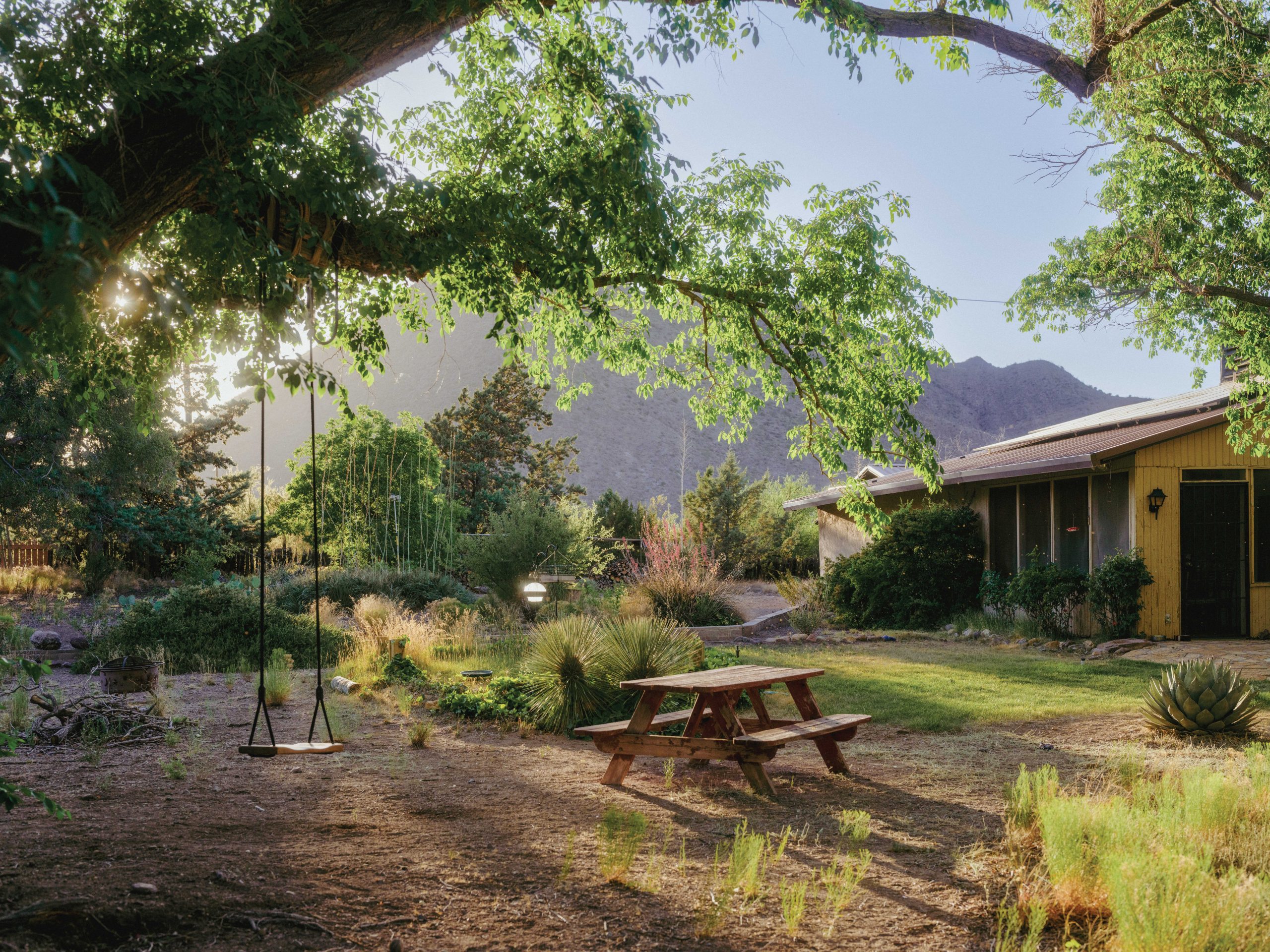
Unlike most Arizona towns, Portal grew up not around mining or agriculture but through a scientific research center, which was funded in part by the American Museum of Natural History in New York, where Nabokov was a member. The Southwestern Research Center, as it’s now known, received additional support from the Rockefeller family in 1955, and to this day it continues to attract a steady stream of biologists interested in studying Portal’s diverse flora and fauna.
The Chiricahuas are one of Arizona’s “sky islands” – isolated mountain ranges whose proximity to harsh, low-lying deserts make them ideal fomenting grounds for biodiversity. Rare bird species, like the elegant trogon, make the Chiricahuas a world-famous birding destination, and the riparian climate within the canyon is home to one of the most diverse ranges of bats found anywhere in the United States.
Portal’s human residents are likewise curious creatures. It’s a small town of roughly 700 people, many of whom hold Ph.D.s, and is perhaps the only municipality in Arizona without a church or saloon but with a bookstore and a library. I drive into town on a quiet Thursday afternoon and check into its only general store to call after Ted Troller, Portal’s oldest resident, who promised to show me around. “Just tell the girl at the store that you’re here to see me,” the 84-year-old had told me over the phone. “Everyone knows each other down here.”

Nabokov’s own arrival to Portal occasioned little pageantry. In 1953, he was a relatively obscure literary figure known mostly to American audiences for his lecturing, though his autobiography Speak, Memory, published two years earlier, had begun to bring wider attention to his writing. He had been in America for a little more than a decade, having arrived in 1940 after fleeing a series of world-rending events in Europe. The first was the 1917 October Revolution in his native Russia, which took the life of his imperialist father and forced the family to flee to Germany, where he met Véra, also a Russian émigré. They married in 1925 and welcomed their only child, Dmitri, in 1934. The rise of Nazism, which would later claim the life of Nabokov’s brother, forced another retreat, this time to the United States. He resolved to recreate himself from a promising Russian novelist into a towering figure in American letters.
The Nabokovs – both in their early 50s at this point – stayed for about a month in Portal at a ranch belonging to the Toles sisters, who were themselves teachers and authors of children’s books. The writer spent his days hunting butterflies in the morning and writing Lolita in longhand during the afternoon. In a letter to his friend, the literary critic Harry Levin, he wrote rapturously of the view of the Chiricahua Mountains that he saw from the living room where he worked: “The nearer mountains are maroon, spotted with the dark green of junipers and the lighter green of mesquites, and the far mountains are purple as in the Wellesley song,” a reference to the fight song at the university where he once taught.
It’s unclear which sections of Lolita profited from Nabokov’s time in Portal, but some of the landscape leaks into the writing, such as when Humbert describes a high-desert driving scene: “As we pushed westward, patches of what the garage-man called ‘sage brush’ appeared, and then the mysterious outlines of table-like hills, and then red bluffs ink-blotted with junipers, and then a mountain range, dun grading into blue, and blue into dream.”
Though Nabokov never explicitly names any Arizona town or city besides Phoenix in Lolita, he does conjure a sort of Arizona medley via Humbert’s narration: “Obvious Arizona, pueblo dwellings, aboriginal pictographs, a dinosaur track in a desert canyon, printed there 30 million years ago, when I was a child.”
Nabokov is likely making some sort of statement about cliché with the word “Obvious” – but the romantic in me wants to think he’s commenting on the state’s penchant for offbeat municipal nomenclature. Stare at a map long enough and you’ll find scads of odd names. Some are festive: Santa Claus, Christmas. Some have a moral: Show Low, Love. And some are existential: Why, Nothing.
Since communing with wildlife seems essential to the Nabokovian experience, I spend the first night of my road trip camping in the Chiricahuas. Unfortunately, no butterflies – just the pleasant sound of birdsong echoing like rainwater off the rhyolite walls.
In the morning, I get coffee with Troller – the only man in town who still remembers the spring of 1953. Vladimir and Véra struck up a fast friendship with Troller’s father, who like the Nabokovs was an émigré with roots in the European intelligentsia. Troller’s father was born in Austria and studied aerospace engineering under the legendary Austro-Hungarian mathematician Theodore von Kármán. He retired from an executive post at an aviation institute in 1952 to take up ranching in the U.S. Southwest – a region he had fallen in love with over many years of cross-country travel.
Troller still lives on the ranch his father purchased in the 1950s. He is clear-eyed and sprightly for a man in his 80s, and his warmly weathered face reminds me of Teddy Roosevelt’s famous remark on the Grand Canyon: “Leave it as it is. You cannot improve on it. The ages have been at work on it.”
Troller’s memory of Nabokov is hazy – he was only 13 – but he can accurately recall the details that matter most to teen boys everywhere: “Nabokov was tall and had a heavy accent. I don’t remember much more about him, but I do remember that his wife was real good-looking.” He tells me that he always wondered if the real Lolita is still living somewhere in Portal. “Of course,” he says with a laugh, “she’d have gray hair by now.”
The Nabokovs left Portal in May 1953 after Vladimir found an unexpected visitor at their front door. “A couple of days ago Vladimir killed a fair-sized rattler a few steps from our porch,” Véra wrote to a friend on May 12, 1953. “[He] is saving his trophy: a seven-piece rattler.”
The current owner of the cottage, Benjamin C. Fortna, a professor of Middle Eastern studies at the University of Arizona, says that he hasn’t had any rattlesnake trouble since he and his wife moved in. “We did see a fair-sized Gila monster, though.”
According to Boyd’s biography, Nabokov first visited Arizona in 1941. At the time, he was working at Cornell University, where he gave a popular series of lectures on modern European novels. The success of his first year occasioned an offer to lecture at Stanford University the following summer, but the Nabokovs found that they were unable to afford traveling across the country on their own.
One of Nabokov’s students at Cornell, Dorothy Leuthold, offered to help. Boyd notes that she had a new car, and in exchange for free Russian lessons she was happy to drive the couple across the country. The arrangement might raise eyebrows today, but it fit with Nabokov’s personable approach to teaching.
The novelist John Updike wrote about an experience his wife, Martha Ruggles, had with Nabokov while taking his class at Cornell. Nabokov once withheld her exam so that she had to seek him out to learn her score. It was a 97. “I wanted to see,” he told her, “what a genius looked like.”
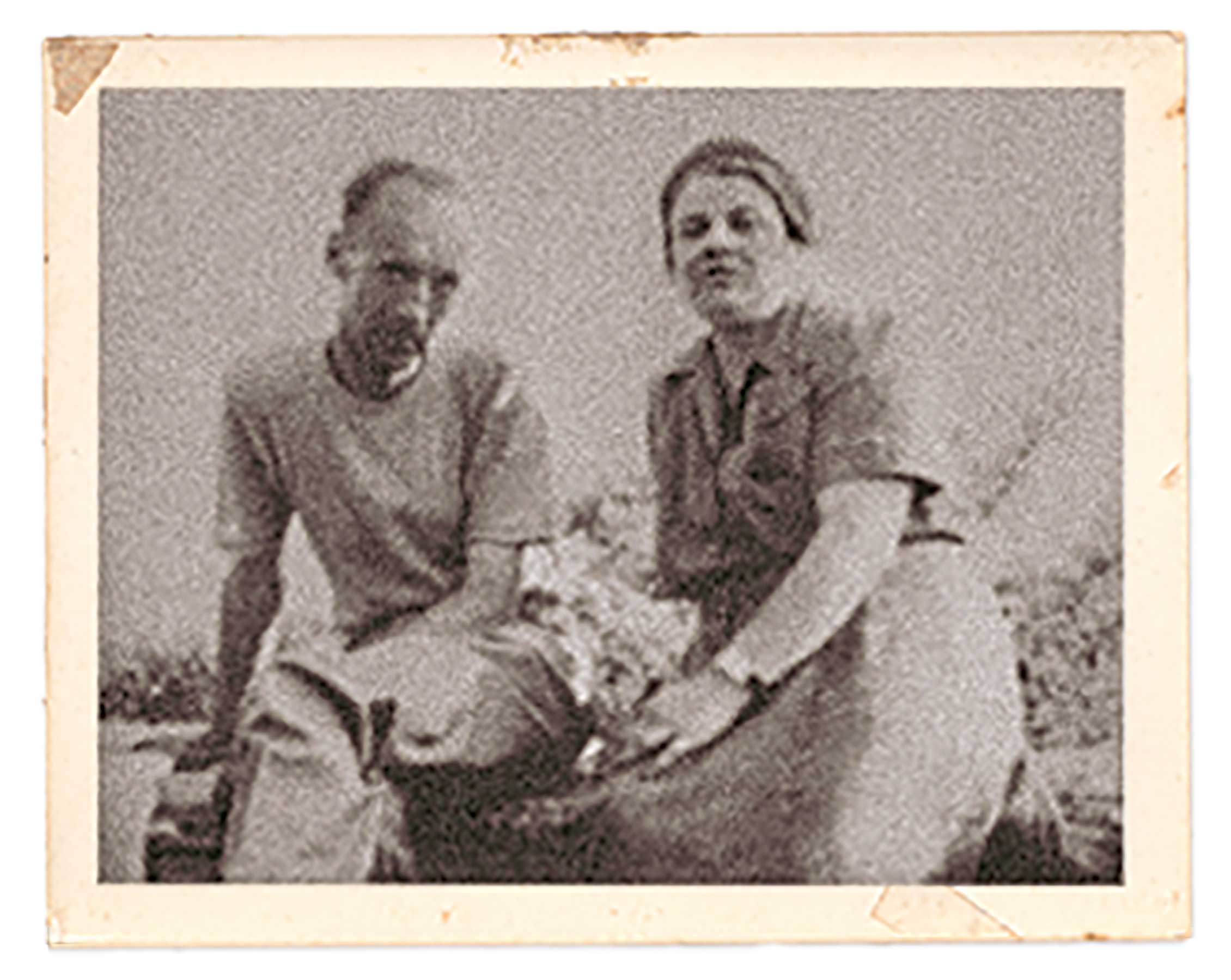
Nabokov himself may have been a once-in-a-generation literary genius, but as a first-time tourist to Arizona he was no different than any other, at least in respect: He wanted to see the Grand Canyon. En route, the trio stopped in the Route 66 town of Holbrook, where they stayed at a motel formerly known as Forest Courts.
Sherry Reed, director at the Navajo County Historical Society in Holbrook, says Forest Courts eventually became Central Auto Court, which in turn became the Pow Wow Courts, which, alas, were turned into studio apartments. Two days into my journey, I try to reserve a room at the Wigwam, which has teepee-shaped dwelling units obviously responsible for inspiring the traffic cone motel in Disney’s Cars, but run into a familiar problem: no vacancy.
Onward to the Grand Canyon, where Nabokov checked into the Bright Angel Lodge for a week in June 1941. As soon as he arrived, Nabokov set about receiving permission from the park’s rangers to collect butterfly specimens, and on the morning of June 9, he spotted a soft brown butterfly that had been kicked up from the dust by Dorothy while she was walking down Bright Angel Trail.
It was a novel species: Nabokov named it Neonympha dorothea, in honor of his driver and trailside companion, and wrote up a formal paper on his findings that was published in a lepidopterist journal in 1942. Then he wrote a poem called “A Discovery”: “Wide open on its pin (though fast asleep),/and safe from creeping relatives and rust,/in the secluded stronghold where we keep/type specimens it will transcend its dust.”
There’s a specimen of Nabokov’s butterfly in the Grand Canyon Museum Collection, a caramel-colored Canyonland Gemmed Satyr labeled “Nabokov, 1942.” Museum archivists Colleen Hyde and Kim Besom are proud to display other highlights of the museum’s collection, including original prints from the Kolb brothers’ Bright Angel studio, John Wesley Powell’s pocket watch and ancestral Puebloan pottery.

Thinking of that little brown satyr buried in the strata of the canyon’s human history brings to mind a passage from Nabokov’s Speak, Memory, in which he reflects on the experience of capturing a butterfly, which may very well describe the joy of writing fiction: “It is like a momentary vacuum into which rushes all that I love. A sense of oneness with sun and stone. A thrill of gratitude to whom it may concern – to the contrapuntal genius of human fate or to tender ghosts humoring a lucky mortal.”
Leaving the Grand Canyon to drive down 89A through Flagstaff and the fulgurant sandstone gorges carved into the earth by the Verde River, I embark on the final leg of my road trip to the last place Nabokov ever visited in the Southwest.
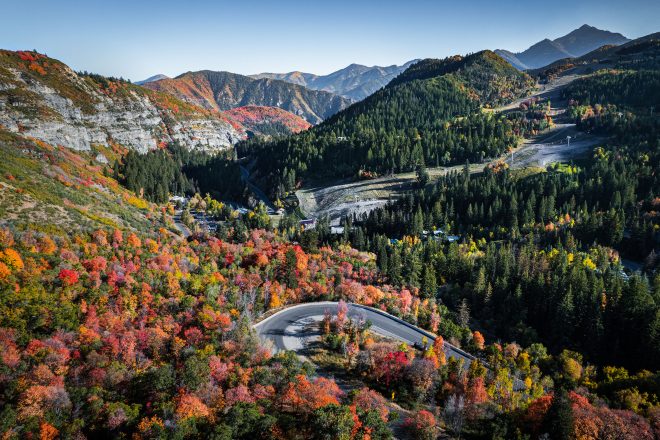
Oak Creek Canyon, a small town just north of Sedona, is known mostly to Arizonans for Slide Rock State Park, a series of naturally formed waterslides that drop visitors into the clear, cool waters of Oak Creek. There is so much more to Oak Creek Canyon, however, than the coccyx-crushing thrills of Slide Rock. Oak Creek has the curious ability of evoking the geography of one’s childhood no matter where they grew up: the low streams and sycamores recall the Midwest and the deep pools and rope swings evoke the American South; the quiet glance of a deer in the snow brings to mind New England, while the rocky canyon and evergreen pines belong unmistakably to our Mountain West.
In a letter to Harry Levin, Nabokov wrote of this feeling, “Every time I come to this dear West, I feel a pang of recognition, [but] no Switzerlands could lure me away.”
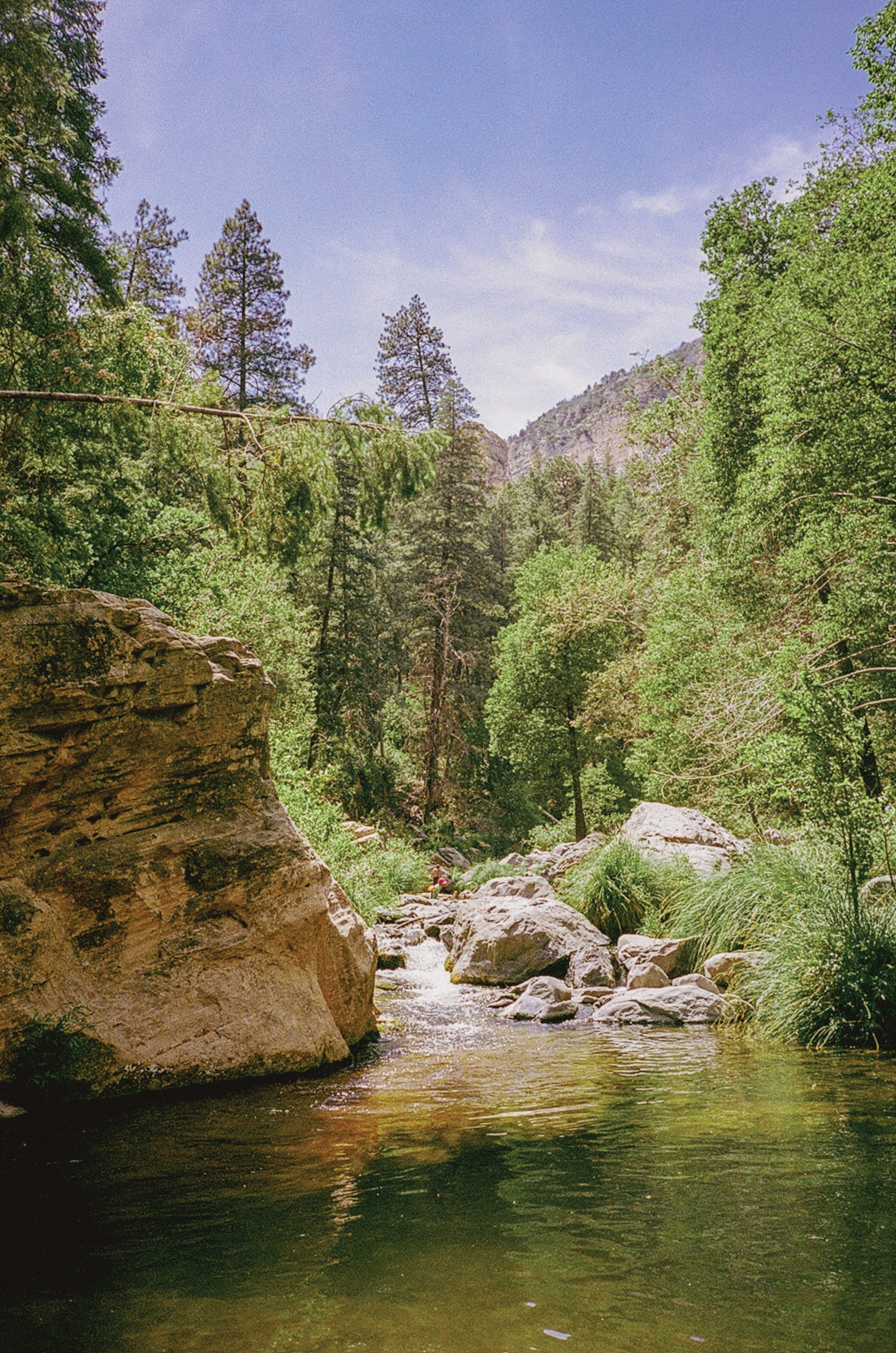
According to Boyd, the Nabokovs stopped at Oak Creek Canyon “on a hunch” in May 1959. By this time, Nabokov was one of the most famous writers in the world. Lolita hit No. 1 on The New York Times best seller list upon its initial U.S. publication in 1958 – previously, it had only been released in France – and Nabokov was working on a script adaptation for filmmaker Stanley Kubrick. Their collaboration would ultimately result in a critically acclaimed 1962 movie starring Peter Sellers, James Mason and 14-year-old newcomer Sue Lyon in the titular role.
But American fame was proving to be as daunting as the American landscape for the author. Privately, he was weighing the possibility of moving back to Europe – a decision that might have been hastened by the film, which Kubrick financed in England and, subsequently, was obligated to shoot there. Knowing their time as Americans might be drawing to a close, the Nabokovs set off from New England for one more summer in the Southwest.
They originally engaged a room at a motel on the eastern slope of the canyon, but – after a mysterious dispute with the motel’s owner – were compelled to cross the stream in search of new lodging. They soon met Bob Kittredge, a self-taught cabin builder who constructed a series of hand-hewn log cabins – now known as Forest Houses Resort – that still stand nobly along Oak Creek.
Kittredge was also an author, and when Nabokov arrived the two men bonded over a recently released bookseller’s catalog that featured Lolita alongside Kittredge’s own novel, Skylight. But the most interesting story Kittredge ever wrote is one that he never formally published: One Way West, a true tale recounting how he made it to Oak Creek. That story begins in 1931, when a 20-something Kittredge and his brother, who went by “Blood,” decided to remake themselves out west with little more than a truck, a Harley Davidson and “pistols, pistols and more pistols.” They set off from New York, where Blood had recently been expelled from West Point, and drove to Indiana, where they purchased a Rhesus monkey for $15 and named it Rita. In Santa Fe they added another accomplice, a baby coyote named The Stranger, and eventually ditched the truck to cram all together in a motorcycle with a sidecar. Eventually, the foursome found its way to Oak Creek, which, Kittredge wrote, “still remains the most perfect place either of us have ever seen.”

Nabokov loved his sabbatical at Forest Houses. In a letter to Levin, he noted excitedly that the Russian-born surrealist painter Pavel Tchelitchew had passed through town, and advised his friend, “If you ever visit the west I highly recommend this resort.”
Kittredge’s son, also named Bob, is the current owner of the property and remembers his dad’s fondness for Nabokov. “Dad… knew he was a great writer,” he says. “They understood each other’s temperament quite well.”
The two men played chess together using pieces hand-carved by the German artist Max Ernst, a close friend of Kittredge’s who had painted some of the interiors in Forest Houses’ cabins. Boyd notes that Nabokov spent his time in Oak Creek working on an unpublished short story, The Admirable Anglewing, and fielding correspondences with the outside world, including a visit from a Sports Illustrated journalist who walked with the author along the creek, hunting for butterflies.
“It is in this kind of country that my nymph occurs,” Nabokov told his visitor. For the last time, he wrote again to his friend Levin with breathless descriptions of Arizona’s scenery: “I am writing to you from the depths of a marvelous, green and red, well-watered Arizona canyon where the mingling of deciduous trees with desertic elements of flora form a fascinating ecological paradox.”
Nabokov spent more than two months in Oak Creek – by far his longest stay in Arizona – and left in July 1959.
The author’s sentimental promise that “no Switzerlands could lure me away” ultimately proved false – in fact, it was exactly Switzerland that lured the couple away. In 1961, they crossed the Atlantic to take up permanent residency in a lakeside hotel in Montreux, Switzerland, where Nabokov spent his twilight years writing and hunting butterflies in relative isolation. He would never step foot on American soil again, passing away from bronchitis in 1977 at age 78.
Nabokov’s status as a Russian-born émigré who had spent his early life in Europe, his most illustrious years in America and his dotage in Europe again makes his characterization as a novelist hard to pin down. Was he a Russian writer who wrote in English? An American writer with a Russian origin story? Later in his life, a literary critic decided to settle the question by asking Nabokov whether he felt more like an American or a European. “American,” he said finally. “I’m as American as April in Arizona.”